Effects of a Health Promotion Program on Health Behavior in Working-age Adults
Keywords:
Health promotion program, Health behavior, Working-age adultsAbstract
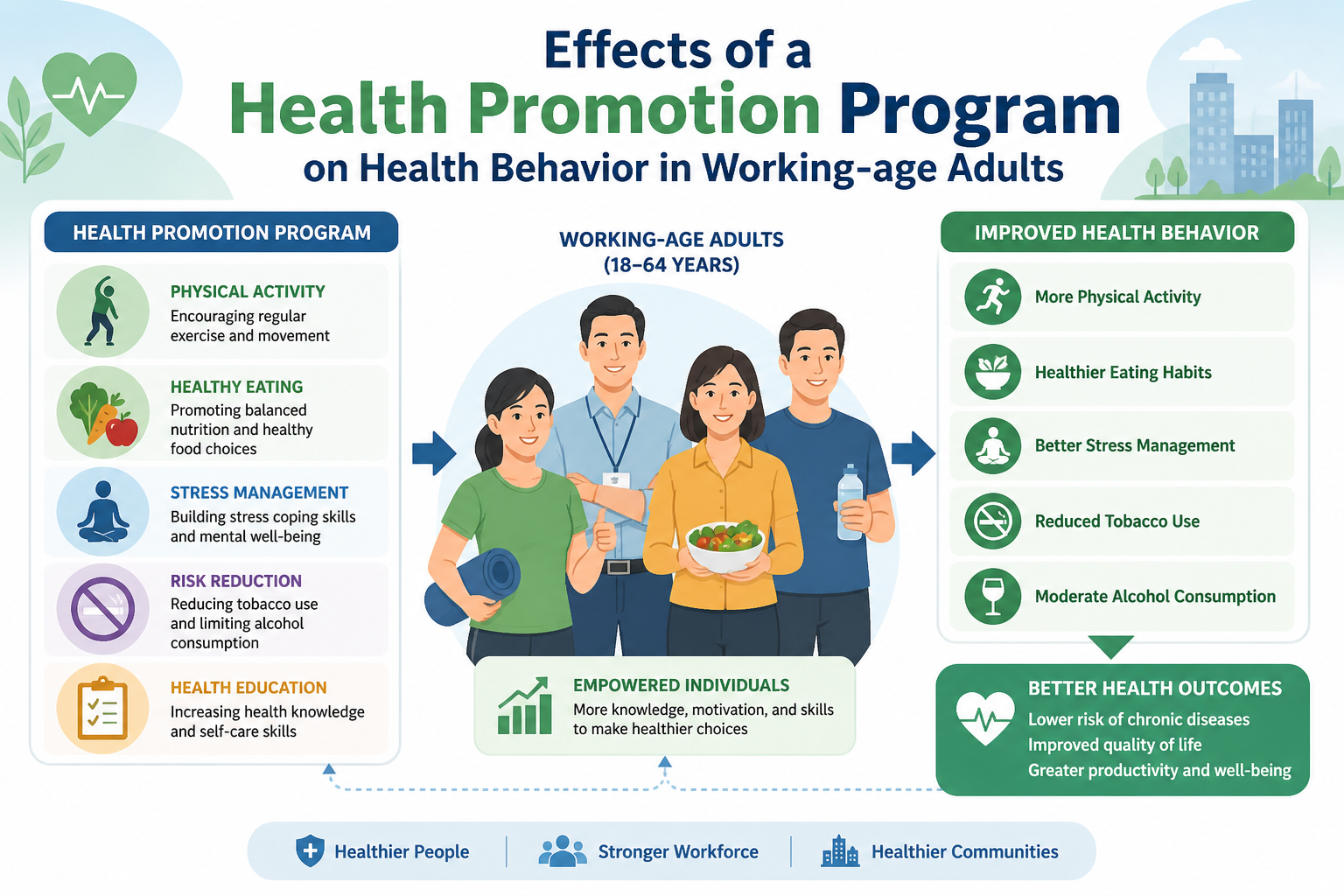
This quasi-experimental one-group pretest-posttest design aimed to examine the effects of a health promotion program on health behaviors among working-age adults. This study openly recruited 45 participants who are supporting staff in a nursing college. All participants had received training in a health promotion program that applied the conceptual framework of Pender’s Health Promotion Model along with a 12-week program. The research instrument was a health promotion program (CVI=1) and a health behavior questionnaire based on the 3Es 2Ss principle (CVI=1, reliability=0.86). Data were analyzed using descriptive analysis: frequency, percentage, mean, standard deviation, and Wilcoxon signed-rank test. The results revealed that after participation in the program, participants demonstrated significantly higher mean health behavior scores (Mean = 3.93, SD = 0.238) compared with pre-intervention scores (Mean = 3.65, SD = 0.227), with statistical significance (p<0.05). Specifically, mean scores for dietary behavior, physical activity, stress management, and alcohol consumption were significantly higher after the intervention (p < 0.05). In contrast, smoking behavior did not show a statistically significant change (p = 0.25). The finding indicated that the health promotion program was associated with improvement in health behavior among supporting staff; however, smoking cessation may require longer follow-up periods or sustained motivational support to facilitate successful quitting.
References
Boromarajonani College of Nursing, Buddhachinaraj. (2023). Annual health check-up report of supporting staff, fiscal years 2022–2023. [Unpublish]
Centers for Disease Control and Prevention. (2025). Smoking and tobacco use: Why quitting is hard.CDC.
Cebeci, F., Celik, S., & Kose, S. (2021). Awareness of health risks related to smoking behavior among adults. Journal of Substance Use, 26(3), 245–251.
Choi, J., Kim, S., & Jeong, H. (2024). Application of Pender’s Health Promotion Model to improve health behaviors in patients with chronic illness. Journal of Nursing Research, 32(1), 45–53.
Department of Health, Ministry of Public Health. (n.d.). Health promotion guidelines based on the 3Es 2Ss principle. Ministry of Public Health, Thailand.
Department of Health Service Support. (2024). Strategies for non-communicable disease prevention. Ministry of Public Health, Thailand.
Gonzalo, R. (2024). Behavioral change and self-efficacy in health promotion interventions. Public Health Nursing, 41(2), 180–188.
Hamwong, P., & Butprom, S. (2023). Health promotion and quality of life among working-age adults. Thai Journal of Public Health, 53(2), 112–124.
Health Education Division, Department of Health Service Support, Ministry of Public Health. (2022). 3Es 2Ss health behavior modification handbook. Nonthaburi: Ministry of Public Health, Thailand.
Huang, Y., Huang, C., & Wu, Y. (2022). Lifestyle modification and work performance among employees. International Journal of Environmental Research and Public Health, 19(8), 4567.
Institute for Population and Social Research, Mahidol University. (2023). Thailand's health situation report. Mahidol University.
Kraisi, T., & Metheeraworachat, S. (2021). Health promotion and disease prevention in community settings. Thai Journal of Nursing, 70(1), 15–26.
Ljubičić, M. (2023). Healthy lifestyle behaviors and mental well-being. European Journal of Public Health, 33(4), 612–618.
Loykaew, K., Vorapongsathorn, T., & Vorapongsathorn, S. (2019). Effects of health education based on Pender’s Health Promotion Model on patients with type 2 diabetes mellitus. Journal of Nursing Science, 37(4), 89–102.
Pender, N. J., Murdaugh, C. L., & Parsons, M. A. (2002). Health promotion in nursing practice (4th ed.). New Jersey: Prentice Hall.
Pender, N. J., Murdaugh, C. L., & Parsons, M. A. (2011). Health promotion in nursing practice (6th ed.). Boston: Pearson.
Plurphanswat, N., & Rodu, B. (2023). Harm reduction approaches for smoking cessation. Tobacco Induced Diseases, 21, 100517.
Pronk, N. P., et al. (2021). Health promotion strategies in workplace settings. American Journal of Health Promotion, 35(3), 345–356.
Schott, G., et al. (2025). Long-term smoking behavior and withdrawal symptoms. Addictive Behaviors, 149, 107891.
Strategy and Planning Division, Office of the Permanent Secretary, Ministry of Public Health. (2023). 12th National Health Development Plan. Ministry of Public Health, Thailand.
Sunonsatitkul, J., Pechmanee, T., & Panyasaisophon, P. (2024). Effects of health promotion programs based on Pender’s model among people at risk of type 2 diabetes mellitus. Journal of Health Education, 47(1), 23–35.
Thanapop, K., & Thanapop, S. (2021). Work ability and non-communicable diseases among Thai workers. Industrial Health, 59(5), 372–380.
Thamsaart, S., Phudlar, N., & Panyasai, S. (2020). Health behavior modification based on the 3Es 2Ss principle. Journal of Community Health Development, 8(2), 55–68.
Vichai, T. (2013). 7-Color traffic light life screening tool. Thailand.
Vichitkunakorn, P., et al. (2025). Behavioral risk factors and non-communicable diseases in Thailand.
BMC Public Health, 25, 1345.
Downloads
Published
Issue
Section
License
Copyright (c) 2026 International Journal of Public Health and Health Sciences

This work is licensed under a Creative Commons Attribution-NonCommercial-NoDerivatives 4.0 International License.
If the manuscript is accepted for publication, copyright of the article shall be assigned to the IJPHS. After acceptance of a manuscript, the authors will be requested to complete a copyright transfer agreement form