Assessing Rainwater Quality Across Regions in Thailand: Implications for Public Health and Water Management
Keywords:
Rainwater, Water Quality, Qater ManagementAbstract
Background: Recognizing the impact of contaminated water on public health, ensuring access to high-quality water is critical for improving health outcomes. Rainwater, a significant natural resource in Thailand, exhibits varying compositions across regions, directly influencing overall water quality and consequently affecting public health. Therefore, there is a need to conduct comprehensive surveys to assess rainwater suitability for household use.
Purpose: This study aimed to survey the quality of rainwater in Thailand by determining the composition as physical, chemical and biological in accordance with the Department of Health Guidelines for Drinking Water Quality (2020) of Thailand.
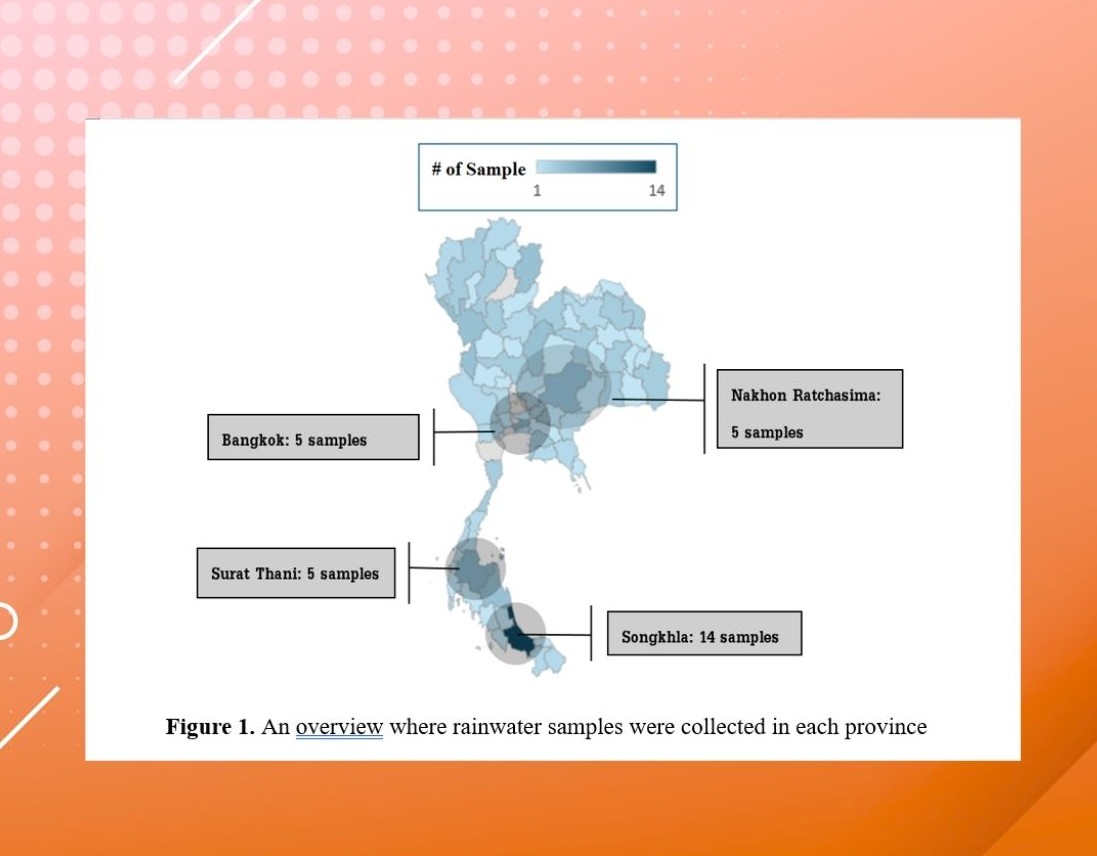
Methods: From November 2022 to February 2024, 152 rainwater samples were collected from six regions: north, northeast, central, east, southern east coast, and southern west coast of Thailand. The water analysis followed the Standard Methods for the Examination of Water and Wastewater (23rd edition). Descriptive statistics were applied to analyze data across 82 parameters, including 21 criteria aligned with the Guidelines for Drinking Water Quality and 61 parameters focusing on pesticide substances.
Results: A comprehensive analysis of the 152 rainwater samples revealed that every sample exhibited at least one parameter failing to meet water quality standards. Key concerns included acidic pH levels observed in 80% of samples and excessive coloration exceeding permissible limits in 20% of samples. Bacterial contamination, predominantly total coliform bacteria, was widespread, detected in approximately 87% of samples, surpassing occurrences of Escherichia coli. Mercury contamination was identified in a single sample from northeast Thailand, highlighting localized chemical risks. Pesticides, such as carbamates, organophosphates, pyrethroids, and glyphosate, were sporadically detected in the southern region. These findings underscore the urgent need to enhance and enforce water quality standards before promoting widespread consumption of rainwater.
Conclusions: A comprehensive analysis of the 152 rainwater samples revealed that every sample exhibited at least one parameter failing to meet water quality standards. Key concerns included acidic pH levels observed in 80% of samples and excessive coloration exceeding permissible limits in 20% of samples. Bacterial contamination, predominantly total coliform bacteria, was widespread.
References
Programme WWWA. The United Nations World Water Development Report 2023: partnerships and cooperation for water. WWDR 2023. UNESCO; 2023.
Seckler D, Amarasinghe UA, Molden DJ, de Silva R, Barker R. World Water Demand and Supply,1990 to 2025: Scenarios and Issues. International Water Management Institute.
Vass A. Over half the world will face water shortages by 2032. Bmj. 2002;324(7349):1293.
Arora NK, Mishra I. Sustainable development goal 6: Global Water Security. Environmental Sustainability. 2022;5(3):271-5.
Report of the World Water Council task force on IWRM: Opening up integrated water resource management to include energy, food, health and education. WORLD WATER COUNCIL REPORT 2023: WORLD WATER COUNCIL; 2023.
Section HD. Yearly report of water situation 2022: Hydro Informatics Institute; 2022 [Available from: https://www.thaiwater.net/uploads/contents/current/YearlyReport2022/rain2.html.
sanitation BoFaW. Drinking water quality criteria 2020: Department of Health; 2020 [Available from: https://foodsan.anamai.moph.go.th/th/water-quality/204437.
Oanh NTK. A Study on Urban Air Pollution Improvement in Asia. JICA Ogata Research Institute; 2017.
Office NS. Thailand Environment Statistics 2020: Ministry of Digital Economy and Society; 2020 [Available from: https://www.nso.go.th/nsoweb/storage/ebook/2023/20230505213435_61496.pdf.
Sakchai C. Result of analysis of outdoor rainwater quality: Environment and Pollution Control Office 4; 2020 [Available from: https://epo04.pcd.go.th/th/news/detail/67838.
Pesticides: Department of Pharmacology, Faculty of Veterinary Medicine, Kasetsart University; [cited 2024. Available from: https://www.pharmaco.vet.ku.ac.th/pdf_file/Pesticide_20161020.pdf]
Agricultural land areas in Thailand. Land Use Policy and Planning Division, Department of Land Development: Land Use Policy and Planning Division; [cited 2567. Available from: https://webapp.ldd.go.th/lpd/node_modules/img/Download/zonmap/zonmap2/agri_zone_th.pdf.
sanitation BoFaW. Drinking water quality criteria 2020: Department of Health; 2020 [Available from: https://foodsan.anamai.moph.go.th/th/water-quality/204437.
Buly P., Chochit S., Saradech W., Muhammad A. Water quality of roof rainwater harvesting system in Thamyai Subdistrict, Thung Song District, Nakhon Si Thammarat Province. Srinakharinwirot University Journal of Sciences and Technology. 2019;10(20, July-December):34-45. Srinakharinwirot University Journal of Sciences and Technology. 2019;10(20, July-December): 34-45.
Suwanaruang T. Heavy metal Contaminated in Environments and Health Effects. Research and Development Health System Journal. 2019;13(1).
Community health center, Amphoe (District), Pollution from rainwater [cited 2024. Available from: https://kb.psu.ac.th/psukb/bitstream/2016/15698/
"Nong Bua Lamphu Model": Driving environmental and agricultural development through research. Manager Online. February 20, 2020.
Chimcheud S, Faengchanda R, Kwanpan A, Srimarut Th. Monitoring of physical, chemical and microbiological factors of rainwater and rainwater collection behavior for consumption: a case study of Village No. 1, Phraek Nam Daeng Subdistrict, Amphawa District, Samut Songkhram Province. Journal of Industrial Technology: Suan Sunandha Rajabhat University. 2023;11(2):52-9.
Downloads
Published
Issue
Section
License
Copyright (c) 2026 International Journal of Public Health and Health Sciences

This work is licensed under a Creative Commons Attribution-NonCommercial-NoDerivatives 4.0 International License.
If the manuscript is accepted for publication, copyright of the article shall be assigned to the IJPHS. After acceptance of a manuscript, the authors will be requested to complete a copyright transfer agreement form