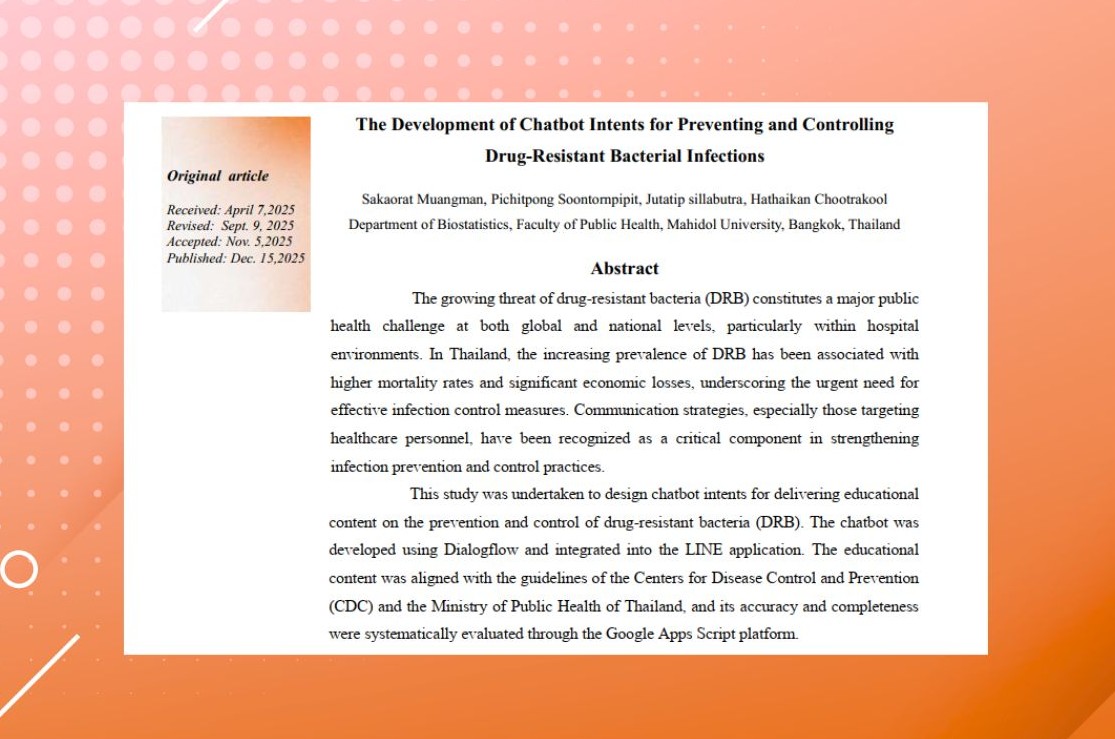
The Development of Chatbot Intents for Preventing and Controlling Drug-Resistant Bacterial Infections
Keywords:
Chatbot, Line Developer, Drug-Resistant Bacterial Infections , Google Apps ScriptAbstract
The growing threat of drug-resistant bacteria (DRB) constitutes a major public health challenge at both global and national levels, particularly within hospital environments. In Thailand, the increasing prevalence of DRB has been associated with higher mortality rates and significant economic losses, underscoring the urgent need for effective infection control measures. Communication strategies, especially those targeting healthcare personnel, have been recognized as a critical component in strengthening infection prevention and control practices.
This study was undertaken to design chatbot intents for delivering educational content on the prevention and control of drug-resistant bacteria (DRB). The chatbot was developed using Dialogflow and integrated into the LINE application. The educational content was aligned with the guidelines of the Centers for Disease Control and Prevention (CDC) and the Ministry of Public Health of Thailand, and its accuracy and completeness were systematically evaluated through the Google Apps Script platform.
The findings of this study highlight the potential of conversational AI as an innovative tool for enhancing knowledge dissemination and supporting DRB prevention among healthcare professionals, while also offering promising opportunities for further development and application.
References
Talagadadeevi, P. (2024). Resistance to multiple drugs in microorganisms. UPI Journal of Pharmaceutical and Medical Health Sciences, 7(2), 21–24.
Hussein, S., Ahmed, S. K., Mohammed, S. M., Qurbani, K., Ali, S., Saber, A. F., et al. (2024). Recent developments in antibiotic resistance: An increasing threat to public health. Annals of Animal Science, 25(3), 1–10. https://doi.org/10.2478/aoas-2024-0111
Ghazaei, C. (2022). Upcoming multi-drug-resistant and extensively drug-resistant bacteria. Research in Molecular Medicine, 30(1), 1–9.
Tahmasebi, H., Arjmand, N., Monemi, M., Babaeizad, A., Alibabaei, F., Alibabaei, N., et al. (2025). From cure to crisis: Understanding the evolution of antibiotic-resistant bacteria in human microbiota. Biomolecules, 15(1), 93. https://doi.org/10.3390/biom15010093
Masud, M. H., Rahman, M. S., Jahan, N., Titas, A. R., Sany, Z. A., Faysal, F., et al. (2024). Evaluation of multi-drug-resistant isolates associated with clinical infections from two hospitals in the Dhaka region, Bangladesh. Yemen Journal of Medicine, 1(1), 1–7.
Adnan, F., Khursheed, N., Khan, M., Ali, M. M., Hussain, S., & Mansoor, N. (2022). Changing trends of multidrug-resistant bacteria: A six-year experience from a tertiary care hospital. Journal of Ayub Medical College Abbottabad, 34(3), 442–446.
Yungyuen, T., Chatsuwan, T., Plongla, R., Kanthawong, S., Yordpratum, U., Voravuthikunchai, S. P., et al. (2021). Nationwide surveillance and molecular characterization of critically drug-resistant Gram-negative bacteria: Results of the Research University Network Thailand study. Antimicrobial Agents and Chemotherapy, 65(9), e00024-21. https://doi.org/10.1128/AAC.00024-21
Tangcharoensathien, V., Sattayawutthipong, W., Kanjanapimai, S., Kanpravidth, W., Brown, R., & Sommanustweechai, A. (2017). Antimicrobial resistance: From global agenda to national strategic plan, Thailand. Bulletin of the World Health Organization, 95(8), 599–603. https://doi.org/10.2471/BLT.16.179648
Thamlikitkul, V., Rattanaumpawan, P., Boonyasiri, A., Pumsuwan, V., Judaeng, T., Tiengrim, S., et al. (2015). Thailand antimicrobial resistance containment and prevention program. Journal of Global Antimicrobial Resistance, 3(4), 290–294. https://doi.org/10.1016/j.jgar.2015.10.002
Apisarnthanarak, A., Kiratisin, P., Khawcharoenporn, T., & Warren, D. K. (2012). Using an intensified infection prevention intervention to control carbapenemase-producing Enterobacteriaceae at a Thai center. Infection Control & Hospital Epidemiology, 33(9), 960–961. https://doi.org/10.1086/667384
Buser, G. L., Cassidy, P. M., Cunningham, M. C., Rudin, S. D., Hujer, A. M., Vega, R., et al. (2017). Failure to communicate: Transmission of extensively drug-resistant Acinetobacter baumannii in multiple facilities in Oregon, 2012–2014. Infection Control & Hospital Epidemiology, 38(1), 95–101. https://doi.org/10.1017/ice.2016.240
Kram, J. J. F., Borlaug, G., Safdar, N., & Sethi, A. K. (2015). Development and distribution of educational materials for carbapenem-resistant Enterobacteriaceae. WMJ, 114(2), 48–51.
Vaillant, L., Birgand, G., Esposito-Farese, M., Astagneau, P., Pulcini, C., Robert, J., et al. (2019). Awareness among French healthcare workers of the transmission of multidrug-resistant organisms: A large cross-sectional survey. Antimicrobial Resistance & Infection Control, 8(1), 173. https://doi.org/10.1186/s13756-019-0625-0
Laranjo, L., Dunn, A. G., Tong, H. L., Kocaballi, A. B., Chen, J., Bashir, R., et al. (2022). The development and use of chatbots in public health: A scoping review. JMIR Human Factors, 9(4), e35882. https://doi.org/10.2196/35882
Powell, L., Nour, R., Sleibi, R., Al Suwaidi, H., & Zary, N. (2022). Democratizing the development of chatbots to improve public health: A feasibility study of COVID-19 misinformation. JMIR Human Factors, 9(5), e43120. https://doi.org/10.2196/43120
Jerom, A. B. (2023). Design and development of AI-powered healthcare WhatsApp chatbot. In Proceedings of the 2nd International Conference on Vision Towards Emerging Trends in Communication and Networking (ViTECoN 2023) (pp. 1–6). IEEE. https://doi.org/10.1109/ViTECoN58111.2023.10157423
Rodsawang, C., Thongkliang, P., Intawong, T., Sonong, A., Thitiwatthana, Y., & Chottanapund, S. (2020). Designing a competent chatbot to counter the COVID-19 pandemic and empower risk communication. OSIR Journal, 13(2).
Afsahi, A. M., Seyed Alinaghi, S., Molla, A., Mirzapour, P., Jahani, S., Razi, A., et al. (2024). Chatbots utility in healthcare industry: An umbrella review. Frontiers in Health Informatics, 13, 200. https://doi.org/10.30699/fhi.v13i0.561
Mierzwa, S. J., Souidi, S., Conroy, T., Abusyed, M., Watarai, H., & Allen, T. (2019). On the potential, feasibility, and effectiveness of chat bots in public health research going forward. Online Journal of Public Health Informatics, 11(2), e4. https://doi.org/10.5210/ojphi.v11i2.9998
Gabarron, E., Larbi, D., Denecke, K., & Arsand, E. (2020). What do we know about the use of chatbots for public health? Studies in Health Technology and Informatics, 270, 796–800. https://doi.org/10.3233/SHTI200270
Downloads
Published
Issue
Section
License
Copyright (c) 2026 International Journal of Public Health and Health Sciences

This work is licensed under a Creative Commons Attribution-NonCommercial-NoDerivatives 4.0 International License.
If the manuscript is accepted for publication, copyright of the article shall be assigned to the IJPHS. After acceptance of a manuscript, the authors will be requested to complete a copyright transfer agreement form