A study of Readiness for Interprofessional Learning Among Nursing student and Medical Students of Praboromarajchanok Institute
Keywords:
Readiness, Interprofessional Learning, Nursing students, Medical studentsAbstract
Background: Interprofessional Learning (IPL) promotes collaboration among different healthcare professionals. Yet, there is limited research exploring factors influencing IPL readiness among students from various disciplines.
Methods: This descriptive cross-sectional study compared levels of readiness for IPL among nursing students (n=180) and medical students (n=96) of Praboromarajchanok Institute (PBRI). We used the Readiness for Interprofessional Learning Scale (RIPLS) to assess IPL readiness. The questionnaire had a Cronbach’s Alpha coefficients of 0.909. Descriptive statistics were used to describe the findings and Independent t-tests were utilized to compare means of readiness for IPL among groups.
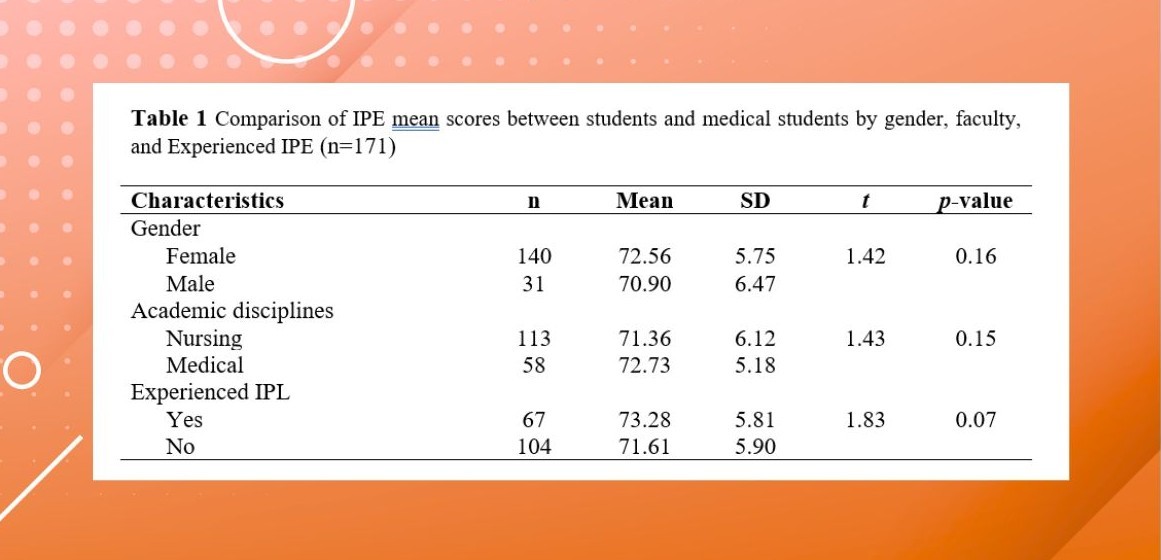
Findings: A majority of participants were female (81.4%) and had never experienced IPL before (60.5 %). Overall, the mean score for IPL readiness was high (M=72.26, SD = 5.20). Female respondents had higher mean scores than males (M=72.56, SD = 5.75; M=70.90, SD =6.47; responsively). Medical students had higher level of readiness for IPL than nursing students (M = 72.73, SD = 5.18; M=71.61, SD =5.90; respectively). Students with previous IPL experience had higher mean scores than those without experience (M=73.28, SD = 5.81; M=71.61, SD = 5.90; respectively). None of these differences were statistically significant.
Conclusions: The study found high levels of IPL readiness among participants. However, participants’ gender, academic discipline, and prior IPL experience did not cause significant variations in IPL readiness. Further research could explore additional variables and longitudinal impacts on IPL readiness.
References
Gil P. Soriano. (2019). Readiness of Health Science Students Towards Interprofessional Learning. Interprofessional Journal of Nursing Education, 11(3): 74-79.
Hammick M, Freeth D, Koppel I, & Reeves S. (2007). A best evidence systematic review of interprofessional education: BEME Guide no.9. Med Teach, 29: 735-751.
Jaideep, Talwalkar, Deborah, et al. (2016). Readiness for Interprofessional Leaning among Healthcare Professional Students. International Journal of Medical Education, 7:144-148.
Kodchakorn Rukroong, Kannika Rukroong, Kanokporn Tanchan, kamolchanok Netwong, Kamolporn Porkpipat, Kamolpan Chanmake, et al., 2017. Readiness for Interprofessional Learning of Sophomore and Junior Nursing Students at Boromarajonani College of Nursing, Suratthani. The 6th Active Learning Conference: How Active Learning answer Thailand 4.0 (pp.220-233). Suratthani, Walailak University.
Pill, J., Orchard, C., & Wright, L. (2018). Interprofessional education and practice guide: Guide 3. Interprofessional education and practice: Measuring and evaluating outcomes. Journal of Interprofessional Care, 32(1), 1-10. doi:10.1080/13561820.2017.1391490
Reeves, S., Pelone, F., Harrison, R., & Goldman, J. (2016). Interprofessional collaboration to improve professional practice and healthcare outcomes. Cochrane Database of Systematic Reviews, 2016(6). doi:10.1002/14651858.CD000072.pub3
Thawatchai Yuenyow, Chularat Howharn, & Woranart Promsuan. (2019). Effects of Interprofessional Education on Perception on Interprofessional Roles and Responsibility, and Teamwork. Nursing Public Health and Education Journal, 20 (1): 137-147.
World Health Organization. (1988). Learning Together to Work Together for Health. Report of a WHO study Group on Multiprofessional Education of Health Personnel: The Team Approach, Technical Report Series 769. Geneva.
Woermann, U.; Weltsch, L; Kunz, A; Stricker, D; & Guttormsen, S. (2016). Attitude towards and Readiness for Interprofessional Education in Medical and Nursing Students of Bern. GMS Journal for Medical Education, 33(5): 1-20.
Zhewei Li, Yihan Sun, & Yang Zhang. (2018). Adaptation and Reliability of the Readiness for Interprofessional Learning Scale (RIPLS) in the Chinese Health Care Students Setting. BMC Medical Education, 18:309. doi.org/10.1186/s12909-018-1423-8.
Downloads
Published
Issue
Section
License
Copyright (c) 2026 International Journal of Public Health and Health Sciences

This work is licensed under a Creative Commons Attribution-NonCommercial-NoDerivatives 4.0 International License.
If the manuscript is accepted for publication, copyright of the article shall be assigned to the IJPHS. After acceptance of a manuscript, the authors will be requested to complete a copyright transfer agreement form