Association between Selected Parental Factors and Early Childhood Challenging Behaviors: A Survey Study in Mae Hong Son
Keywords:
Challenging behaviours, Early childhood, Behavioural management, Parent trainingAbstract
Background: Challenging behaviours in early childhood can disrupt development, necessitating effective management strategies. This study examined the associations between early childhood behaviours and selected parental factors in relation to management of challenging behaviours.
Participants and Methods: A descriptive quantitative survey was conducted with 151 parents and caregivers of children aged 3–6 in Muang Municipality, Mae Hong Son. Data collection employed validated questionnaires assessing reported challenging behaviours (RCB), perceptions of challenging behaviours (PCB), maladaptive management strategies (MM), use of ABC strategies (ABC), and use of functional behaviour assessment (FBA). Multiple regression analysis was performed.
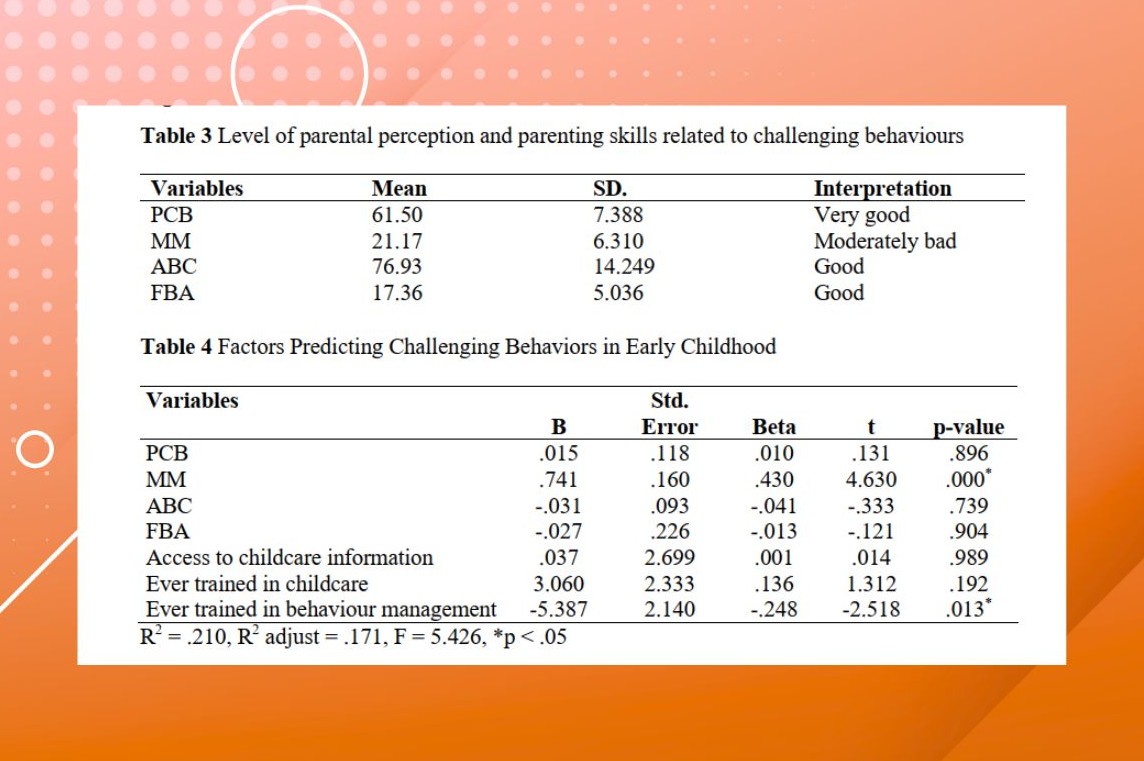
Results: Disruptive behaviours, such as interrupting and talking loudly, were the most frequently reported, reflecting attention-seeking tendencies. Social and emotional behaviours, including indirect expression of needs and temperamental actions, ranked second, followed by shyness-related behaviours. Non-compliance and aggressive behaviours were less frequent, while destructive and self-harming behaviours were the least reported. Maladaptive management strategies were positively associated with the exacerbation of challenging behaviours, whereas ABC strategies, FBA, and caregiver perceptions showed no significant association with behavioural outcomes (adjusted R2 = .171, F = 5.426, p < .05).
Conclusion and Recommendations: Maladaptive management may exacerbate challenging childhood behaviours, whereas parental training in behaviour management has a preventive effect. Training programs should focus on reducing the use of maladaptive management strategies and promoting positive, evidence-based alternatives.
References
AKTU, Y. (2024). The role of parenting stress on parenting self-efficacy and parental burnout among Turkish parents: a moderated mediation model. BMC Psychology, 12(1), 475. https://doi.org/10.1186/s40359-024-01980-7
Belsky, J., Vandell, D. L., Burchinal, M., Clarke-Stewart, K. A., McCartney, K., & Owen, M. T. (2007). Are there long-term effects of early child care? Child Development, 78(2), 681–701. https://doi.org/10.1111/j.1467-8624.2007.01021.x
Biglan, A., Flay, B. R., Embry, D. D., & Sandler, I. N. (2012). The critical role of nurturing environments for promoting human well-being. American Psychologist, 67(4), 257–271. https://doi.org/10.1037/a0026796
Bronfenbrenner, U. (1979). The Ecology of Human Development. Harvard University Press.
Cheng, H., & Furnham, A. (2021). Factors influencing children’s behavioral problems: Results from a longitudinal study of British children from birth to seven years. Psychiatry International, 2(2), 224–232. https://doi.org/10.3390/psychiatryint2020017
Crnic, K., Ross, E. (2017). Parenting Stress and Parental Efficacy. In: Deater-Deckard, K., Panneton, R. (eds) Parental Stress and Early Child Development. Springer, Cham. https://doi.org/10.1007/978-3-319-55376-4_11
Hammerton, G., et al. (2019). Childhood behavioral problems and adverse outcomes in early adulthood: A comparison of Brazilian and British birth cohorts. Journal of Developmental and Life-Course Criminology, 5(4), 517–535. https://doi.org/10.1007/s40865-019-00126-3
Herrenkohl, T. I., Kosterman, R., Mason, W. A., Hawkins, J. D., McCarty, C. A., & McCauley, E. (2010). Effects of childhood conduct problems and family adversity on health, health behaviors, and service use in early adulthood: Tests of developmental pathways involving adolescent risk-taking and depression. Development and Psychopathology, 22(3), 655–665. https://doi.org/10.1017/S0954579410000349
Horner, R., Sugai, G., & Anderson, C. (2010). Examining the Evidence Base for School-Wide Positive Behavior Support. Focus on Exceptional Children, 42(8), 1–14. https://doi.org/10.17161/foec.v42i8.6906
Kiartsuwan, J., Apiwongwarn, P., Kaewwiset, P., et al., (2023). Parents’experiences in the management ofearlychildhood challenging behaviours: A descriptive qualitative study. Journal of Nursing and Health Research (JNHR), 24(3), 32-46.
Koepp, A. E., Watts, T. W., Gershoff, E. T., Ahmed, S. F., Davis-Kean, P., & Duncan, G. J. (2023). Attention and behavior problems in childhood predict adult financial status, health, and criminal activity: A conceptual replication and extension. Developmental Psychology. https://doi.org/10.1037/dev0001533
Lulla, D., Mascarenhas, S. S., How, C. H., & Yeleswarapu, S. P. (2019). An approach to problem behaviours in children. Singapore Medical Journal, 60(4), 168–172. https://doi.org/10.11622/smedj.2019034
McGilloway, S., Bywater, T., Ni Mhaille, G., Leckey, Y., Kelly, P., & Comiskey, C. (2011). A parenting intervention for childhood behavioural problems: A randomized controlled trial in disadvantaged community-based settings. Journal of Consulting and Clinical Psychology, 80(1), 116–127. https://doi.org/10.1037/a0026304
Meadan, H., Ayvazo, S., & Ostrosky, M. M. (2014). The ABCs of challenging behavior: Understanding basic concepts. Young Exceptional Children, 17(3), 3–17. https://doi.org/10.1177/1096250614523969
Nicholls, G., Bailey, T., Grindle, C. F., & Hastings, R. P. (2023). Challenging behaviour and its risk factors in children and young people in a special school setting: A four wave longitudinal study. Journal of Applied Research in Intellectual Disabilities, 36(2), 366–373. https://doi.org/10.1111/jar.13066
O’Neill, R. E., Horner, R. H., Albin, R. W., Sprague, J. R., Storey, K., & Newton, J. S. (2015). Functional Assessment and Program Development for Problem Behavior: A Practical Handbook. Cengage Learning.
Roberts, M. Y., & Kaiser, A. P. (2011). The effectiveness of parent-implemented language interventions: a meta-analysis. American journal of speech-language pathology, 20(3), 180–199. https://doi.org/10.1044/1058-0360(2011/10-0055)
Sanders, M. R., Kirby, J. N., Tellegen, C. L., & Day, J. J. (2014). The Triple P-Positive Parenting Program: A systematic review and meta-analysis of a multi-level system of parenting support. Clinical Psychology Review, 34(4), 337–357. https://doi.org/10.1016/j.cpr.2014.04.003
Staton, S., Coles, L., Houen, S. Seale, B., Mecklenburgh, N, Van Halen, O., … & Thorpe, K. (2019) Responding to challenging behaviour with Children aged 2-5 years in Early Childhood Education and Care settings. Melbourne: Evidence for Learning
Sugai, G., Lewis-Palmer, T., & Hagan-Burke, S. (2000). Overview of the functional behavioral assessment process. Exceptionality, 8(3), 149–160.
Sutherland, L. A., Beavers, D. P., Kupper, L. L., Bernhardt, A. M., Heatherton, T., & Dalton, M. A. (2008). Like parent, like child: child food and beverage choices during role playing. Archives of pediatrics & adolescent medicine, 162(11), 1063–1069. https://doi.org/10.1001/archpedi.162.11.1063
Tevis, C., & Matson, J. L. (2022). Challenging behaviour in children with developmental disabilities: an overview of behavioural assessment and treatment methods. BJPsych Advances, 28(6), 401–409. https://doi:10.1192/bja.2022.59
Wertz, J., Agnew-Blais, J., Caspi, A., Danese, A., Fisher, H. L., Goldman-Mellor, S., Moffitt, T. E., & Arseneault, L. (2018). From childhood conduct problems to poor functioning at age 18 years: Examining explanations in a longitudinal cohort study. Journal of the American Academy of Child & Adolescent Psychiatry, 57(1), 54–60. https://doi.org/10.1016/j.jaac.2017.09.437
Downloads
Published
Issue
Section
License
Copyright (c) 2026 International Journal of Public Health and Health Sciences

This work is licensed under a Creative Commons Attribution-NonCommercial-NoDerivatives 4.0 International License.
If the manuscript is accepted for publication, copyright of the article shall be assigned to the IJPHS. After acceptance of a manuscript, the authors will be requested to complete a copyright transfer agreement form