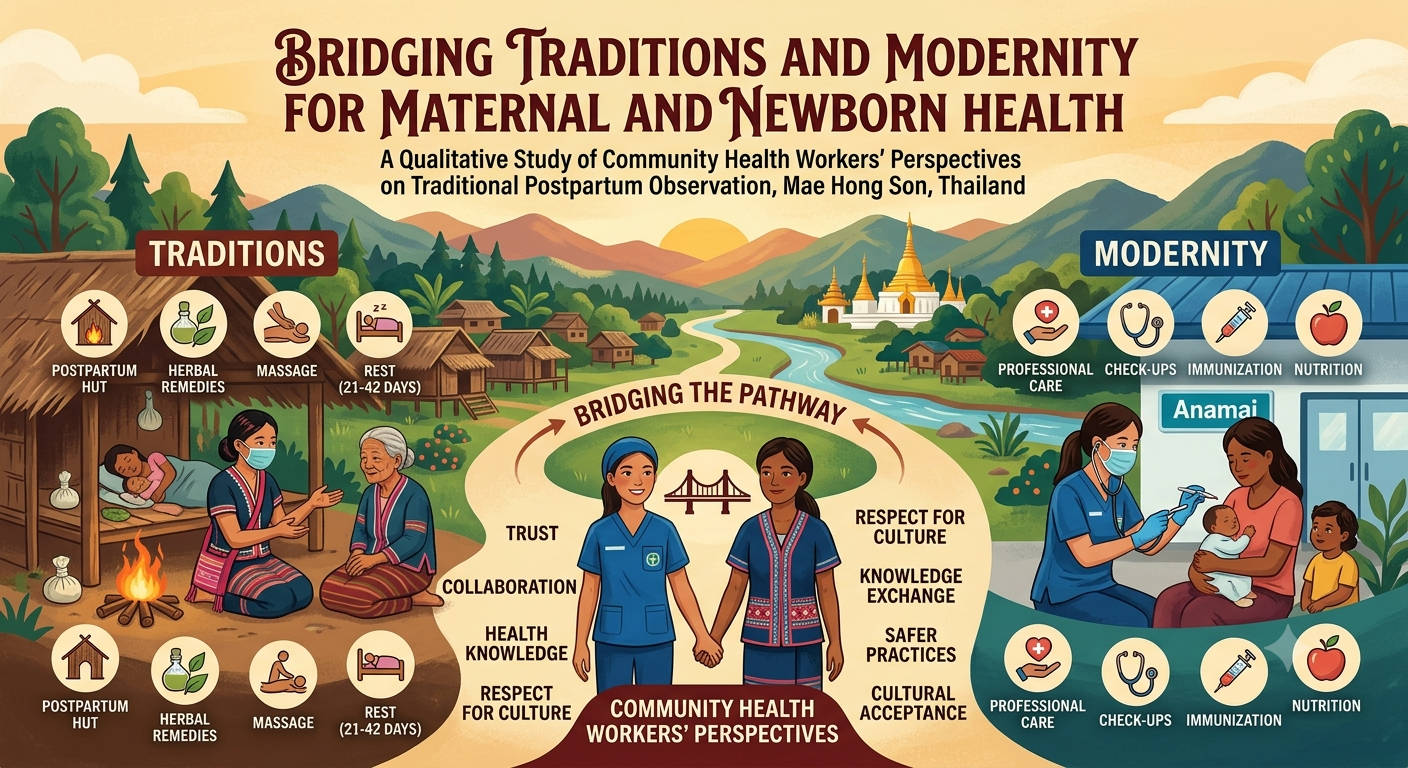
Bridging Traditions and Modernity for Maternal and Newborn Health: A Qualitative Study of Community Health Workers’ Perspectives on Traditional Postpartum Observation, Mae Hong Son, Thailand
Keywords:
Postpartum care, Traditional practices, Modern healthcare, Community Health practitioners, Village health volunteersAbstract
Background: Postpartum care is deeply embedded in cultural traditions, particularly in multi-ethnic communities like Mae Hong Son, Thailand, where traditional practices coexist with modern healthcare. Understanding the perspectives of community health practitioners (CHPs) and village health volunteers (VHVs) is crucial for integrating traditional and modern postpartum care to improve maternal and neonatal health outcomes.
Objective: This study aimed to explore traditional postpartum observation practices from the perspectives of CHPs and VHVs in Mae Hong Son.
Methods: A qualitative study used three focus group discussions with 15 VHVs and semi-structured in-depth interviews with six CHPs. The data were analyzed thematically, with findings organized into key themes and sub-themes.
Results: Seven major themes emerged: (1) Acceptability of traditional and modern postpartum practices, showing generational and professional differences in attitudes; (2) Compatibility between traditional and modern postpartum care, identifying areas of alignment, complementarity, and conflict; (3) Towards common goals of safety, success, and satisfaction; (4) Phases of traditional postpartum observation, detailing rigour, relaxation, re-introduction, and resumption; (5) Benefits and risks of traditional and modern postpartum care, evaluated through traditions, personal experiences, and scientific evidence; (6) Family influence and support, highlighting the pivotal roles of family members, focusing on culturally sensitive approaches to align the two systems, and (7) Strategies for traditional and modern integration.
Conclusion: The study underscores the importance of culturally sensitive, family-centered, and hybrid postpartum care models that integrate beneficial traditional practices with modern evidence-based interventions. Future research should evaluate the long-term impacts of integrated postpartum care on maternal and neonatal health while exploring family dynamics and generational shifts in care practices.
References
Altuntu, K., Anık, Y., & Ege, E. (2018). Traditional Practices of Mothers in the Postpartum Period: Evidence from Turkey. African journal of reproductive health, 22(1), 94–102. https://doi.org/10.29063/ajrh2018/v22i1.9
Aygör, H., Durduran, Y., & Ege, E. (2021). Traditional practices performed by nurses during postpartum period. Clinical and Experimental Health Sciences, 11(3), 512-515. https://doi.org/10.33808/clinexphealthsci.835132
Balaji, A. B., Claussen, A. H., Smith, D. C., Visser, S. N., Morales, M. J., & Perou, R. (2007). Social support networks and maternal mental health and well-being. Journal of women's health (2002), 16(10), 1386–1396. https://doi.org/10.1089/jwh.2007.CDC10
Cai, D., Villanueva, P., Lu, H., Zimmermann, B., & Horsch, A. (2024). A qualitative study of postpartum practices and social support of Chinese mothers following childbirth in Switzerland. Midwifery, 138, 104-137. https://doi.org/10.1016/j.midw.2024.104137
Cheung N. F. (1997). Chinese zuo yuezi (sitting in for the first month of the postnatal period) in Scotland. Midwifery, 13(2), 55–65. https://doi.org/10.1016/s0266-6138(97)90057-7
Dennis, C. L., & McQueen, K. (2009). The relationship between infant-feeding outcomes and postpartum depression: a qualitative systematic review. Pediatrics, 123(4), e736–e751. https://doi.org/10.1542/peds.2008-1629
Foong, S. C., Foong, W. C., Tan, M. L., & Ho, J. J. (2022). Mothers' hygiene experiences in confinement centres: A cohort study. PloS one, 17(5), e0268676. https://doi.org/10.1371/journal.pone.0268676
Kamdee, B., & Nuntaboot, K. (2021). Cultural-based care for Hmong pregnant women and postpartum mothers in Northern Thailand: Qualitative study. Pakistan Journal of Medical & Health Sciences, 15(12), 3717–3720. https://doi.org/10.53350/pjmhs2115123717
Lee, D. T., Ngai, I. S., Ng, M. M., Lok, I. H., Yip, A. S., & Chung, T. K. (2009). Antenatal taboos among Chinese women in Hong Kong. Midwifery, 25(2), 104–113. https://doi.org/10.1016/j.midw.2007.01.008
Liamputtong, P. (2004). Yu Duan practices as embodying tradition, modernity, and social change in Chiang Mai, Northern Thailand. Women & Health, 40(1), 79–99. https://doi.org/10.1300/J013v40n01_05
Naunboonruang, P., Apiwongwarn, P., Chantarawakin, P., Oangkanawin, P., Sittipa, K., Kumpala, N., & Lorga, T. (2023). Analysis of first-time fatherhood narratives in relation to pregnancy, childbirth, and postpartum care within the context of one province in the upper north region. Journal of Nursing and Health Research, 24, 45–60.
Ngai, F. W., Chan, S. W., & Ip, W. Y. (2009). The effects of a childbirth psychoeducation program on learned resourcefulness, maternal role competence, and perinatal depression: A quasi-experiment. International Journal of Nursing Studies, 46(10), 1298–1306. https://doi.org/10.1016/j.ijnurstu.2009.03.007
Punyopashtambha, H. (2019). A synthesis of local wisdom research on women’s healthcare. Srinakharinwirot Research and Development Journal of Humanities and Social Sciences, 11(21). 161-173.
Raven, J. H., Chen, Q., Tolhurst, R. J., & Garner, P. (2007). Traditional beliefs and practices in the postpartum period in Fujian Province, China: A qualitative study. BMC Pregnancy and Childbirth, 7, 8. https://doi.org/10.1186/1471-2393-7-8
Ruengrit, A. & Srikrajang, J. (2013, Dec 23-24). Mae Kum Duen: Intergraded Conventional and Traditional Postpartum Care [Conference Proceeding]. Interdisciplinary life course development conference (ILCD), Lampang Rajabhat University, Lampang.
Smith, T. J., Tan, X., Arnold, C. D., Sitthideth, D., Kounnavong, S., & Hess, S. Y. (2022). Traditional prenatal and postpartum food restrictions among women in northern Lao PDR. Maternal & child nutrition, 18(1), e13273. https://doi.org/10.1111/mcn.13273
Tsai, S. S., & Wang, H. H. (2019). Role changes in primiparous women during “doing the month” period. Midwifery, 74, 6–13. https://doi.org/10.1016/j.midw.2019.03.007
Wang, Q., Chaloumsuk, N., & Fongkaew, W. (2022). An ethnography of “doing the month” and modern postpartum practices among rural women in Jiangxi, China. Pacific Rim International Journal of Nursing Research, 26(2), 341–354.
Yim, I. S., Tanner Stapleton, L. R., Guardino, C. M., Hahn-Holbrook, J., & Dunkel Schetter, C. (2015). Biological and psychosocial predictors of postpartum depression: Systematic review and call for integration. Annual Review of Clinical Psychology, 11, 99–137. https://doi.org/10.1146/annurev-clinpsy-101414-020426
Zhao, A., Lan, H., Szeto, I. M.-Y., Huo, S., Yang, Y., Yang, J., & Zhang, Y. (2022). Traditional postpartum customs in modern urban Chinese women and its association with dietary quality. Global Transitions, 4, 82–89. https://doi.org/https://doi.org/10.1016/j.glt.2022.12.003
Downloads
Published
Issue
Section
License
Copyright (c) 2026 International Journal of Public Health and Health Sciences

This work is licensed under a Creative Commons Attribution-NonCommercial-NoDerivatives 4.0 International License.
If the manuscript is accepted for publication, copyright of the article shall be assigned to the IJPHS. After acceptance of a manuscript, the authors will be requested to complete a copyright transfer agreement form