Factors Influencing Self-Management Behaviors for Hypertension Prevention Among Prehypertensive Individuals in Mae Hong Son Province, Northern Thailand
Keywords:
Prehypertensive Individuals, Self-management, Self-efficacy, Health Services, Health LiteracyAbstract
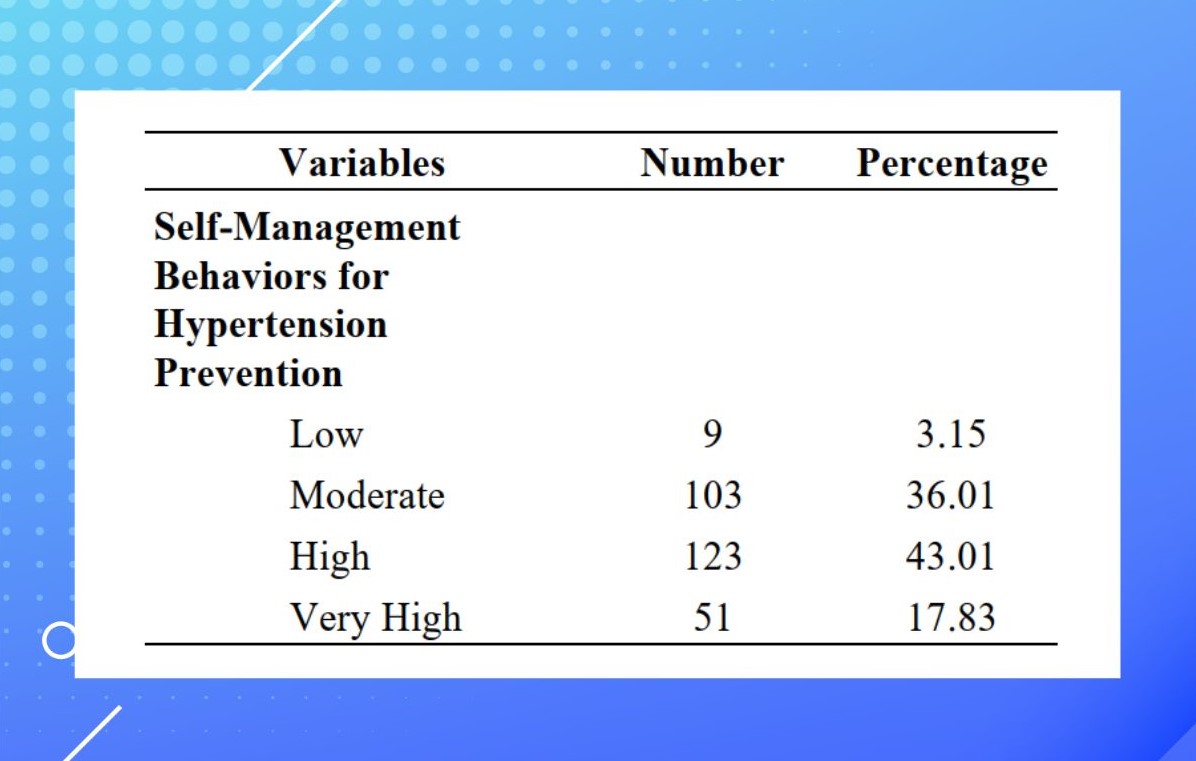
Hypertension is a significant health problem affecting populations worldwide and serving as a major risk factor for cardiovascular and cerebrovascular diseases. These are leading causes of premature death, particularly among populations in remote areas such as Mae Hong Son Province. Preventing hypertension requires proper self-management behaviors, alongside other factors such as self-management ability awareness, access to and use of healthcare services, and health literacy. This study aims to describe these variables and examine the influence of access to health information and services, self-efficacy, and health literacy on self-management among individuals with prehypertension in Mae Hong Son. The sample consisted of 286 individuals at risk of hypertension, aged 35 and above, selected by convenience sampling. The data collection tools included a five-part interview: personal information, self-efficacy, access to health information and services, health literacy, and self-management behaviors. The quality of the tools was validated for reliability using Cronbach’s alpha, which ranged from .77 to .98. The study results revealed that the sample exhibited low self-management behavior (6.14%), moderate (33.22%), high (44.07%), and only 16.57% exhibited the highest level of self-management behavior. The findings revealed that self-efficacy had a positive correlation (r = .722, p < .01) and could significantly predict self-management behavior (ß = .623, p < .001). Additionally, access to health information and services was positively correlated (r = .491, p < .01) and significantly predicted self-management behavior (ß = .260, p < .001). Health-promoting hospitals should refocus self-management programs by enhancing self-efficacy in individuals with prehypertension.
References
Aekplakorn, W., Chariyalertsak, S., Kessomboon, P., Assanangkornchai, S., Taneepanichskul, S., Goldstein, A., Cazabon, D., Neelapaichit, N., & Aimiosior, O. (2024). Trends in hypertension prevalence, awareness, treatment, and control in the Thai population, 2004 to 2020. BMC Public Health, 24, 3149. https://doi.org/10.1186/s12889-024-20643-1
Appel, L. J., Moore, T. J., Obarzanek, E., Vollmer, W. M., Svetkey, L. P., Sacks, F. M., ... & Karanja, N. (1997). A clinical trial of the effects of dietary patterns on blood pressure. New England Journal of Medicine, 336(16), 1117-1124. https://doi.org/10.1056/NEJM199704173361601
Bandura, A. (1997). Self-efficacy: The exercise of control. New York, NY: W.H. Freeman.
Barlow, J., Wright, C., Sheasby, J., Turner, A., & Hainsworth, J. (2002). Self-management approaches for people with chronic conditions: A review. Patient Education and Counseling, 48(2), 177–187. https://doi.org/10.1016/S0738-3991(02)00032-0
Berkman, N. D., Sheridan, S. L., Donahue, K. E., Halpern, D. J., & Crotty, K. (2011). Low health literacy and health outcomes: An updated systematic review. Annals of Internal Medicine, 155(2), 97–107. https://doi.org/10.7326/0003-4819-155-2-201107190-00005
Chen, J., Tian, Y., Yin, M., Lin, W., Tuersun, Y., Li, L., Yang, J., Wu, F., Kan, Y., Li, X., Gan, Y., Sun, X., Wu, Y., & He, F. (2023). Relationship between self-efficacy and adherence to self-management and medication among patients with chronic diseases in China: A multicentre cross-sectional study. Journal of Psychosomatic Research, 164, 111105. https://doi.org/https://doi.org/10.1016/j.jpsychores.2022.111105
Chen, J., Tian, Y., Yin, M., Lin, W., Tuersun, Y., Li, L., Yang, J., Wu, F., Kan, Y., Li, X., Gan, Y., Sun, X., Wu, Y., & He, F. (2023). Relationship between self-efficacy and adherence to self-management and medication among patients with chronic diseases in China: A multicentre cross-sectional study. Journal of Psychosomatic Research, 164, 111105. https://doi.org/https://doi.org/10.1016/j.jpsychores.2022.111105
Esler, M. (2017). Mental stress and cardiovascular risk: Brain mechanisms and stress responses in hypertension. Journal of Hypertension, 35(3), 451-457. https://doi.org/10.1097/HJH.0000000000001191
Fuchs, F. D., de Mello, R. B., & Fuchs, S. C. (2015). Preventing the progression of prehypertension to hypertension: Role of antihypertensives. Current Hypertension Reports, 17(1), 505. https://doi.org/10.1007/s11906-014-0505-1
Graves, B. A., Liu, G., Kunberger, J., Canaday, L., & Bambis, B. (2019). Access to Diabetes Self-Management Education in a Rural State: A GIS Analysis. Online Journal of Rural Nursing and Health Care, 19(2), 98–126. https://doi.org/10.14574/ojrnhc.v19i2.575
Guo, S., Armstrong, R., Waters, E., et al. (2021). Role of health literacy in health behavior change. Health Promotion International, 36(1), 123–135.
Hayes, P., Ferrara, A., Keating, A., McKnight, K., & O'Regan, A. (2022). Physical Activity and Hypertension. Reviews in Cardiovascular Medicine, 23(9),302. https://doi.org/10.31083/j.rcm2309302
He, F. J., Tan, M., Ma, Y., & MacGregor, G. A. (2020). Salt reduction to prevent hypertension and cardiovascular disease. Journal of the American College of Cardiology, 75(6), 632-647. https://doi.org/10.1016/j.jacc.2019.11.055
Hibbard, J. H., & Greene, J. (2013). What the evidence shows about patient activation: Better health outcomes and care experiences; fewer data on costs. Health Affairs, 32(2), 207-214.
Iroegbu, C., Tuot, D. S., Lewis, L., & Matura, L. A. (2024). The Influence of Patient-Provider Communication on Self-Management Among Patients With Chronic Illness: A Systematic Mixed Studies Review. Journal of advanced nursing, 10.1111/jan.16492. Advance online publication. https://doi.org/10.1111/jan.16492
Kongai, A., Kamdaeng, P., Lorga, T., Apiwongwarn, P., Satjasakulrat, S., & Naunboonruang, P. (2023). Hypertension Literacy and Self-Management among Older Persons Living with Hypertension, Mae Hong Son Province: A Critical Incident Technique Qualitative Study. Journal of Nursing and Therapeutic Care, 41(4), e265940.
Li, Y., Wang, L., Feng, X., Zhang, M., Huang, Z., Deng, Q., ... & Wang, L. (2019). Geographical variations in hypertension prevalence, awareness, treatment and control in China: findings from a nationwide and provincially representative survey. Journal of Hypertension, 37(9), 1819-1827. https://doi.org/10.1097/HJH.0000000000002093
Lu, J., Liu, L., Zheng, J., & Zhou, Z. (2022). Interaction between self-perceived disease control and self-management behaviors among Chinese middle-aged and older hypertensive patients: the role of subjective life expectancy. BMC Public Health, 22(1), 733. https://doi.org/10.1186/s12889-022-12990-8
Margerison, C., Riddell, L.J., McNaughton, S.A., & Nowson, C.A. (2020). Associations between dietary patterns and blood pressure in a sample of Australian adults. Nutrition Journal, 19, 5. https://doi.org/10.1186/s12937-019-0519-2
MIMS. (2024). Hypertension: Disease Background. Retrieved December 9, 2024 from https://www.mims.com/thailand/disease/hypertension/disease-background
Ndanuko, R.N., Tapsell, L.C., Charlton, K.E., Neale, E.P., & Batterham, M.J. (2016). Dietary Patterns and Blood Pressure in Adults: A Systematic Review and Meta-Analysis of Randomized Controlled Trials. American Society for Nutrition, 7, 76-89. https://doi.org/10.3945/an.115.009753
Nutbeam, D. (2008). The evolving concept of health literacy. Social Science & Medicine, 67(12), 2072–2078. https://doi.org/10.1016/j.socscimed.2008.09.050
Paltzat, K., Scott, S., Dhaliwal, K. K., Saunders-Smith, T., Manns, B. J., Campbell, T., Ivers, N., Pannu, R., & Campbell, D. J. T. (2023). Patient Perspectives on a Tailored Self-Management Education and Support Intervention for Low-Income Seniors With Chronic Health Conditions. CJC open, 5(11), 808–815. https://doi.org/10.1016/j.cjco.2023.08.002
Pescatello, L. S., Buchner, D. M., Jakicic, J. M., Powell, K. E., Kraus, W. E., & Bloodgood, B. (2015). Physical activity to prevent and treat hypertension: A systematic review. Medicine & Science in Sports & Exercise, 47(7), 1324-1333. https://doi.org/10.1249/MSS.0000000000000751
Rerksuppaphol, S., & Rerksuppaphol, L. (2011). Prevalence of prehypertension and hypertension among rural Thai adolescents. Journal of the Medical Association of Thailand, 94(7), 849-854.
Schillinger, D., Grumbach, K., Piette, J., et al. (2002). Association of health literacy with diabetes outcomes. JAMA, 288(4), 475–482.
Sharkiya, S.H. (2023). Quality communication can improve patient-centred health outcomes among older patients: a rapid review. BMC Health Service Research, 23, 886. https://doi.org/10.1186/s12913-023-09869-8
Tan, F.C.J.H., Oka, P., Dambha-Miller, H. et al. (2021). The association between self-efficacy and self-care in essential hypertension: a systematic review. BMC Fam Pract. 22(44) https://doi.org/10.1186/s12875-021-01391-2
Wattanakitkrileart, D., Jarusombat, L., Chauyakul, P., & Pratumsri, V. (2015). Effect of a self-management program on perceived self-efficacy to control dyspnea and exercise tolerance in patients with chronic obstructive pulmonary disease. Ramathibodi Nursing Journal, 21(3), 352 – 367.
Whelton, P. K., Carey, R. M., Aronow, W. S., Casey, D. E., Collins, K. J., Dennison Himmelfarb, C., ... & Wright, J. T. (2018). 2017 ACC/AHA/AAPA/ABC/ACPM/AGS/APhA/ASH/ASPC/NMA/PCNA guideline for the prevention, detection, evaluation, and management of high blood pressure in adults. Hypertension, 71(6), e13-e115. https://doi.org/10.1161/HYP.0000000000000065
World Health Organization [WHO]. (2021). Hypertension. Retrieved December 9, 2024 from https://www.who.int/news-room/fact-sheets/detail/hypertension
WHO. (2023). First WHO report details devastating impact of hypertension and ways to stop it. Retrieved December 9, 2024 from https://www.who.int/thailand/news/detail/19-09-2023-first-who-report-details-devastating-impact-of-hypertension-and-ways-to-stop-it
WHO. (2023). Hypertension Thailand 2023 country profile. Retrieved December 9, 2024 from https://www.who.int/publications/m/item/hypertension-tha-2023-country-profile
Wilson, C., Alam, R., (Assoc, S., Knighting, K., Williamson, S., & Beaver, K. (2011). Patient access to healthcare services and optimisation of self‐management for ethnic minority populations living with diabetes: a systematic review. Health & Social Care in the Community, 20, 1–19. https://doi.org/10.1111/j.1365-2524.2011.01017.
Wongchanglor, J., Duangchan, P., & Intarakamhang, U. (2017). Influencing factors to individual and family self-management behavior of first-time postpartum mother. Kuakarun Journal of Nursing, 24(1), 179 – 196.
Xie, Z., Liu, K., Or, C., Chen, J., Yan, M., & Wang, H. (2020). An examination of the socio-demographic correlates of patient adherence to self-management behaviors and the mediating roles of health attitudes and self-efficacy among patients with coexisting type 2 diabetes and hypertension. BMC Public Health, 20(1), 1227. https://doi.org/10.1186/s12889-020-09274-4
Yamane, T. (1973). Statistics: An Introductory Analysis. London: John Weather Hill.
Downloads
Published
Issue
Section
License
Copyright (c) 2025 International Journal of Public Health and Health Sciences

This work is licensed under a Creative Commons Attribution-NonCommercial-NoDerivatives 4.0 International License.
If the manuscript is accepted for publication, copyright of the article shall be assigned to the IJPHS. After acceptance of a manuscript, the authors will be requested to complete a copyright transfer agreement form