Discharge Planning for Neonates in Neonatal Intensive Care Units: A Scoping Review
Keywords:
Discharge planning, Neonates, Neonatal Intensive Care Units, Scoping ReviewAbstract
The effective discharge planning for neonates in Neonatal Intensive Care Units (NICUs) is essential to ensuring a smooth home-care transition. The discharge preparation process plays a crucial role in facilitating this readiness. By identifying and implementing key components of a comprehensive discharge plan, healthcare providers can optimize outcomes for infants and their families. This scoping review aligns with the Joanna Briggs Institute (JBI) scoping review methodology. The systematic scoping reviews were sourced following the PCC framework published on CINAHL, ScienceDirect, PubMed, Google Scholar, and Directory of Open Access Journals from 2014 to September 2024.
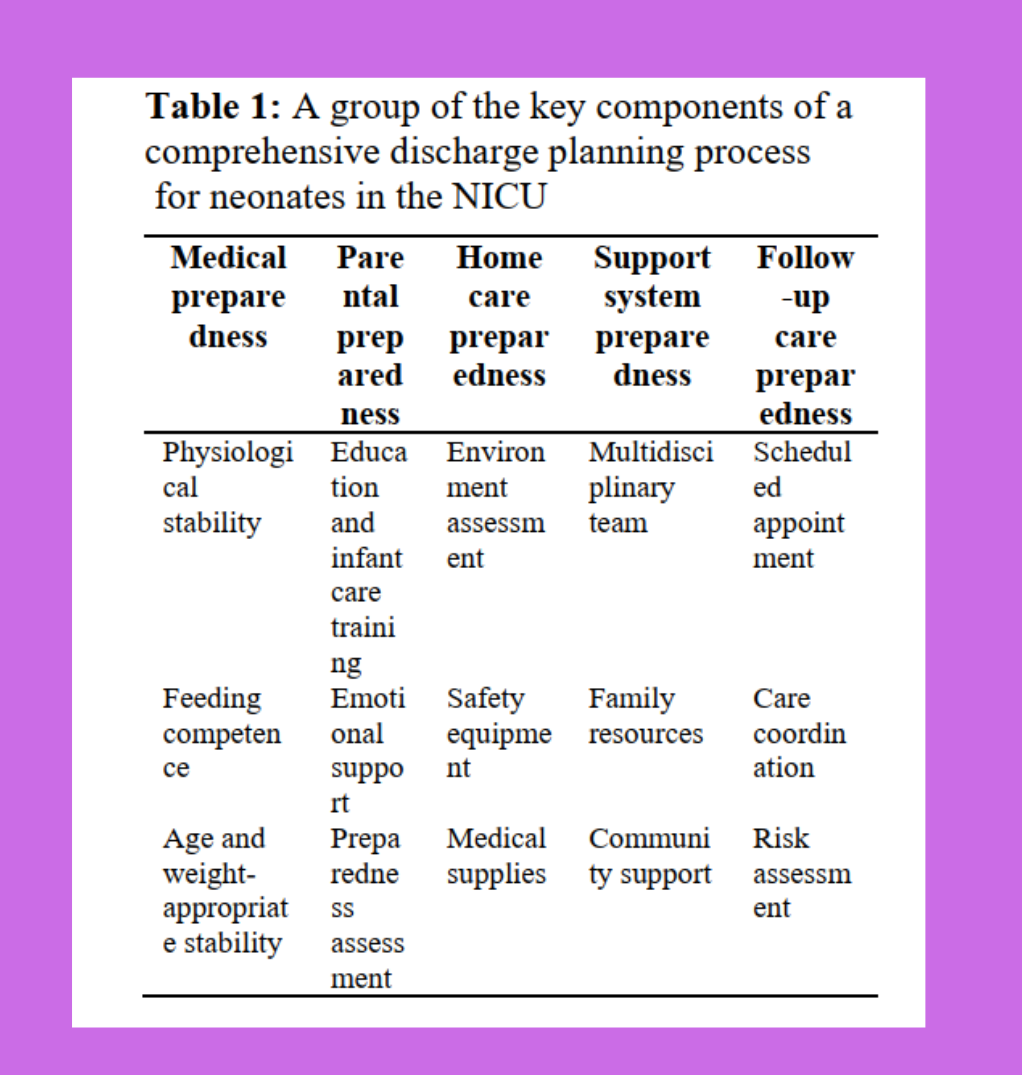
A total of 382 articles were identified; following the screening, 57 reviews underwent full-text screening, and 21 articles met the inclusion criteria and were included in this review. The key components of a comprehensive discharge planning process for neonates in Neonatal Intensive Care Units were identified and grouped into five points of preparedness as follows: 1) Medical preparedness 15/21 (71.42%), 2) Parental preparedness 17/21 (80.95%), 3) Home Care preparedness 11/21 (52.38%), 4) Support system preparedness 13/21 (61.90%), and 5) Follow-Up Care preparedness 15/21 (71.21%). This review has identified the five key components of a comprehensive discharge planning process for neonates in the Neonatal Intensive Care Unit that have a positive impact on neonatal outcomes. However, further applied research is needed to transfer this empirical knowledge into clinical practice.
References
Aliane, U., Maonga, E. M., Esperance, D., & Niringiyimana, A. (2024). Readiness for Hospital Discharge and Its Influencing Factors: A Review. EAS journal of nursing and midwifery, 6(3), 65-72. doi: 10.36349/easjnm.2024.v06i03.001
Anderson, N., & Narvey, M. (2022). Discharge planning of the preterm infant. Paediatrics & child health, 27 2, 129-130.
Brachio, S. S., Farkouh-Karoleski, C., Abreu, A., Zygmunt, A., Purugganan, O., & Garey, D. (2020). Improving neonatal follow-up: A quality improvement study analyzing in-hospital interventions and long-term show rates. Pediatric Quality & Safety, 5(6), e363. https://doi.org/10.1097/pq9.0000000000000363
Carter, A. C., & Carter, B. S. (2024). The ethical rationale for comprehensive Neonatal Intensive Care unit follow-up. Nursing Ethics: Normative Foundations, Advanced Concepts, and Emerging Issues, 200-214.
Çelik, R., & Altay, N. (2023). The role of nurses in preparing mothers of premature infants for discharge and home care. J Educ Res Nurs, 20(4), 387-392.
Cheng, L., Zhang, Y., Gu, Y., Lu, C., Liu, Q., & Yuan, H. (2016). Families’ readiness for discharge of their pre-term infant: A best practice implementation project. JBI database of systematic reviews and implementation reports, 14(9), 367–380. https://doi.org/10.11124/JBISRIR-2016-003087
Costa, H. P. F., & Costa, E. P. F. (2022). Neonatal complications of prematurity. Perinatology: Evidence-Based Best Practices in Perinatal Medicine, 1133-1150.
Franck, L. S., Kriz, R. M., Bisgaard, R., Gay, C. L., Sossaman, S., Sossaman, J., Cormier, D. M., Joe, P., Sasinski, J. K., Kim, J. H., Lin, C., & Sun, Y. (2023). Parent readiness for their preterm infant’s Neonatal Intensive Care Unit discharge. The Journal of perinatal & neonatal nursing, 37(1), 68–76. https://doi.org/10.1097/JPN.0000000000000612
Green, J., Fowler, C., Petty, J., & Whiting, L. (2020). The transition home of extremely premature babies: An integrative review. Journal of Neonatal Nursing.
Griffith, T., Singh, A., Naber, M., Hummel, P., Bartholomew, C., Amin, S., White-Traut, R., & Garfield, L. (2022). Scoping review of interventions to support families with preterm infants post-NICU discharge. Journal of pediatric nursing, 67, e135–e149.
Karnati, S., Kollikonda, S., & Abu-Shaweesh, J. (2020). Late preterm infants–Changing trends and continuing challenges. International Journal of Pediatrics and Adolescent Medicine, 7(1), 38-46.
Kristiawati, K., Rustina, Y., Budi, I.B., & Hariyati, R.T. (2020). How to prepare your preterm baby before discharge. Sri Lanka Journal of Child Health, 49, 390.
Mazur, K. M., Desmadryl, M., VanAntwerp, K., Ziegman, C., Nemshak, M., & Shuman, C. J. (2021). Implementing evidence-Informed discharge preparedness tools in the NICU: Parents’ perceptions. Advances in neonatal care: official journal of the National Association of Neonatal Nurses, 21(5), E111–E119. https://doi.org/10.1097/ANC.0000000000000836
Mak, S., & Thomas, A. (2022). Steps for conducting a scoping review. Journal of graduate medical education, 14(5), 565–567. https://doi.org/10.4300/JGME-D-22-00621.1
Malwade, S., Chalipat, S., Shah, P., & Mane, S. (2024). The role of early intervention therapy in neurodevelopmental outcomes of premature infants. Cureus, 16(9), e68618.
McCord, H., Fieldhouse, E., & El-Naggar, W. (2024). Criteria for discharge of preterm infants from Canadian neonatal intensive care units. European journal of pediatrics, 183(4), 1759–1763.
Qian, J., Qian, M., Ren, Y., Ye, L., Qian, F., Jin, L., Chen, L., & Xu, H. (2021). Readiness for hospital discharge and influencing factors: a cross-sectional study on patients discharged with tubes from the department of hepatobiliary surgery. BMC surgery, 21(1), 121.
Padratzik, H. C., & Love, K. (2022). NICU discharge preparation and transition planning: Foreword. Journal of Perinatology, 42(Suppl 1), 3-4.
Peters, M. D. J., Marnie, C., Colquhoun, H., Garritty, C. M., Hempel, S., Horsley, T., Langlois, E. V., Lillie, E., O’Brien, K. K., Tunçalp, Ӧ., Wilson, M. G., Zarin, W., & Tricco, A. C. (2021). Scoping reviews: reinforcing and advancing the methodology and application. Systematic Reviews, 10(1). https://doi.org/10.1186/s13643-021-01821-3
Peters, M. D., Godfrey, C., McInerney, P., Khalil, H., Larsen, P., Marnie, C., ... & Munn, Z. (2022). Best practice guidance and reporting items for the development of scoping review protocols. JBI evidence synthesis, 20(4), 953-968.
Pillai, A., Pournami, F., Prabhakar, J., Nair, P., & Jain, N. (2022). Effect of early parent participation program on physiological stability in preterm infants: A randomized controlled trial. American journal of perinatology, 39(16), 1796–1804. https://doi.org/10.1055/s-0041-1726126
Osorio Galeano, S. P., & Salazar Maya, Á. M. (2023). Preparing parents for discharge from the Neonatal Unit, the transition, and care of their preterm children at home. Investigation y education en enfermeria, 41(1), e04. https://doi.org/10.17533/udea.iee.v41n1e04
Salmani, N., Zare Marvast, M., Kahdouei, S., & Weiss, M. E. (2020). Adaptation of the parent readiness for hospital discharge scale with mothers of preterm infants discharged from the neonatal intensive care unit. Journal of Clinical Nursing, 29(23-24), 4544–4553.
Smith, V. C. (2021). Discharge planning considerations for the neonatal intensive care unit. Archives of Disease in Childhood-Fetal and Neonatal Edition, 106(4), 442-445.
Smith, V. C., Love, K., & Goyer, E. (2022). NICU discharge preparation and transition planning: guidelines and recommendations. Journal of Perinatology: official journal of the California Perinatal Association, 42(Suppl 1), 7–21. https://doi.org/10.1038/s41372-022-01313-9
Yeary, J. & Smith, V. C. (2022). Promoting equity and support for the whole family through the new NICU discharge preparation and transition planning guidelines. Zero to Three, 43(2), 33–37.
Downloads
Published
Issue
Section
License
Copyright (c) 2024 International Journal of Public Health and Health Sciences

This work is licensed under a Creative Commons Attribution-NonCommercial-NoDerivatives 4.0 International License.
If the manuscript is accepted for publication, copyright of the article shall be assigned to the IJPHS. After acceptance of a manuscript, the authors will be requested to complete a copyright transfer agreement form