The Development of a Construction of Life and Careers Skills Instrument Based on the 21st Century for Nursing Students at Praboromarajchanok Institute
Keywords:
Life and careers skills, 21st Century, Nursing studentsAbstract
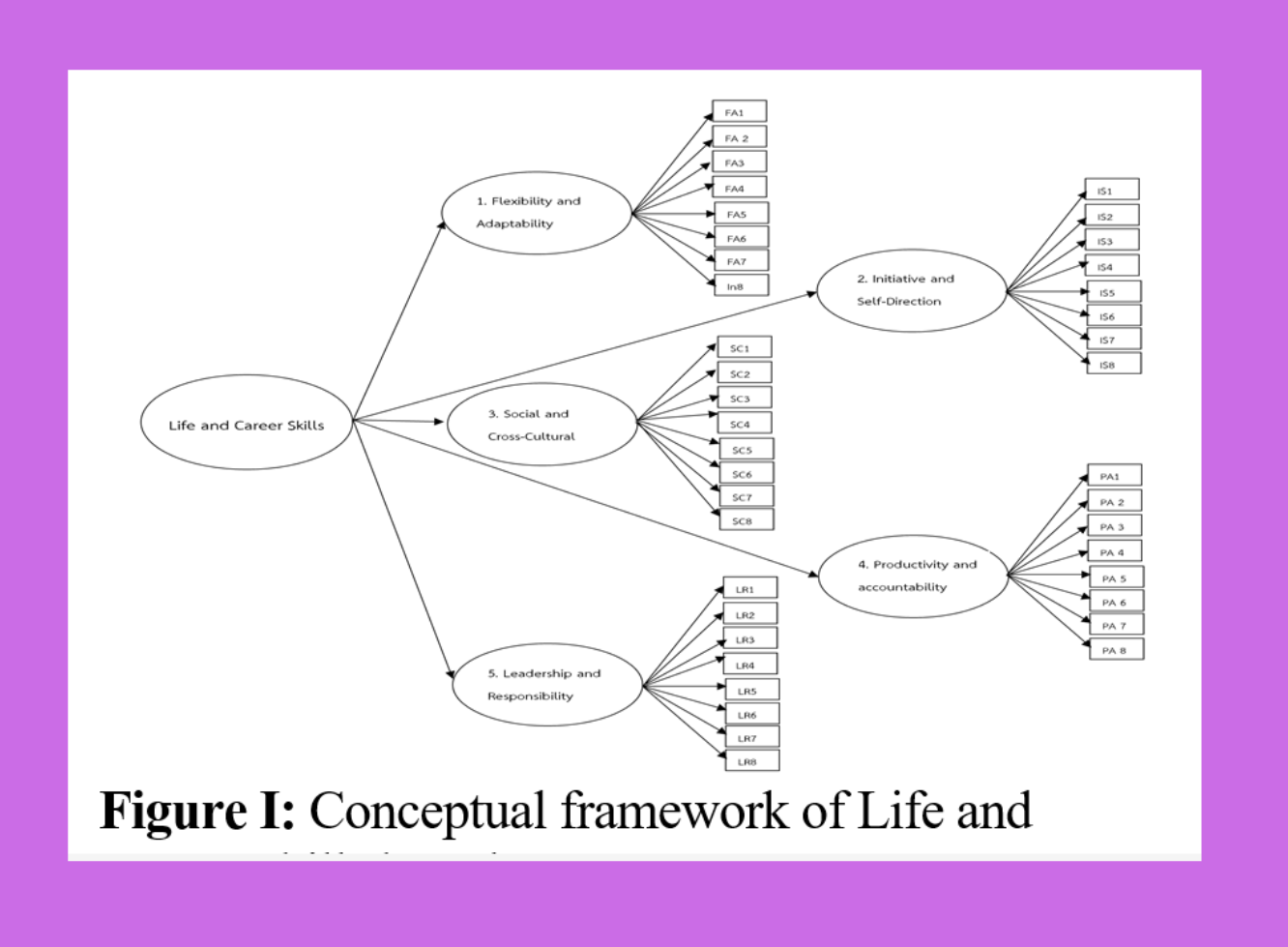
Background: Regarding teaching and learning management, the purpose of creating the nursing program is to produce effective professional nursing students who meet the healthcare service and system. Professional nurses are required with proper knowledge, innovation, information, media, and technology, including life and careers skills for working through current society. The research objectives were 1) To examine and validate the confirmatory factors, and 2) to study the results of the construction of a life skill instrument that is based on the 21st Century in Life and careers skills. Methods: This study was a descriptive research design. Three hundred and sixty nursing students who are 2nd, 3rd, and 4th-year students enrolled at Praboromarajachanok Institute by random sampling from 27 Boromrajonani College of Nursing in Thailand. The research instruments were the construction of life skills questionnaires comprising 5 elements. The research data were analyzed using frequency, mean, standard deviation, and CFA. Results: The results represented that the Model is related to the evidence-based 5 elements of life and careers skills. Furthermore, careers represented the standard estimated of an observed variable total of 40 variables between 0.75 – 0.91. Chi-square 781, df 617, relative Chi-square 1.26, p < .001, RMSEA 0.02, SRMR 0.020, TLI 0.98. Conclusion: Nursing educational institutions should play an important role in producing new registered nurses with soft skills as a qualification, especially focusing on Life and careers skills that can show that the nurse can confront any problem properly. The development of this instrument can guide nursing educators to assess nursing students to identify their strengths and weaknesses. Allowing them to improve their competency before graduation, especially can help nursing educators to prepare the nursing students for entering the nursing profession on the right track. It enables concrete monitoring of nursing students’ progress and can be used to regulate the curriculum and teaching methods. This also helps nursing educators to create a plan appropriately that supports supplementary curriculum activities for further educational development.
References
Armpat, C., Pisaipan, P., Tarmong, C., Suwannarat, K., Netgrajang, C., & Chonlatankampanat, W. (2018). Factors correlated with perception toward 21st Century Learning Skills among nursing students, Phrapokklao Nursing College. Journal of Phrapokklao Nursing College, Chanthaburi, 29(2), 36–46.
Benner, P., Sutphen, M., Leonard, V., & Day, L. (2010). Educating nurses: A call for radical transformation. Jossey-Bass, San Francisco.
Chantra, R., Thongphet, P., & Sarakshetrin, A. (2016). Factors related the ideal characteristics of Thai graduates according to Thailand Qualification Framework for higher education (TQF: HED) the Nursing Student of Boromarajonani College of Nursing, Surat Thani. Journal of Nursing and Education, 9(4), 90-101.
Chen, R., & Wilson, M. (2021). Social skills development in nursing students: A longitudinal study. Journal of Nursing Education, 60(4), 185-192.
Comrey, A. L., & Lee, H. B. (1992). A first course in factor analysis (2nd ed.). Hillsdale, NJ: Lawrence Erlbaum.
Hair, J. F., Babin, B. J., Anderson, R. E., & Black, W. C. (2019). Multivariate data analysis (8th ed.). England Pearson Prentice.
Janjaroen, K. & Nakaramontree, S. (2016). The relationship between social support and life skills among nursing students. The Southern College Network Journal of Nursing and Public Health (May-August): 85-99.
Kumar, K. (2012). A beginner’s guide to Structural Equation Modeling, 3rd ed. Journal- Royal Statistical Society Series A, 175(3), 828–829.
Lee, S., & Park, J. (2021). Academic achievement and self-directed learning in nursing students: A correlation study. Nurse Education Today, 97, 104-110.
Martinez, C., & Chen, L. (2021). Developing self-direction skills in nursing education. Journal of Nursing Education, 60(3), 143-148.
Nokkaew, P., & Mankong, C. (2021). Life and careers skills in the 21st Century of junior high school students grade 9 in Samut Prakan province. Mahachula Academic Journal, 8(1), 263–278.
Preechakoon, B., Molek, R., Chuwongin, D., Gongmuang, P., & Sombutboon, M. (2021). Nursing in Data Technology Era. The Journal of Chulabhorn Royal Academy, 3(1), 19–39.
Rotherham, A. J., & Willingham, D. (2009). 21st century skills: The challenges ahead. Educational Leadership, 67(1), 16–21.
Sangprateeptong, V. (2018). Guidelines for assessment of learning outcomes in the 21st century. Ubon Ratchathani Journal of Research and Evaluatio, 7(1), 1-10.
Smith, J. R., & Johnson, K. L. (2022). Resilience in nursing practice. Journal of Nursing Management, 30(2), 45-58.
Schumacker, R. E., & Whittaker, T. A. (2022). A beginner’s guide to Structural Equation Modeling (5th Ed.). New York: Routledge.
Taylor, M., & Brown, N. (2022). Healthcare system demands and nursing competencies: A correlation study. Journal of Advanced Nursing, 78(2), 456-464.
Thailand Nursing and Midwifery Council. (2021). Guidelines for developing professional nursing competency in the COVID-19. https://www.tnmc.or.th/news/124
Thailand Nursing and Midwifery Council. (2023). New nursing manual. V. indi deside Ltd.
Thompson, R., & Brown, M. (2020). Professional responsibility in nursing education. Journal of Advanced Nursing, 76(4), 890-898.
Tuntirojanawong, S. (2017). A direction of educational management in the 21st Century. Veridian E- Journal, 10(2), 2843-2854.
Yamane, T. (1973) Statistics: An introductory analysis (3rd Ed). Harper and Row, New York.
World Health Organization. (2020, April 6). State of the World’s nursing 2020: Investing in education, jobs, and leadership. WHO. https://www.who.int/publications/i/item/9789240003279
Downloads
Published
Issue
Section
License
Copyright (c) 2024 International Journal of Public Health and Health Sciences

This work is licensed under a Creative Commons Attribution-NonCommercial-NoDerivatives 4.0 International License.
If the manuscript is accepted for publication, copyright of the article shall be assigned to the IJPHS. After acceptance of a manuscript, the authors will be requested to complete a copyright transfer agreement form