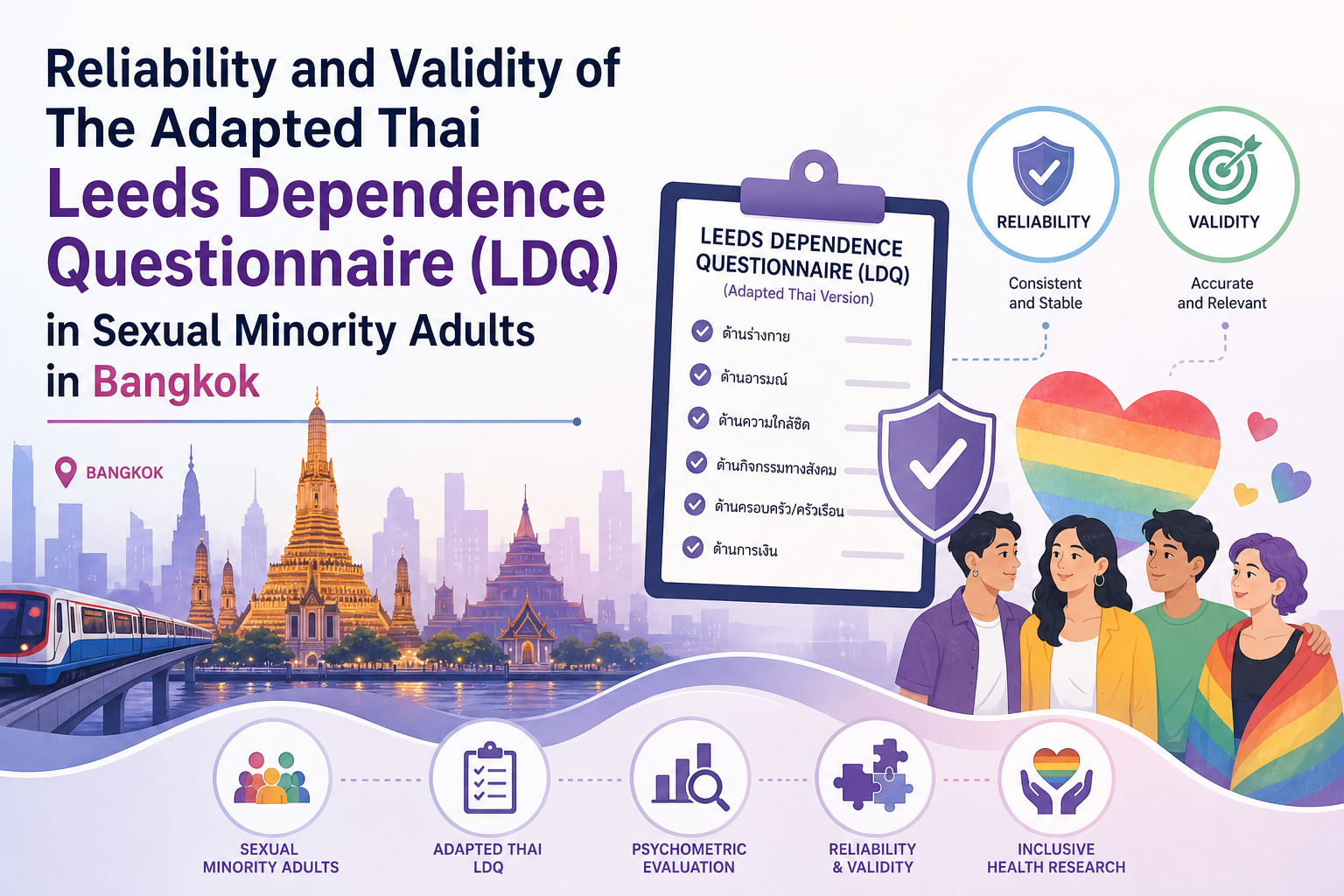
Reliability and Validity of The Adapted Thai Leeds Dependence Questionnaire (LDQ) in Sexual Minority Adults in Bangkok
Keywords:
Sexual minority adults, Substance abuse, Scale adaptation, Exploratory factor analysis (EFA), Confirmatory factor analysis (CFA)Abstract
Substance use among sexual minority adults in Thailand poses significant risks. This study aimed to translate and validate the Leeds Dependence Questionnaire (LDQ) into Thai, providing a culturally sensitive tool for assessing substance dependence in this population. This quantitative study aimed to examine the psychometric properties of the Thai version of the LDQ among sexual minority adults. A total of 450 participants in Bangkok were recruited using non-probability sampling methods, specifically convenience and snowball sampling, to effectively access this target population. The instrument’s reliability and validity were evaluated using Cronbach's alpha, exploratory factor analysis (EFA), confirmatory factor analysis (CFA), and convergent validity tests.
The Thai version of the LDQ demonstrated high reliability (α=.93) and validity. EFA identified a single-factor structure, which was further confirmed by CFA. The CFA results, applying modification indices, showed χ²=74.808 (p<.001), df=27, χ²/df=2.771, CFI=0.983, TLI=0.972, GFI=0.956, RMSEA=0.077, and PNFI=0.584. Additionally, convergent validity was established with a Composite Reliability (CR) of 0.953 and an Average Variance Extracted (AVE) of 0.671. The Thai adaptation of the LDQ is a reliable and valid tool for assessing substance dependence among sexual minority adults in Bangkok. CFA confirmed the model's fit, with most indices within acceptable ranges, supporting the tool's structural integrity. This adaptation enhances self-assessment and facilitates timely access to treatment. Future research should focus on validating the LDQ in diverse cultural settings to improve its applicability and effectiveness.
References
Allen, J. P., Columbus, M., & Fertig, J. B. (1995). Assessment in alcoholism treatment: an overview. Assessing alcohol problems: A guide for clinicians and researchers. Treatment handbook Series, (4), 1-9.
Anonymous. (2020). The Strategic Plan of Narcotics Control Management in 2021-2023. Narcotics Control Management Center, Ministry of Public Health, Thailand.
Babor, T. F., De La Fuente, J. R., Saunders, J. B. & Grant, M. (1989) AUDIT—The Alcohol Use Disorders Identification Test: Guidelines for Use in Primary Health Care (Geneva, World Health Organization).
Brown, R. L., & Rounds, L. A. (1995). Conjoint screening questionnaires for alcohol and other drug abuse: criterion validity in a primary care practice. Wisconsin medical journal.
Brown, R., Edwards, J., & Rounds, L. (1995). Medical students’ need of and support for substance‐abuse prevention. Teaching And Learning In Medicine, 7(2), 102-110.
Brunning, L., & McKeever, N. (2020). Asexuality. Journal Of Applied Philosophy, 38(3), 497-517.
Bush, B., Shaw, S., Cleary, P., Delbanco, T. L., & Aronson, M. D. (1987). Screening for alcohol abuse using the CAGE questionnaire. The American journal of medicine, 82(2), 231-235.
Callis, A. (2016). Beyond bi: Sexual fluidity, identity, and the post-sexual revolution. In N. L.Fischer & S. Seidman (Eds.), Introducing the new sexuality studies. New York, NY: Routledge. 215–224.
Chin, W. W. (2018). The partial least squares approach to structural equation modeling. Modern methods for business research, 295(2), 295-336.
Cronbach, L. J. (1951). Coefficient alpha and the internal structure of tests. psychometrika, 16(3), 297-334.
Dorsten, L. (2019). Convenience Sample. Interpreting Social And Behavioral Research, 111-114.
Edwards, G., & Gross, M. M. (1976). Alcohol dependence: provisional description of a clinical syndrome. British Medical Journal, 1(6017), 1058–1061.
Ewing, J. A. (1984). Detecting alcoholism: the CAGE questionnaire. Jama, 252(14), 1905-1907.
First, M. B. (2012). Structured clinical interview for DSM-IV axis I disorders. Biometrics Research Department.
Flentje, A., Livingston, N., Roley, J., & Sorensen, J. (2015). Mental and Physical Health Needs of Lesbian, Gay, and Bisexual Clients in Substance Abuse Treatment. Journal Of Substance Abuse Treatment, 58, 78-83.
Guadamauz, T. E. & Kanchawee, K. (2016). Understanding Substance Use Among Young People in The Context of Chem-Sex Parties. Mahidol University.
Hair, J. F., Howard, M. C., & Nitzl, C. (2020). Assessing measurement model quality in PLS-SEM using confirmatory composite analysis. Journal of Business Research, 109, 101–110.
Hartney, E. (2020). Sexual Minority Meaning and Characteristics. Verywell Mind. Retrieved 10 February 2022, from https://www.verywellmind.com/what-are-sexual-minorities-21876.
Hartney, E., Orford, J., Dalton, S., Ferrins-Brown, M., Kerr, C., & Maslin, J. (2003). Untreated heavy drinkers: a qualitative and quantitative study of dependence and readiness to change. Addiction Research & Theory, 11(5), 317-337.
Ho, R. (2014). Handbook of Univariate and Multivariate Data Analysis with IBM SPSS, Second Edition. Taylor and Francis.
Hughes, T., Veldhuis, C., Drabble, L., & Wilsnack, S. (2020). Research on alcohol and other drug (AOD) use among sexual minority women: A global scoping review. PLOS ONE, 15(3), e0229869.
Humeniuk, R., Henry-Edwards, S., Ali, R., Poznyak, V., Monteiro, M. G., & World Health Organization. (2010). The Alcohol, Smoking and Substance Involvement Screening Test (ASSIST): manual for use in primary care.
Johnson, T. (2014). Snowball Sampling: Introduction. Wiley Statsref: Statistics Reference Online.
Kaner, E. F., Heather, N., Brodie, J., Lock, C. A., & McAvoy, B. R. (2001). Patient and practitioner characteristics predict brief alcohol intervention in primary care. The British journal of general practice, 51(471), 822.
Kelly, J., Magill, M., Slaymaker, V., & Kahler, C. (2010). Psychometric validation of the Leeds Dependence Questionnaire (LDQ) in a young adult clinical sample. Addictive Behaviors, 35(4), 331-336.
Kerr, D. L., & Oglesby, W. H. (2017). LGBT populations and substance abuse research: An overview. Research methods in the study of substance abuse, 341-355.
Kirch, W. (2008). Encyclopedia of public health.
Lemma, A. (2021). Understanding transgender. Transgender Identities, 25-35.
Lennings, C. J. (1999). An evaluation of the Leeds dependence questionnaire. Journal of Child & Adolescent Substance Abuse, 8(3), 73-87.
Magruder-Habib, K., Stevens, H. A., & Alling, W. C. (1993). Relative performance of the MAST, VAST, and CAGE versus DSM-III-R criteria for alcohol dependence. Journal of Clinical Epidemiology, 46(5), 435-441.
Marsden, J., Farrell, M., Finch, E., Cummins, M. & Strang, J. (1998). The Rating of Injection Site Condition Scale (RISC): An assessment of injecting related morbidity and complications amongst drug misusers. Unpublished scale. London: National Addiction Centre.
Massah, O., Rafiey, H., Shariatirad, S., Radfar, S. R., Ahounbar, E., & Farhoudian, A. (2019). The validity and reliability of the Persian Version of the Leeds Dependence Questionnaire. Iranian Rehabilitation Journal, 17(2), 91-96.
Meyer, I. (2016). The Elusive Promise of LGBT Equality. American Journal Of Public Health, 106(8), 1356-1358.
Muccini, C., Pinyakorn, S., Kolsteeg, C., Kroon, E., Sacdalan, C., Crowell, T. A., Chan, P., Paul, R., Hsu, D., Phanuphak, N., & Colby, D. J. (2024). Chemsex and rising substance use linked to sexually transmitted infections among men who have sex with men living with HIV in Bangkok, Thailand. IJID Regions, 13, 100465.
Peña, B., & Tadros, E. (2021). Clinician knowledge, training, and experience working with pansexual youth. Sexual And Relationship Therapy, 1-19.
Pollitt, A., & Roberts, T. (2021). Internalized Binegativity, LGBQ + Community Involvement, and Definitions of Bisexuality. Journal Of Bisexuality, 21(3), 357-379.
Raistrick, D., Bradshaw, J., Tober, G., Weiner, J., Allison, J., & Healey, C. (1994). Development of the Leeds Dependence Questionnaire (LDQ): a questionnaire to measure alcohol and opiate dependence in the context of a treatment evaluation package. Addiction, 89(5), 563-572.
Rungreangkulkij, S & Kittirattanapaiboon, P. (2021). The Impact of Gender on Mental Health and Concepts of Gender Approach Mental Health Policy. Journal of Mental Health of Thailand ,29(3).259-272.
Sallis, J., Gripsrud, G., Olsson, U., & Silkoset, R. (2021). Factor Analysis. Research Methods And Data Analysis For Business Decisions, 223-243.
Saunders, J. B., Aasland, O. G., Babor, T. F., De la Fuente, J. R., & Grant, M. (1993). Development of the alcohol use disorders identification test (AUDIT): WHO collaborative project on early detection of persons with harmful alcohol consumption‐II. Addiction, 88(6), 791-804.
Schuler, M., & Collins, R. (2020). Sexual minority substance use disparities: Bisexual women at elevated risk relative to other sexual minority groups. Drug And Alcohol Dependence, 206, 107755.
Seiter, C. (2022). 50+ Resources For LGBTQIA Allies. Buffer Resources. Retrieved 10 February 2022, from https://buffer.com/resources/lgbtqia-resources/.
Shultz, K., Whitney, D., & Zickar, M. (2020). Confirmatory Factor Analysis. Measurement Theory In Action, 302-316.
Soderstrom, C. A., Smith, G. S., Dischinger, P. C., McDuff, D. R., Hebel, J. R., Gorelick, D. A., & Read, K. M. (1997). Psychoactive substance use disorders among seriously injured trauma center patients. Jama, 277(22), 1769-1774.
Substance Abuse and Mental Health Services Administration U.S. Department of Health and Human Services. (2018). 2018 National Survey on Drug Use and Health: Lesbian, Gay, & Bisexual (LGB) Adults.
Substance Abuse and Mental Health Services Administration U.S. Department of Health and Human Services. (2020). 2020 National Survey on Drug Use and Health: Lesbian, Gay, & Bisexual (LGB) Adults.
Tate, J. C., & Schmitz, J. M. (1993). A proposed revision of the Fagerstrom Tolerance Questionnaire. Addictive Behaviors, 18(2), 135-143.
Tavakol, M., & Dennick, R. (2011). Making sense of Cronbach's alpha. International Journal Of Medical Education, 2, 53-55.
Thailand Population 2022 (Demographics, Maps, Graphs). (2022). Retrieved 22 March 2022, from https://worldpopulationreview.com/countries/thailand-population.
Thomas, B. A., & McCambridge, J. (2008). Comparative psychometric study of a range of hazardous drinking measures administered online in a youth population. Drug and Alcohol Dependence, 96(1-2), 121-127.
World Health Organization. (2013). Translation and linguistic evaluation protocol and supporting material. WHO/United Nations ESCAP Project on Health and Disability Statistics.
Yimsaard, P., Mootz, J. J., Rungnirundorn, T., Janamnuaysook, R., Samitpol, K., & Guadamuz, T. E. (2024). Assessing the acceptability of implementing a Screening, Brief Intervention and Referral to Treatment for alcohol use among transgender women in Bangkok, Thailand: A mixed-method pre-implementation study. Addiction, 119(5), 863–874.
Downloads
Published
Issue
Section
License
Copyright (c) 2026 International Journal of Public Health and Health Sciences

This work is licensed under a Creative Commons Attribution-NonCommercial-NoDerivatives 4.0 International License.
If the manuscript is accepted for publication, copyright of the article shall be assigned to the IJPHS. After acceptance of a manuscript, the authors will be requested to complete a copyright transfer agreement form