Factors Predictor and Self-care Behavior for Urinary Incontinence among the Elderly Females in Khon Kaen Province, Thailand: Cross-sectional Study
Keywords:
Self-care behavior, Urinary incontinence, Elderly female, PredictorAbstract
The purposes of this research were to study the factors predicting Urinary Incontinence (UI) and self-care behavior in caring for UI among elderly females. Explained using Orem’s Self-Care Theory. The sample group consisted of 288 elderly female living in Daeng Yai Sub-district, Mueang District, Khon Kaen Province. Multistage sampling was conducted using a demographic interview form, screening form, factors that cause UI form, and self-care behavior in caring for UI in elderly females’ form. Also, reliability by Kuder-Richardson20 (K-R20) equals 0.89 and Cronbach’s alpha coefficient equal to 0.90 and 0.87 respectively. Data were analyzed using chi-square (Z2), Pearson product-moment correlation coefficient, and stepwise multiple regression.
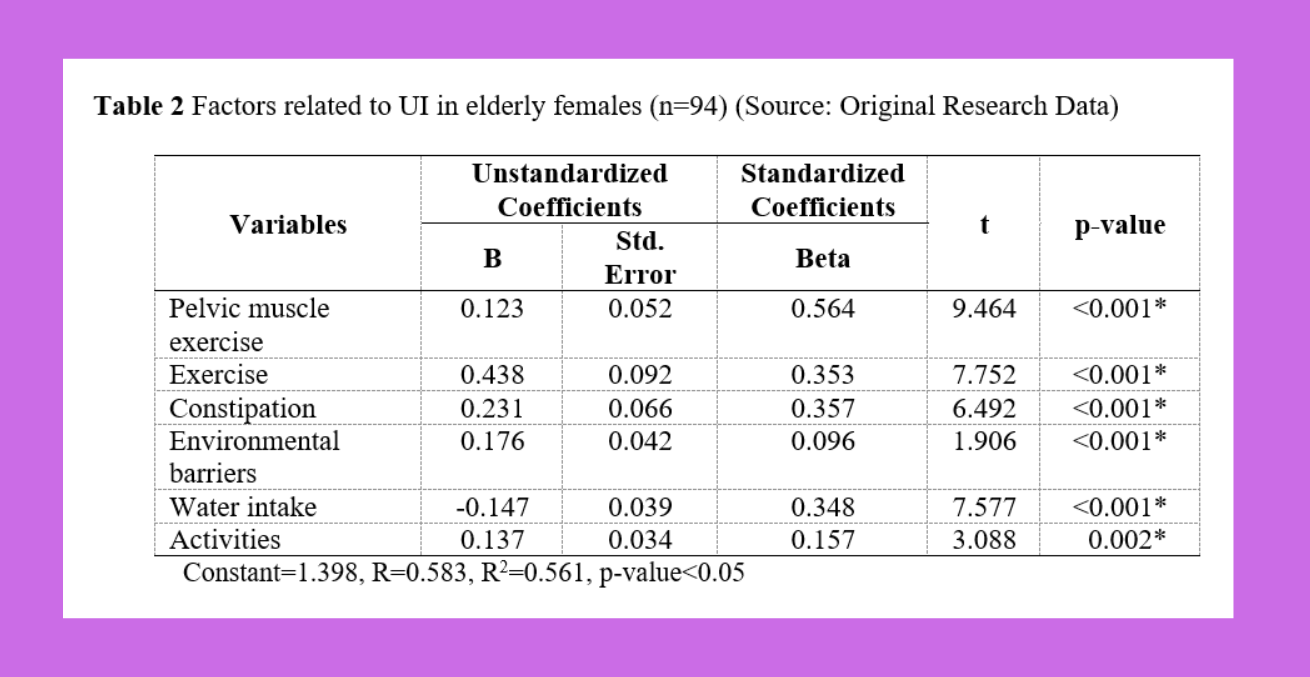
The results showed that factors predicting UI in elderly females include pelvic muscle exercise, exercise, constipation, environmental barriers, water intake, and activities. The overall self-care behavior of caring for UI among elderly females was at a moderate level. When considering each dimension, UI self-care behavior was moderate for overall prediction, behavioral changes, and self-care performance. This factor predicted the occurrence of UI in elderly females by 56.1% (R2=0.561, F= 4.053, p=0.05). Health policymakers should develop and implement strategic plans for UI in health setting services to screening and establish a more effective and efficient model of care.
References
Chaisri, S., Sarit-apirak, S., Udomsubpayakul, U. & Monomai, J. (2017). Proficiency and
health-related behaviors regarding pelvic organ prolapse and urinary incontinence among personal in a private hospital. Ramathibodi Medical Journal, 40:11-9.
Chompoowisate, P., Laokhompruttajarn, J. & Laokhompruttajarn, T. (2022). The relationship
between physical health and social support affecting the quality of life of the elderly
in Naseow sub-district, Muang district, Chaiyaphum Province. Journal of The Royal
Thai Army Nurses, 23(3): 238-247.
Condon, M., Mannion, E., Molloy, D.W. & O'Caoimh, R. (2019). Urinary and faecal
incontinence: point prevalence and predictors in a university hospital. International
Journal of Environmental Research and Public Health, 194: 1-8.
Daniel, W.W. & Cross, C.L. (2017). Biostatistics: basic concepts and methodology for the
health sciences. (10th). Wiley.
Ekphakorn, W. (2021). Survey of Thai people's health by physical examination 6th year 2019-
Faculty of Medicine Ramathibodi Hospital. Mahidol University.
Eshkoor, S.A., Hamid, T.A., Shahar, S. & Mun, C.M. (2017). Factors related to urinary
incontinence among the Malaysian elderly. Journal of Nutritional Health Aging, 21(2): 220-226.
Fumaneechote, A. and Phakthongsuk, P. (2017). Prevalence of urinary incontinence among
the elderly in the community of Ban Phru Municipality, Hat Yai District, Songkhla Province. Songklanagarind Medical Journal, 35(2), 133–138.
Hachanda, V., Sommart, J., Auiwattanakul, P. & Suwannaphant, K. (2022). Health literacy
about dietary supplements and traditional medicine among the elderly in Non Udom Sub-district, Chum Phae District, Khon Kaen Province, Thailand. Thai Journal of Public Health and Health Sciences, 5(2):131-144.
Kim, K., Shin, J., Choi, J., Park, J., Park, H. & Lee, J. (2018). Association of geriatric
syndromes with urinary incontinence according to sex and urinary incontinence related quality of life in older inpatients a cross sectional study of an acute care hospital. Korean Journal of Family Medicine, 40(4): 235-240.
Morley, JE. (2017). Rapid geriatric assessment. Journal of the American Medical Directors
Association, 16: 808-812.
Murukesu, R.R., Singh, D.A. & Shahar, S. (2019). Prevalence of urinary incontinence and its
association with declined cognitive and physical function among community dwelling
older adults: A review. Malaysian Journal of Public Health Medicine, 19: 31-40.
Orem, D.E. (2001). Nursing: concepts of practice. (5th ed.). Mosby.
Padungkul, L. & Mantangkul, S. (2017). Urinary incontinence management and perceptive
quality of life of female clients at the gynecological clinic. Songklanagarind Journal of Nursing, 37(1): 75-83.
Radziminska, A., Rajek, MW., Straczynska, A., Podhorecka, M., Kozakiewlcz, M. &
Kormatowska, K. (2018). The impact of pelvic floor muscle training on the
myostatin concentration and severity of urinary incontinence in elderly
women with stress urinary incontinenece–a pilot study. Clinical Interventions
in Aging, 13: 1893–1898.
Rattanawisai, P., Srichaikul, B. and Songkhasri, C. (2017). Results of the training program.
Controlling bladder excretion and exercising the pelvic floor muscles to prevent urinary incontinence in elderly females, Natan Subdistrict, Tha Khan Tho District. Kalasin Province. Journal of the Disease Prevention and Control Office 7 Khon Kaen, 24(1), 47–57.
Saboia, DM., Firmiano, MLV., Bezerra, KC., Vasconcelos, NJA., Oria, MOB. &
Vasconcelos, CTM. (2017). Impact of urinary incontinence types on women’s quality of life. Journal of School of Nursing University of Sao Paulo. Retrieved 3, 2023 from doi.org/10.1590/S1980-220X2016032603266.
Shi, H., Zhao, L., Cui, L., Wang, Z., Wang, D., Liu, P., Si, G., Guo, D. & Lui, W. (2022). A
critical overview of systematic reviews and meta-analyses of acupuncture for female stress urinary incontinence. Pain Research and Management.
Shuo, D.U., Zhao, J.P., Shi-hao, D.U., Wei, G.U.O., Xiao-long. X., Guan-qun, W., Guan-
xiong, H. & Chao, Y. (2023). Systematic review and meta-analysis of moxibustion on
urinary incontinence among women. World Journal of Acupuncture-Moxibustion, 33(4): 314-324.
Sultan, A.H., Monga, A., Lee, J., Emmanuel, A., Norton, C. & Santoro, G. (2017). An
International Urogynecological Association (IUGA)/International Continence Society (ICS) joint report on the terminology for female anorectal dysfunction. Neurourology and Urodynamics, 36: 10-34.
Torres-Lacomba, M., Navarro-Brazalez, B., Yuste-Sanchez, M.J., Sanchez-Sanchez, B.,
Prieto-Gomez, V. & Vergara-Perez, F. (2022). Women's experiences with compliance with pelvic floor home exercise therapy and lifestyle changes for pelvic organ prolapse symptoms: A qualitative study. Journal of Personalized Medicine, 12: 498-513.
Watakit, U. (2022). Study of experiences and acceptance of technology that affect intentions
to use social media of the elderly in Khon Kaen province. NEU ACADEMIC AND RESEARCH JOURNAL, 14(1): 133-146.
World Health Organization. (2017). Integrated care for older people guidelines (ICOPE)
about Evidence profile : urinary incontinence. Geneva : Switzerland.
Zangphukieo, N. (2020). Guidelines for conveying local wisdom of the elderly society: A
case study of Sangsuk School–the Elderly, Ban tio Sub-district, Lom Sak District, Phetchabun province. NEU ACADEMIC AND RESEARCH JOURNAL, 10(2): 55-67.
Zhang, D., Wang, S., Gao, L., Jia, Y., Wang, H., Sun, X. & Wang, J. (2022). Analysis of
characteristics and quality of life of elderly women with mild to moderate urinary incontinence in community dwellings. International Journal of Environmental
Downloads
Published
Issue
Section
License
Copyright (c) 2024 International Journal of Public Health and Health Sciences

This work is licensed under a Creative Commons Attribution-NonCommercial-NoDerivatives 4.0 International License.
If the manuscript is accepted for publication, copyright of the article shall be assigned to the IJPHS. After acceptance of a manuscript, the authors will be requested to complete a copyright transfer agreement form