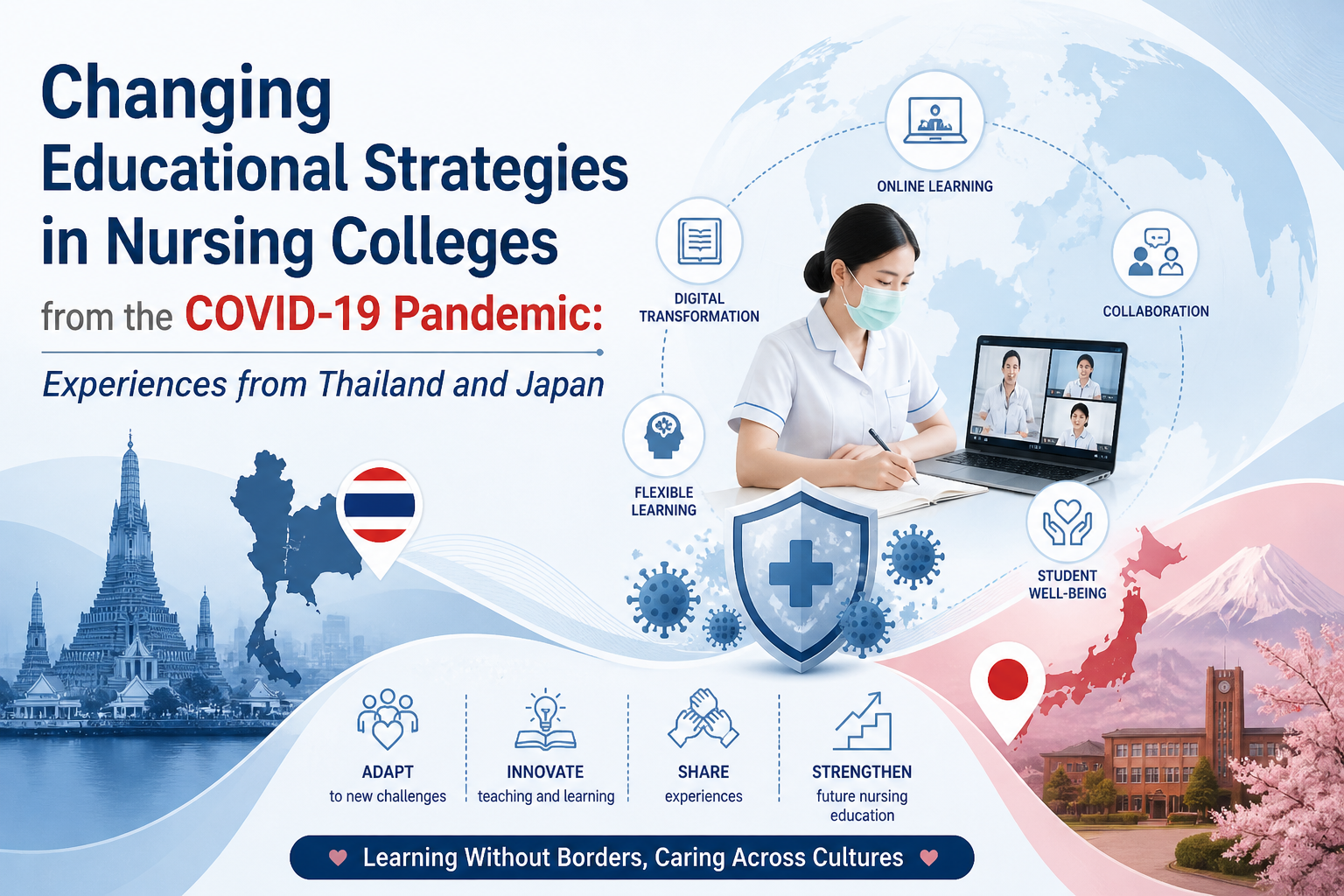
Changing Educational Strategies in Nursing Colleges from the COVID-19 Pandemic : Experiences from Thailand and Japan
Keywords:
Changing nursing education, Pandemic's educational impact, Adaptive teaching methodsAbstract
This article examines the impact of the COVID-19 pandemic on nursing education in Thailand and Japan, focusing on the adaptations in teaching methods and educational strategies implemented during the crisis. The study compares case studies from Srimahasarakam Nursing College in Thailand and Okayama Saiseikai Nursing College in Japan, highlighting significant shifts in educational management. Both institutions transitioned to online teaching for theoretical courses and emphasized infection control in laboratory-based training. Despite challenges, the innovative strategies employed contributed to a 100% national exam pass rate in Japan, demonstrating the effectiveness of these adaptations. The study explores similarities and differences in teaching methods, including blended learning, simulation-based training, and policy support. Findings indicate that the pandemic quickened educational transformation, integrating technology and adaptive learning techniques into nursing curricula. Understanding these adaptations provides valuable insights for future educational strategies in healthcare crisis management.
References
Adnan, M., & Anwar, K. (2020). Online learning amid the COVID-19 pandemic: Students'
perspectives. Journal of Pedagogical Sociology and Psychology, 2(1), 45–51. https://doi.org/10.33902/JPSP.2020261309
Bouchaud, M., Brown, D., & Swan, B. A. (2017). Creating a new education paradigm to prepare
nurses for the 21st century. Journal of Nursing Education and Practice. 7(10): 26-35.
Brown, A. M. (2015). Simulation in undergraduate mental health nursing education: A literature
review. Clinical simulation in nursing, 11(10): 445-449.
Carrillo, C. and Flores M.A. (2020) ‘COVID-19 and teacher education: a literature review of online
teaching and learning practices’, European Journal of Teacher Education, 43(4): 466-487.
Department of Disease Control, Ministry of Public Health, Thailand. (2021). Situation of Coronavirus
Disease 2019. Retrieved September 5, 2021 from https://ddc.moph.go.th/brc/news.php?news =16715&deptcode=brc
Department of Disease Control, Ministry of Public Health, Thailand. (2022). Announcement
Regarding the Coronavirus Disease 2019. Retrieved October 1, 2022 from https://ddc.moph.go.th/law.php?law=1
Fuglsang, S., Bloch, C. W., & Selberg, H. (2022). Simulation training and professional self-
confidence: A large-scale study of third year nursing students. Nurse education today, 108,
Gawlik-Kobylinska, M., Domalewska, D., & Maciejewski, P. (2021). How to motivate students? The
four dimensional instructional design approach in a non-core blended learning course.
In Cross Reality and Data Science in Engineering: Proceedings of the 17th International
Conference on Remote Engineering and Virtual Instrumentation 17 (pp. 782-794). Springer International Publishing.
Gazza, E. A. (2017). The experience of teaching online in nursing education. Journal of Nursing
education, 56(6): 343-349.
Hodges, C., Moore, S., Lockee, B., Trust, T., & Bond, A. (2020). The difference between emergency
remote teaching and online learning. Educause Review, 27(1), 1–12. https://er.educause.edu/articles/2020/3/the-difference-between-emergency-remote-teaching-and-online-learning
Kim, S., Jeong, S. H., Kim, H. S., & Jeong, Y. J. (2022). Academic success of online learning in
undergraduate nursing education programs in the COVID-19 pandemic era. Journal of
Professional Nursing, 38: 6-16.
Landrum, B. (2020). Examining Students' Confidence to Learn Online, Self-Regulation Skills and
Perceptions of Satisfaction and Usefulness of Online Classes. Online Learning, 24(3): 128-
Law, K. M., Geng, S., & Li, T. (2019). Student enrollment, motivation and learning performance in a
blended learning environment: The mediating effects of social, teaching, and cognitive
presence. Computers & Education, 136: 1-12.
Mukhtar, K., Javed, K., Arooj, M., & Sethi, A. (2020). Advantages, limitations and recommendations
for online learning during COVID-19 pandemic era. Pakistan Journal of Medical Sciences, 36(COVID19-S4), S27–S31. https://doi.org/10.12669/pjms.36.COVID19-S4.2785
Panich, V. (2017). Ways to create learning for students in the 21st century. Walailak Journal of
Learning Innovations, 1(2), 3–14. Retrieved from https://so03.tci-thaijo.org/index.php/jliwu/article/view/95054/74242)
Raurell Torredà, M., Olivet Pujol, J., Romero Collado, À., Malagon Aguilera, M. C., Patiño Masó, J.,
& Baltasar Bagué, A. (2015). Case‐based learning and simulation: Useful tools to enhance
nurses’ education? Nonrandomized controlled trial. Journal of Nursing Scholarship, 47(1):
-42.
Robinson, M., & Breen, H. (2020). Online Nursing Education: A Collaborative Approach: A
Collaborative Approach. Jones & Bartlett Learning.
Rosati, L. J., & Szoka, A. (2019). THEME THREE Homeostasis and Regulation. Concepts for
Nursing Practice E-Book, 84.
Saraketrin, A., Rongmuang, D., Chantra, R., (2019) Nursing education in the 21st century:
Competencies and roles of nursing instructors, Journal of The Royal Thai Army Nurses, 20(1): 12-20.
Toqan, D., Ayed, A., Khalaf, I. A., & Alsadi, M. (2023). Effect of High-Fidelity Simulation on Self-
Satisfaction and Self-Confidence Among Nursing Students. SAGE Open Nursing, 9,
Tathahira, T. (2020). Promoting students’ critical thinking through online learning in higher
education: Challenges and strategies. Englisia: Journal of Language, Education, and
Humanities, 8(1): 79-92.
Wai, A. K., Lam, V. S., Ng, Z. L., Pang, M. T., Tsang, V. W., Lee, J. J., & Wong, J. Y. (2021).
Exploring the role of simulation to foster interprofessional teamwork among medical and
nursing students: A mixed-method pilot investigation in Hong Kong. Journal of
interprofessional care, 35(6): 890-898.
Downloads
Published
Issue
Section
License
Copyright (c) 2026 International Journal of Public Health and Health Sciences

This work is licensed under a Creative Commons Attribution-NonCommercial-NoDerivatives 4.0 International License.
If the manuscript is accepted for publication, copyright of the article shall be assigned to the IJPHS. After acceptance of a manuscript, the authors will be requested to complete a copyright transfer agreement form