Comparing Efficacy of Combined Intense Pulsed Light Therapy and Low-level Light Therapy Versus Intense Pulsed Light for the Treatment of Dry Eye Disease: A Retrospective Study
##plugins.themes.bootstrap3.article.sidebar##
##plugins.themes.bootstrap3.article.main##
摘要
Introduction: Dry eye disease is a prevalent condition that impacts millions of individuals globally, with meibomian gland dysfunction (MGD) being a significant contributor to the development of this condition. In recent years, intense pulsed light (IPL) and low-level light therapy (LLLT) have emerged as promising treatments for MGD-related dry eye disease. Several studies have reported that a combined therapy of IPL with LLLT is effective in treating MGD patients. However, to date, there is a lack of research comparing the efficacy of IPL alone versus IPL in combination with LLLT in the treatment of dry eye patients.
Purpose: To compare the efficacy of Intense Pulsed Light therapy combined with Low-Level Light therapy Versus Intense Pulsed Light for the treatment of dry eye disease
Study design: Retrospective single-center clinical study
Materials and Methods: Patients presenting with a dry eye disease (DED) with MGD and having received treatment with IPL or IPL with LLLT at Thammasat University Hospital between February 2023 and November 2023 were included. The single IPL session and combined IPL and LLLT session was performed once weekly over 3 weeks. The end point was the mean difference of DEQ-5 score between baseline (0-14 days before the first session of the treatment) and 2 weeks after the last session. Data collection was done retrospectively. Statistical analysis was done using STATA 16.0.
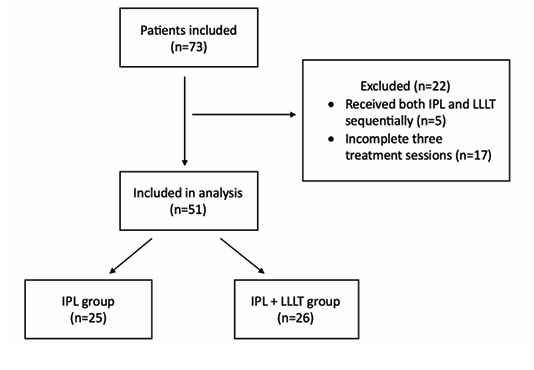
Results: 51 patients were included (25 patients from IPL group, 26 patients from IPL with LLLT group). DEQ-5 score significantly decreased after the single IPL treatment and the combined IPL with LLLT treatment (P < 0.001). Patients in the combined IPL with LLLT group showed significant improvement in DEQ-5 score compared with the single IPL group (-10.2 ± 3.1 vs -7.8 ± 2.1, P < 0.05). There was no adverse effect reported in both groups.
Conclusions: Both IPL and IPL with LLLT were safe and effective in improving ocular discomfort symptoms in MGD-related dry eye disease. However, the combined IPL with LLLT determined a greater improvement in symptoms.
##plugins.themes.bootstrap3.article.details##
参考
Craig JP, Nichols KK, Akpek EK, et al. TFOS DEWS II definition and classification report. Ocul Surf. 2017;15(3):276–83.
Stapleton F, Alves M, Bunya VY, et al. TFOS DEWS II Epidemiology Report. Ocul Surf. 2017;15(3):334-65.
Nichols KK, Foulks GN, Bron AJ, et al. The International Workshop on Meibomian Gland Dysfunction: executive summary. Investig Ophthalmol Vis Sci. 2011;52(4):1922–9.
Sabeti S, Kheirkhah A, Yin J, et al. Management of meibomian gland dysfunction. Surv Ophthamol. 2020;65:205–17.
Qiao J, Yan X. Emerging treatment options for meibomian gland dysfunction. Clin Ophthalmol. 2013;7:1797-803.
Alghamdi YA, Camp A, Feuer W, et al. Compliance and subjective patient responses to eyelid hygiene. Eye Contact Lens. 2017;43:213–7.
Kaiserman I, Rabina G, Mimouni M, Sadi Optom NB, Duvdevan N, Levartovsky S, Ben David D. The Effect of Therapeutic Meibomian Glands Expression on Evaporative Dry Eye: A Prospective Randomized Controlled Trial. Curr Eye Res. 2021;46(2):195-201.
Raulin C, Greve B, Grema H. IPL technology: a review. Lasers Surg Med. 2003;32(2):78–87.
Vora GK, Gupta PK. Intense pulsed light therapy for the treatment of evaporative dry eye disease. Curr Opin Ophthalmol. 2015;26(4):314–8.
Liu R, Rong B, Tu P, et al. Analysis of cytokine levels in tears and clinical correlations after intense pulsed light treating meibomian gland dysfunction. Am J Ophthalmol. 2017;183:81–90.
Barbosa Ribeiro B, Marta A, Ponces Ramalhão J, Marques JH, Barbosa I. Pulsed Light Therapy in the Management of Dry Eye Disease: Current Perspectives. Clin Ophthalmol. 2022;16:3883-93.
Tashbayev B, Yazdani M, Arita R, Fineide F, Utheim TP. Intense pulsed light treatment in meibomian gland dysfunction: A concise review. Ocul Surf. 2020;18(4):583-94.
Piyacomn Y, Kasetsuwan N, Reinprayoon U, Satitpitakul V, Tesapirat L. Efficacy and safety of intense pulsed light in patients with meibomian gland dysfunction-A randomized, double-masked, sham controlled clinical trial. Cornea. 2020;39(3):325–32.
Naudin T, Thorel D, Tétart F, Muraine M, Gueudry J. Combined intense pulsed light and low-level light therapy in the treatment of meibomian gland dysfunction. J Fr Ophtalmol. 2021;44:1021–8.
Park Y, Kim H, Kim S, Cho KJ. Effect of low-level light therapy in patients with dry eye: a prospective, randomized, observer masked trial. Sci Rep. 2022;12(1):3575.
D’Souza S, James E, Koul A, Modak D, Kundu G, Shetty R. A randomized controlled study evaluating outcomes of intense pulsed light and low-level light therapy for treating meibomian gland dysfunction and evaporative dry eye. Indian J Ophthalmol. 2023;71(4):1608-12.
Stonecipher K, Abell TG, Chotiner B, Chotiner E, Potvin R. Combined low level light therapy and intense pulsed light therapy for the treatment of meibomian gland dysfunction. Clin Ophthalmol. 2019;13:993–9.
Pérez-Silguero MA, Pérez-Silguero D, Rivero-Santana A, Bernal-Blasco MI, Encinas-Pisa P. Combined Intense Pulsed Light and Low-Level Light Therapy for the Treatment of Dry Eye: A Retrospective Before-After Study with One-Year Follow Up. Clin Ophthalmol. 2021;15:2133-40.
Solomos L, Bouthour W, Malclès A, Thumann G, Massa H. Meibomian Gland Dysfunction: Intense Pulsed Light Therapy in Combination with Low-Level Light Therapy as Rescue Treatment. Medicina (Kaunas). 2021;57(6):619.
Chalmers RL, Begley CG, Caffery B. Validation of the 5-Item Dry Eye Questionnaire (DEQ-5): Discrimination across self-assessed severity and aqueous tear deficient dry eye diagnoses. Cont Lens Anterior Eye. 2010;33(2):55-60.
Kwan J, Yin EP, Lee VY. Effect of intense pulsed light therapy on dry eye symptoms in meibomian gland dysfunction: A randomized controlled study. Ocular Surface. 2021;19:75–81.
Marta A, Baptista PM, Heitor Marques J, Almeida D, José D, Sousa P, Barbosa I. Intense Pulsed Plus Low-Level Light Therapy in Meibomian Gland Dysfunction. Clin Ophthalmol. 2021;15:2803-11.
Giannaccare G, Pellegrini M, Carnovale Scalzo G, Borselli M, Ceravolo D, Scorcia V. Low-Level Light Therapy Versus Intense Pulsed Light for the Treatment of Meibomian Gland Dysfunction: Preliminary Results From a Prospective Randomized Comparative Study. Cornea. 2023;42(2):141-4.
Chung H, Dai T, Sharma SK, Huang YY, Carroll JD, Hamblin MR. The nuts and bolts of low-level laser (light) therapy. Ann Biomed Eng. 2012;40(2):516-33.
Ji YW, Byun YJ, Choi W, et al. Neutralization of ocular surface TNF-α reduces ocular surface and lacrimal gland inflammation induced by in vivo dry eye. Invest Ophthalmol Vis Sci. 2013;54(12):7557-66.
Aimbire F, Albertini R, Pacheco MT, et al. Low-level laser therapy induces dose dependent reduction of TNFalpha levels in acute inflammation. Photomed Laser Surg. 2006;24(1):33-7.
Dell SJ. Intense pulsed light for evaporative dry eye disease. Clin Ophthalmol. 2017;11:1167-73.
