
The Visual Field Recovery Following Transnasal Transphenoidal Surgery for Pituitary Adenoma: A Case Report
Article Sidebar
Main Article Content
บทคัดย่อ
Purpose: To report a pituitary adenoma case with compression of the optic chiasma and visual field defect recovery following transnasal transphenoidal surgery.
Method: A Case report
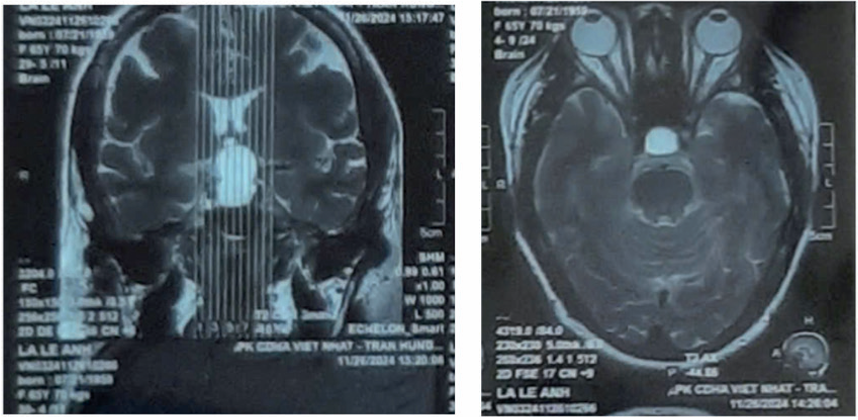
Result: A 65-year-old female patient presented with the primary complaint of decreased visual acuity (VA) and visual field defects in both eyes. Visual field examination revealed bitemporal hemianopia, Ganglion Cell – Inner Plexiform Layer (GCIPL) atrophy in the left eye. Magnetic resonance imaging (MRI) of the sella and parasellar region showed a lesion of the optic chiasm approximately 30 mm in diameter compressing the optic chiasm and the floor of the third ventricle, eroding the sellar floor, with “snowman sign”. Transnasal transsphenoidal surgery was promptly performed following the diagnosis, leading to improvement in VA and visual field defect 25 days postoperative.
Conclusion: Clinicians should be aware that patients with non-functioning pituitary adenomas (NFPAs) usually seek ophthalmologists because of the visual disturbance, such as impaired visual acuity and visual field defects. This case report highlights the importance of early diagnosis and timely neurosurgical intervention in preventing irreversible visual impairment in patients with pituitary macroadenomas.
Conflicts of Interest: None.
Article Details

อนุญาตภายใต้เงื่อนไข Creative Commons Attribution-NonCommercial-NoDerivatives 4.0 International License.
เอกสารอ้างอิง
Mete O, Lopes MB. Overview of the 2017 WHO Classification of Pituitary Tumors. Endocr Pathol. 2017;28(3):228-243.
Agustsson TT, Baldvinsdottir T, Jonasson JG, Olafsdottir E, Steinthorsdottir V, Sigurdsson G, et al. The epidemiology of pituitary adenomas in Iceland, 1955-2012: a nationwide population-based study. Eur J Endocrinol. 2015;173(5):655-64.
Fleseriu M, Karavitaki N. Non-functioning pituitary adenomas, not all the same and certainly not boring! Pituitary. 2018;21(2):109-110.
Colao A, Di Somma C, Pivonello R, Faggiano A, Lombardi G, Savastano S. Medical therapy for clinically non-functioning pituitary adenomas. Endocr Relat Cancer. 2008;15(4):905-15.
Ferrante E, Ferraroni M, Castrignano T, Menicatti L, Anagni M, Reimondo G, et al. Non-functioning pituitary adenoma database: a useful resource to improve the clinical management of pituitary tumors. Eur J Endocrinol. 2006;155(6):823-9.
Sivakumar W, Chamoun R, Nguyen V, Couldwell WT. Incidental pituitary adenomas. Neurosurg Focus. 2011;31(6):E18.
Gnanalingham KK, Bhattacharjee S, Pennington R, Ng J, Mendoza N. The time course of visual field recovery following transphenoidal surgery for pituitary adenomas: predictive factors for a good outcome. J Neurol Neurosurg Psychiatry. 2005;76(3):415-9.
Chabot JD, Chakraborty S, Imbarrato G, Dehdashti AR. Evaluation of Outcomes After Endoscopic Endonasal Surgery for Large and Giant Pituitary Macroadenoma: A Retrospective Review of 39 Consecutive Patients. World Neurosurg. 2015;84(4):978-88.
Chen Y, Liu Z, Lin Z, Shi X. Eye Signs in Pituitary Disorders. Neurol India. 2019;67(4):979-982.
Van Gerven L, Qian Z, Starovoyt A, Jorissen M, Meulemans J, Van Loon J, et al. Endoscopic, Endonasal Transsphenoidal Surgery for Tumors of the Sellar and Suprasellar Region: A Monocentric Historical Cohort Study of 369 Patients. Front Oncol. 2021;11:643550.
Danesh-Meyer HV, Papchenko T, Savino PJ, Law A, Evans J, Gamble GD. In vivo retinal nerve fiber layer thickness measured by optical coherence tomography predicts visual recovery after surgery for parachiasmal tumors. Invest Ophthalmol Vis Sci. 2008;49(5):1879-85.
Cennamo G, Auriemma RS, Cardone D, Grasso LF, Velotti N, Simeoli C, et al. Evaluation of the retinal nerve fibre layer and ganglion cell complex thickness in pituitary macroadenomas without optic chiasmal compression. Eye (Lond). 2015;29(6):797-802.
Dutta P, Gyurmey T, Bansal R, Pathak A, Dhandapani S, Rai A, et al. Visual outcome in 2000 eyes following microscopic transsphenoidal surgery for pituitary adenomas: Protracted blindness should not be a deterrent. Neurol India. 2016;64(6):1247-1253.
