
Efficacy of 0.28% Sodium Hyaluronate Eye Drops in Patients with Moderate to Severe Dry Eye: A Randomized Double-blind Controlled Trial.
Article Sidebar
Main Article Content
Abstract
Background: Dry eye disease (DED) is a prevalent ocular condition, particularly in Asian populations, that adversely affects quality of life and visual function. While sodium hyaluronate (SH) artificial tears are commonly used, the optimal concentration remains unclear. This study compared the efficacy and safety of 0.28% versus 0.18% SH eye drops in patients with moderate to severe DED.
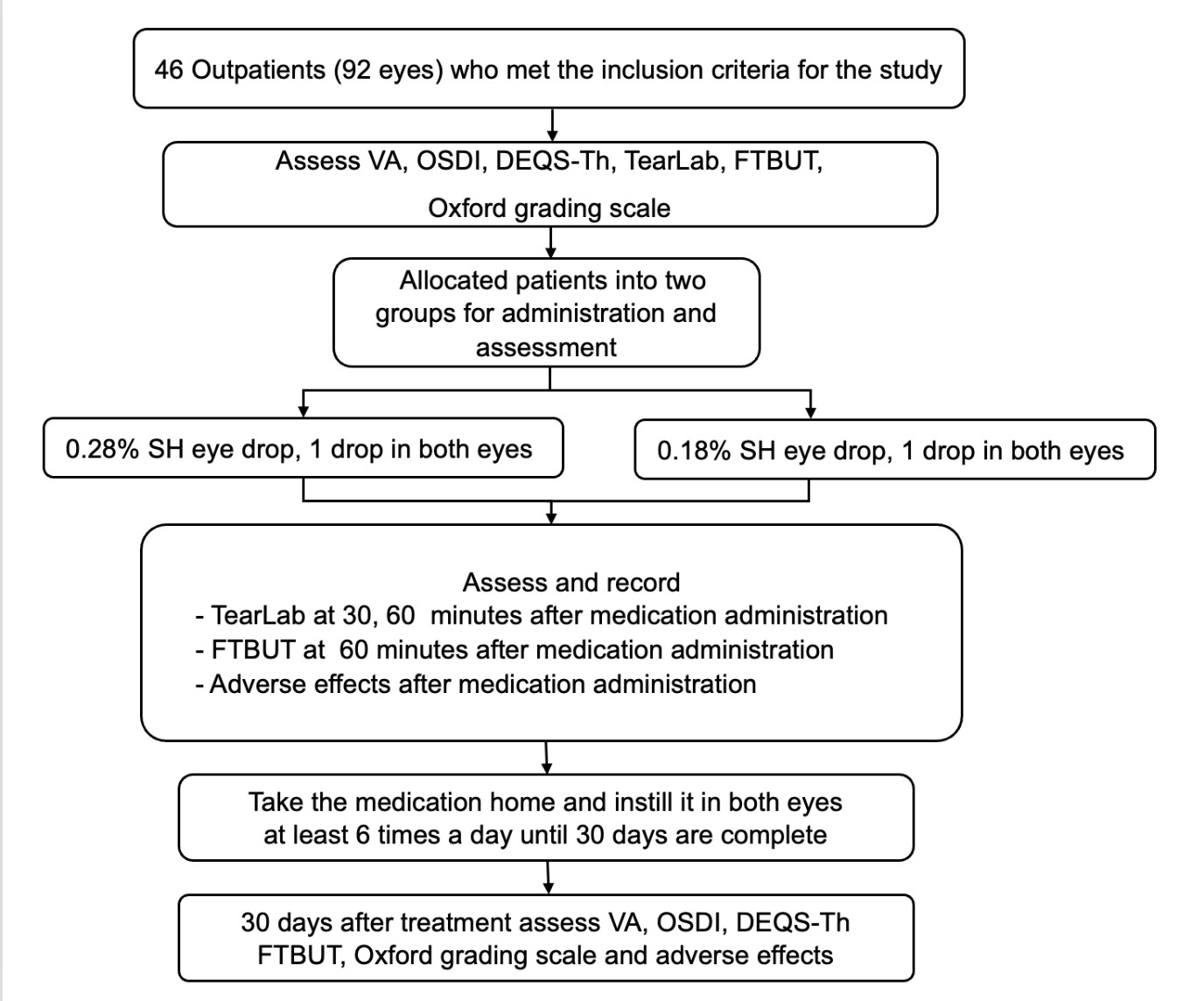
Methods: In this prospective, multicenter, randomized, double-blind controlled trial, patients with moderate to severe DED (OSDI ≥ 23, Oxford grading scale ≥ 2, FTBUT < 7 seconds) were randomized to receive either 0.28% or 0.18% SH eye drops in both eyes, six times daily for 30 days. The primary outcome was change in Oxford grading scale. Secondary outcomes included tear osmolarity, best corrected visual acuity (BCVA), fluorescein tear break-up time (FTBUT), ocular surface disease index (OSDI), quality of life (DEQS-Th), and adverse events, assessed at baseline and after 30 days.
Results: Forty-six patients (92 eyes) were enrolled. The 0.28% SH group showed a significantly greater reduction in Oxford grading scale scores at 30 days compared to the 0.18% group (p = 0.024), with improvement in 91.3% versus 73.9% of patients, respectively (p = 0.021). The 0.28% SH group also achieved a clinically significant reduction in tear osmolarity post-instillation. BCVA improved significantly only in the 0.28% SH group, whereas FTBUT increased in both groups. In addition, both groups improved in OSDI and DEQS-Th scores, with no significant difference between groups. Adverse events were mild and similar between groups.
Conclusions: The 0.28% SH eye drops are safe and effective for treating moderate to severe DED, significantly reducing corneal staining and dry eye symptoms, and improving visual acuity and quality of life.
Conflict of I nterest: The authors declare no competing interest.
Article Details

This work is licensed under a Creative Commons Attribution-NonCommercial-NoDerivatives 4.0 International License.
References
Stapleton F, Alves M, Bunya VY, Jalbert I, Lekhanont K, Malet F, et al. TFOSDEWS II Epidemiology Report. Ocul Surf. 2017;15(3):334-65.
Cai Y, Wei J, Zhou J, Zou W. Prevalence and incidence of dry eye disease in Asia: a systematic review and meta-analysis. Ophthalmic Res. 2022;65(6):647-58.
Lekhanont K, Rojanaporn D, Chuck RS, Vongthongsri A. Prevalence of dry eye in Bangkok, Thailand. Cornea. 2006;25(10):1162-7.
Kasetsuwan N, Gorvanich S, Erjongmanee S, Thienprasiddhi P, Jitapunkul S. Prevalence of dry eye in elderly Thai population (The Romklao eye study). Asian Biomed. 2012;6(6):875-82.
Kunboon A, Tananuvat N, Upaphong P, Wongpakaran N, Wongpakaran T. Prevalence of dry eye disease symptoms, associated factors and impact on quality of life among medical students during the pandemic. Sci Rep. 2024;14:23986.
Sullivan DA, Rocha EM, Aragona P, Clayton JA, Ding J, Golebiowski B, et al. TFOS DEWS II sex, gender, and hormones Report. Ocul Surf. 2017;15(3):284-333.
Guo OL, Akpek E. The negative effects of dry eye disease on quality of life and visual function. Turk J Med Sci. 2020;50(SI–2):1611-5.
Gomes JAP, Santo RM. The impact of dry eye disease treatment on patient satisfaction and quality of life: a review. Ocul Surf. 2019;17:9-19.
Craig JP, Nelson JD, Azar DT, Belmonte C, Bron AJ, Chauhan SK, et al. TFOS DEWS II executive summary. Ocul Surf. 2017;15(4):802-12.
Lemp MA. Management of dry eye disease. Am J Manag Care. 2008;14:S88-S101.
Hynnekleiv L, Magno M, Moschowits E. A comparison between hyaluronic acid and other single-ingredient eye drops for dry eye: A review. Acta Ophthalmol. 2024;102(1):25-37.
Yang YJ, Lee WY, Kim YJ, Hong YP. A meta-analysis of the efficacy of hyaluronic acid eye drops for the treatment of dry eye syndrome. Int J Environ Res Public Health. 2021;18:2383.
Ang BCH, Sng JJ, Wang PXH, Htoon HM,Tong LHT. Sodium Hyaluronate in the treatment of dry eye syndrome: A systematic review and meta-analysis. Sci Rep. 2017;7(1):9013.
Maity M, Allay MB, Ali H, Basu S, Singh S. Effect of different artificial tears on tear film parameters in dry eye disease. Optom Vis Sci. 2025;102(1):37-43.
Hynnekleiv L, Magno M, Ragnheidur R. Hyaluronic acid in the treatment of dry eye disease. Acta Ophthalmol. 2022;100:844-60.
Harrell CR, Feulner L, Djonov V. The Molecular Mechanisms Responsible for Tear Hyperosmolarity-Induced Pathological Changes in the Eyes of Dry Eye Disease Patients. Cells. 2023;12:2755.
Lester M, Orsoni GJ, Gamba G, Affara MT, Mangiafico P, Giuffrida S, et al. Improvement of the ocular surface using hypotonic 0.4% hyaluronic acid drops in keratoconjunctivitis sicca. Eye. 2000;14(Pt6):892-8.
Troiano P, Monaco G. Concentration 0.4% hyaluronic acid eye drops: Effect of hypotonic 0.4% hyaluronic acid drops in dry eye patients: A crossover study. Cornea. 2008;27(9):1126-30.
Aragona P, Simmons PA, Wang H, Wang T. Physicochemical properties of hyaluronic acid-based lubricant eye drops. Transl Vis Sci Technol. 2019;8(2).
Salzillo R, Schiraldi C, Corsuto L, Agostino AD, Filosa R, Rosa MD, et al. Optimization of hyaluronan-based eye drop formulations. Carbohydr Polym. 2016;153:275-83.
Wolffsohn JS, Arita R, Chalmers R, Djalilian A, Dogru M, Dumbleton K, et al. TFOS DEWS II Diagnostic Methodology report. Ocul Surf. 2017;15(3):539-74.
Bron AJ, Evans VE, Smith JA. Grading of corneal and conjunctival staining in the context of other dry eye tests. Cornea. 2003;22:640-50.
Bron AJ, de Paiva CS, Chauhan SK, Bonini S, Gabison EE, Jain S, et al. TFOS DEWS II pathophysiology report. Ocul Surf. 2017;15(3):438-510.
Lemp MA, Bron AJ, Baudouin C, Castillo JMBD, Geffen D, Tauber J, et al. Tear osmolarity in the diagnosis and management of dry eye disease. Am J Ophthalmol. 2011;151(5):792-8.
Sullivan BD, Whitmer D, Nichols KK, Tomlinson A, Foulks GN, Geerling G, et al. An objective approach to dry eye disease severity. Invest Ophthalmol Vis Sci. 2010;51:6125-30.
Sullivan B. Challenges in using signs and symptoms to evaluate new biomarkers of dry eye disease. Ocul Surf. 2014;12:2-9.
Tansanguan S, Tananuvat N, Wongpakaran N, Wongpakaran T, Ausayakhun S. Thai version of the dry eye-related quality of life score questionnaire: preliminary assessment for psychometric properties. BMC Ophthalmol. 2021;21(1):310.
Tananuvat N, Tansanguan S, Wongpakaran N, Wongpakaran T. Reliability,validity, and responsiveness of the Thai version of the dry eye-related Quality of Life Score questionnaire. Plos One. 2022;17(7):e0271228.
Tsubota K. Short tear film breakup time–type dry eye. Invest Ophthalmol Vis Sci. 2018;59(14):65-70.
Ouyang XW, Fang S, Yi YM. Different concentrations of hyaluronic acid eye drops for dry eye syndrome: a systematic review and Meta-analysis. Int J Ophthalmol. 2024;17(6):1110-9.
Shimizu A, Yokoi N, Nishida K, Kinoshita S, Akiyama K. Fluorophotometric measurement of tear volume and tear turnover rate in human eyes. Nippon Ganka Gakkai Zasshi. 1993;97(9):1047-52.
Kim W, Woo IH, Eom Y, Song JS. Short-term changes in tear osmolarity after instillation of different osmolarity eye drops in patients with dry eye. Sci Rep. 2023;13:11012.
Muñoz EC, Patiño AO, Marín DJ, Cadavid LM, Quiroga LO, Lopera DG, et al. Immediate impact on tear osmolarity following the application of different ocular lubricants in patients experiencing moderate dry eye symptoms. Cornea. 2024;43:1040-3.
Calonge M, Sahyoun M, Baillif S, Gain P, Paw E, Mearza A, et al. Sodium hyaluronate 0.30% ocular gel versus sodium hyaluronate 0.18% eye drop in the treatment of moderate to severe dry eye disease. Eur J Ophthalmol. 2023;33(1):188-95.
Karaca EE, Özek D, Kemer OE. Comparison study of two different topical lubricants on tear meniscus and tear osmolarity in dry eye. Cont Lens Anterior Eye. 2020;43:373-7.
