
Visual Outcome of Cataract Surgery in Patients with Pseudoexfoliative Syndrome in Kelantan - A 10 Year Review.
Article Sidebar
Main Article Content
Abstract
Purpose: To investigate the visual outcome and the contributing factors post cataract surgery in patients with pseudoexfoliative syndrome (PXS).
Method: This is a retrospective study among PXS patients who underwent cataract surgery with IOL implantation in a tertiary center, Kelantan, Malaysia from 2015 to 2024. Data was retrieved from the web-based Malaysian Cataract Surgery Registry (CSR). Visual outcomes w ere classified as good if visual acuity was 6/12 or better, and poor if 6/18 or worse, taken from 6 weeks postoperatively onwards. Factors affecting poor visual outcomes (age group, gender, systemic comorbidity, and presence of other complications intraoperatively) were analysed using logistic regression to produce adjusted odds ratio (OR) for variables of interest.
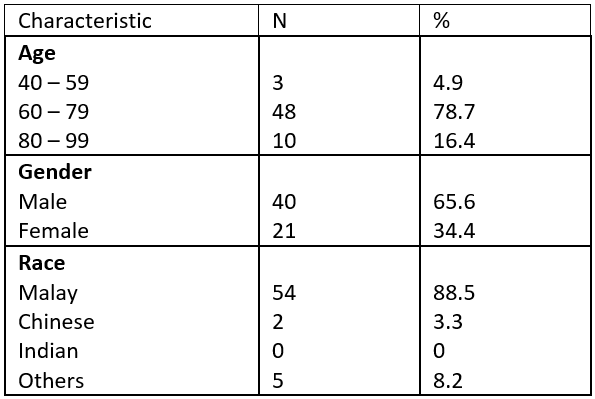
Results: Out of 74 patients with PXS who underwent cataract surgery, 61 (83.7%) cases were qualified. Most patients 38(62.3%) achieved a good visual outcome. In the simple logistic regression, vitreous loss (OR = 4.243, P = 0.024) and type of surgery in which Extracapsular cataract extraction (ECCE) (OR = 0.215, P = 0.017) were significantly associated with visual outcomes postoperatively.
Conclusion: Cataract surgeries in patients with PXS achieved good visual outcomes. Vitreous loss and the choice of operative technique, specifically ECCE, were the significant factors influencing postoperative visual outcomes in cataract surgery with PXS. Despite the higher complication rates associated with PXS, timely identification, careful selection of surgical approach, and adoption of appropriate precautions can reduce these risks and achieve a good visual outcome.
Article Details

This work is licensed under a Creative Commons Attribution-NonCommercial-NoDerivatives 4.0 International License.
References
Thanigasalam T, Reddy S, Zaki R. Factors associated with complications and postoperative visual outcomes of cataract surgery; A study of 1,632 cases. JOVR. 2015;10(4):375.
Thanigasalam Thevi, Abas A. Intraoperative and postoperative complications of cataract surgery in eyes with pseudoexfoliation – An 8-year analysis. Oman J Ophthalmol. 2019;12(3):160-165.
Govetto A, Lorente R, de Parga PV, Rojas L, Moreno C, Lagoa F, et al. Frequency of pseudoexfoliation among patients scheduled for cataract surgery. J Cataract Refract Surg. 2015;41(6):1224-31.
Vijaya L, Asokan R, Panday M, Choudhari NS, Ve Ramesh S, Velumuri L, et al. Six-Year Incidence and Baseline Risk Factors for Pseudoexfoliation in a South Indian Population. Ophthalmol. 2015;122(6):1158-64.
Kanthan GL, Mitchell P, Burlutsky G, Rochtchina E, Jie Jin Wang. Pseudoexfoliation Syndrome and the Long-Term Incidence of Cataract and Cataract Surgery: The Blue Mountains Eye Study. Am J Ophthalmol. 2013;155(1):83-88.e1.
Lee J, Wong EP, Ho SL. Pseudoexfoliation syndrome at a Singapore eye clinic. Clin Ophthalmol. 2015;1619.
Sekeroglu MA, Bozkurt B, Irkec M, Ustunel S, Orhan M, Saracbasi O. Systemic associations and prevalence of exfoliation syndrome in patients scheduled for cataract surgery. Eur J Ophthalmol. 2008;18(4):551-5.
Avramides S, Traianidis P, Sakkias G. Cataract surgery and lens implantation in eyes with exfoliation syndrome. J Cataract Refract Surg. 1997;23(4):583-7.
Zare M, Javadi MA, Einollahi B, Baradaran-Rafii AR, Feizi S, Kiavash V. Risk Factors for Posterior Capsule Rupture and Vitreous Loss during Phacoemulsification. JOVR. 2009;4(4):208-12.
Chen M, LaMattina K, Patrianakos T, Dwarakanathan S. Complication rate of posterior capsule rupture with vitreous loss during phacoemulsification at a Hawaiian cataract surgical center: a clinical audit. Clin Ophthalmol. 2014;8:375-5.
Nagashima RJ. Decreased incidence of capsule complications and vitreous loss during phacoemulsification in eyes with pseudoexfoliation syndrome. J Cataract Refract Surg. 2004;30(1):127-31.
Vazquez-Ferreiro P, Carrera-Hueso FJ, Jornet JEP, Fikri-Benbrahim N, Diaz-Rey M, Sanjuan-Cerveró R. Intraoperative complications of phacoemulsification in pseudoexfoliation: Metaanalysis. J Cataract Refract Surg. 2016;42(11):1666-75.
Bayraktar Ş, Altan T, Küçüksümer Y, Yιlmaz ÖF. Capsular tension ring implantation after capsulorhexis in phacoemulsification of cataracts associated with pseudoexfoliation syndrome. J Cataract Refract Surg. 2001;27(10):1620-8.
Yong GY, Mohamed-Noor J, Salowi MA, Adnan TH, Zahari M. Risk factors affecting cataract surgery outcome: The Malaysian cataract surgery registry. Grzybowski A, editor. PLoS One. 2022;17(9):e0274939.
Thevi T, Maizura Z, Abas AL. The Melaka Hospital cataract complications study analysis of 12,992 eyes. Indian J Ophthalmol. 2017;65(1):24-9.
Thevi T, Godinho MA. Predictive factors of visual outcome of Malaysian cataract patients: a retrospective study. Int J Ophthalmol. 2017;10(9):1452-1459.
Sufi AR, Singh T, Mufti AA, Rather MH. Outcome of Phacoemulsification in patients with and without Pseudoexfoliation syndrome in Kashmir. BMC Ophthalmol. 2012;12(1).
Drolsum L, Haaskjold E, Sandvig K. Phacoemulsification in eyes with pseudoexfoliation. J Cataract Refract Surg. 1998;24(6):787-92.
Al-Mujaini A, Wali U. Visual outcome following extracapsular cataract extraction in mature cataracts with pseudoexfoliation syndrome: A retrospective study. Oman J Ophthalmol. 2013;6(1):23-6.
Aaronson A, Antti Viljanen, Piotr Kanclerz, Grzybowski A, Raimo Tuuminen. Cataract complications study: an analysis of adverse effects among 14,520 eyes in relation to surgical experience. Ann Transl Med. 2020;8(22):1541-1.
