
Factors Affecting the Success of External Dacryocystorhinostomy for the Treatment of Nasolacrimal Duct Obstruction.
Article Sidebar
Main Article Content
Abstract
Purpose: To investigate the factors influencing the success of external dacryocystorhinostomy (DCR) surgery in patients with nasolacrimal duct obstruction.
Study Design: Retrospective cohort study.
Methods: Data were retrospectively collected from patients who underwent external dacryocystorhinostomy at Maharaj Nakhon Si Thammarat Hospital and Fort Wachirawut Hospital between January 1, 2021, and December 31, 2023. Patients were followed up for at least 6 months postoperatively. Surgical failure was defined as cases where lacrimal irrigation could not pass into the throat.
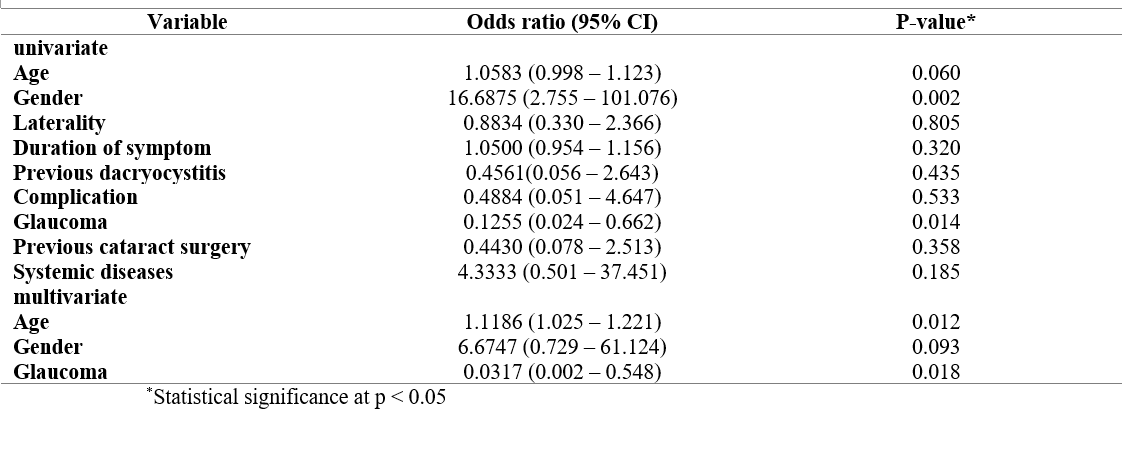
Results: A total of 112 patients were included in the study, with an average age of 70.10 years in the successful group and 60.50 years in the unsuccessful group. The success rate of the surgery was 92.86%. Factors significantly associated with surgical success included patient age, which had a positive correlation with surgical success (OR 1.1186; 95%CI: 1.025-1.221, P = 0.012), while the presence of glaucoma was negatively associated with successful outcomes (OR 0.0317; 95%CI: 0.002 - 0.548, P = 0.018).
Conclusions: Factors associated with the success of external DCR surgery for nasolacrimal duct obstruction include patient age and the presence of glaucoma. Careful patient selection and well-planned treatment strategies are crucial for increasing the likelihood of surgical success.
Article Details

This work is licensed under a Creative Commons Attribution-NonCommercial-NoDerivatives 4.0 International License.
References
Price KM, Richard MJ. The Tearing Patient: Diagnosis and Management. Ophthalmic Pearls. 2009;33-5.
Kashkouli MB, Pakdel F, Kiavash V. Assessment and management of proximal and incomplete symptomatic obstruction of the lacrimal drainage system. Middle East Afr J Ophthalmol. 2012;19(1):60-9.
Helmi KW, Abdulhamid AS, Alomari MS, Alsudais AS, Alqurashi BS, Alsharif A, et al. Transcanalicular laser-assisted and external dacryocystorhinostomy anatomical and functional success in primary acquired nasolacrimal duct obstruction: systematic review and meta-analysis. BMC Ophthalmol. 2025;25:5.
Spencer JH, Michael TY, Cat NB, Spencer JH. Secondary acquired nasolacrimal duct obstruction eyewiki2023/04/16. Available from: https://eyewiki.aao.org/Secondary_Acquired_Nasolacrimal_Duct_Obstruction.
Kanokrat C. Factors Influencing Recurrence of Obstruction Following Surgery for Nasolacrimal Duct Obstruction. Thai J Ophthal. 2019;33(1):19-26.
Rosana P, Uracha A. Outcomes of Surgery for Nasolacrimal Duct Obstruction at Buriram Hospital. MJSBH. 2007;22(1):161-8.
Lefebvre DR, Dhar S, Lee I, Allard F, Freitag SK. External dacryocystorhinostomy outcomes in patients with a history of dacryocystitis. Digit J Ophthal. 2015;21:40-8.
Lee MJ, Khwarg SI, Kim IH, Choi JH, Choi YJ, Kim N, Choung HK. Surgical outcomes of external dacryocystorhinostomy and risk factors for functional failure: a 10-year experience. Eye. 2017;31:691-7.
Erdol H, Akyol N, Imamoglu HI, Sozen E. Long-term follow-up of external dacryocystorhinostomy and the factors affecting its success. Orbit. 2005;24(2):99-102.
Saiju R, Morse LJ, Weinberg D, Shrestha MK, Ruit S. Prospective randomised comparison of external dacryocystorhinostomy with and without silicone intubation. Br J Ophthalmol. 2009;93(9):1220-2.
Huang J, Malek J, Chin D, Snidvongs K, Wilcsek G, Tumuluri K, et al. Systematic review and meta-analysis on outcomes for endoscopic versus external dacryocystorhinostomy. Orbit. 2014;33(2):81-90.
Savino G, Battendieri R, Traina S, Corbo G, D’Amico G, Gari M, et al. External vs. endonasal dacryocystorhinostomy: has the current view changed? Acta Otorhinolaryngol Ital. 2014;34(1):29-35.
Aboauf H, Alawaz RA. Success rate of external dacryocystorhinostomy with and without stent. Cureus. 2024;16(1):e53363.
Eris E, Vural E, Ozarslan Z, Bekmez S, Nurcin H, Celebi ARC, Perente I. Comparison of endoscopic and external dacryocystorhinostomy in terms of operation success and patient satisfaction: a prospective study. Ann Med Res. 2021;28(4):816-20.
Rajabi MT, Shahraki K, Nozare A, Moravej Z, Tavakolizadeh S, Salim RE, et al. External versus endoscopic dacryocystorhinostomy for primary acquired nasolacrimal duct obstruction. Middle East Afr J Ophthalmol. 2022;29(1):1-6.
Panda BB, Nayak B, Mohapatra S, Thakur S, Vishwanath S. Success and complications of endoscopic laser dacryocystorhinostomy vs. external dacryocystorhinostomy: a systematic review and meta-analysis. Indian J Ophthalmol. 2023;71(10):3290-8.
Sobel RK, Aakalu VK, Wladis EJ, Bilyk JR, Yen MT, Mawn LA. A comparison of endonasal dacryocystorhinostomy and external dacryocystorhinostomy: a report by the American Academy of Ophthalmology. Ophthalmol. 2019;126(11):1580-5.
Vinciguerra A, Nonis A, Resti AG, Bussi M, Trimarchi M. Best treatments available for distal acquired lacrimal obstruction: a systematic review and meta-analysis. Clin Otolaryngol. 2020;45(4):545-7.
Dave TV, Mohammed FA, Ali MJ, Naik MN. Etiologic analysis of 100 anatomically failed dacryocystorhinostomies. Clin Ophthalmol. 2016;10:1419-22.
Vinciguerra A, Resti AG, Rampi A, Bussi M, Bandello F, Trimarchi M. Endoscopic and external dacryocystorhinostomy: a therapeutic proposal for distal acquired lacrimal obstructions. Eur J Ophthalmol. 2023;33(3):1287-93.
Vinciguerra A, Nonis A, Resti AG, Bussi M, Trimarchi M. Impact of post-surgical therapies on endoscopic and external dacryocystorhinostomy: systematic review and meta-analysis. Am J Rhinol Allergy. 2020;34(6):846-56.
Su PY. Comparison of endoscopic and external dacryocystorhinostomy for treatment of primary acquired nasolacrimal duct obstruction. Taiwan J Ophthalmol. 2018;8(1):19-23.
Nailwal S, Ram A, Mehrotra N, Sharma R, Agarwal A, Sharma BD, Chopra K, Abassi S. Comparison of external and endonasal dacryocystorhinostomy in acquired nasolacrimal duct obstruction. J Evol Med Dent Sci. 2015;4(14):2283-93.
Dasgupta S, Vats V, Varma A. Comparison of external and endoscopic endonasal dacryocystorhinostomy: a hospital-based retrospective study. Int J Res Med Sci. 2016;4(7):2822-9.
Salih M, Abd El-Rahman Y, Abd El-badie M, Ismael A. A comparative study in dacryocystorhinostomy with versus without silicon tube intubation in nasolacrimal duct obstruction in adults. Egypt J Clin Ophthalmol. 2018;1(2):55-64.
Ali MJ. Etiology of failed dacryocystorhinostomy. In: Atlas of Lacrimal Drainage Disorders. Cham: Springer; 2023;1017-27.
Ali MJ, Psaltis AJ, Murphy J, Wormald PJ. Outcomes in primary powered endoscopic dacryocystorhinostomy: comparison between experienced versus less experienced surgeons. Am J Rhinol Allergy. 2014;28(6):514-6.
Ali MJ, Mishra DK, Baig F, Naik MN. Histopathology, immunohistochemistry, and electron microscopic features of a dacryocystorhinostomy ostium cicatrix. Ophthalmic Plast Reconstr Surg. 2016;32(5):333-6.
Lin GC, Brook CD, Hatton MP, Metson R. Causes of dacryocystorhinostomy failure: external versus endoscopic approach. Am J Rhinol Allergy. 2017;31(3):181-5.
Nomura K, Arakawa K, Sugawara M, Katori Y. Factors influencing endoscopic dacryocystorhinostomy outcome. Auris Nasus Larynx. 2017;44(4):432-8.
Seider N, Miller B, Beiran I. Topical glaucoma therapy as a risk factor for nasolacrimal duct obstruction. Am J Ophthalmol. 2008;145(1):120-3.
Kashkouli MB, Pakdel F, Hashemi M, Ghaempanah MJ, Rezaee R, Kaghaz-Kanani R, Ahadian A. Comparing anatomical pattern of topical anti-glaucoma medications associated lacrimal obstruction with a control group. Orbit. 2010;29(2):65-9.
Quinn MP, Kratky V, Whitehead M, Gill SS, McIsaac MA, Campbell RJ. Association of topical glaucoma medications with lacrimal drainage obstruction and eyelid malposition. Eye. 2023;37:2233-9.
McNab AA. Lacrimal canalicular obstruction associated with topical ocular medication. Aust N Z J Ophthalmol. 1998;26(3):219-23.
Kashkouli MB, Rezaee R, Nilforoushan N, Salimi S, Foroutan A, Naseripour M. Topical antiglaucoma medications and lacrimal drainage system obstruction. Ophthalmic Plast Reconstr Surg. 2008;24(3):172-5.
Ohtomo K, Ueta T, Toyama T, Nagahara M. Predisposing factors for primary acquired nasolacrimal duct obstruction. Graefes Arch Clin Exp Ophthalmol. 2013;251(7):1835-9.
Ortiz-Basso T, Galmarini A, Vigo RL, Gonzalez-Barlatay JM, Premoli EJ. The relationship between topical anti-glaucoma medications and the development of lacrimal drainage system obstruction. Arq Bras Oftalmol. 2018;81(6):490-3.
Kashkouli MB, Parvaresh M, Modarreszadeh M, Hashemi M, Beigi B. Factors affecting the success of external dacryocystorhinostomy. Orbit. 2003;22(4):247-55.
Rabina G, Golan S, Neudorfer M, Leibovitch I. External dacryocystorhinostomy: Characteristics and surgical outcomes in patients with and without previous dacryocystitis. J Ophthalmol. 2013;2013:287524.
Badhu B, Dulal S, Kumar S, Thakur SKD, Sood A, Das H. Epidemiology of chronic dacryocystitis and success rate of external dacryocystorhinostomy in Nepal. Orbit. 2005;24(2):79-82.
Seider N, Kaplan N, Gilboa M, Gdal-On M, Miller B, Beiran I. Effect of timing of external dacryocystorhinostomy on surgical outcome. Ophthalmic Plast Reconstr Surg. 2007;23(3):183-6.
