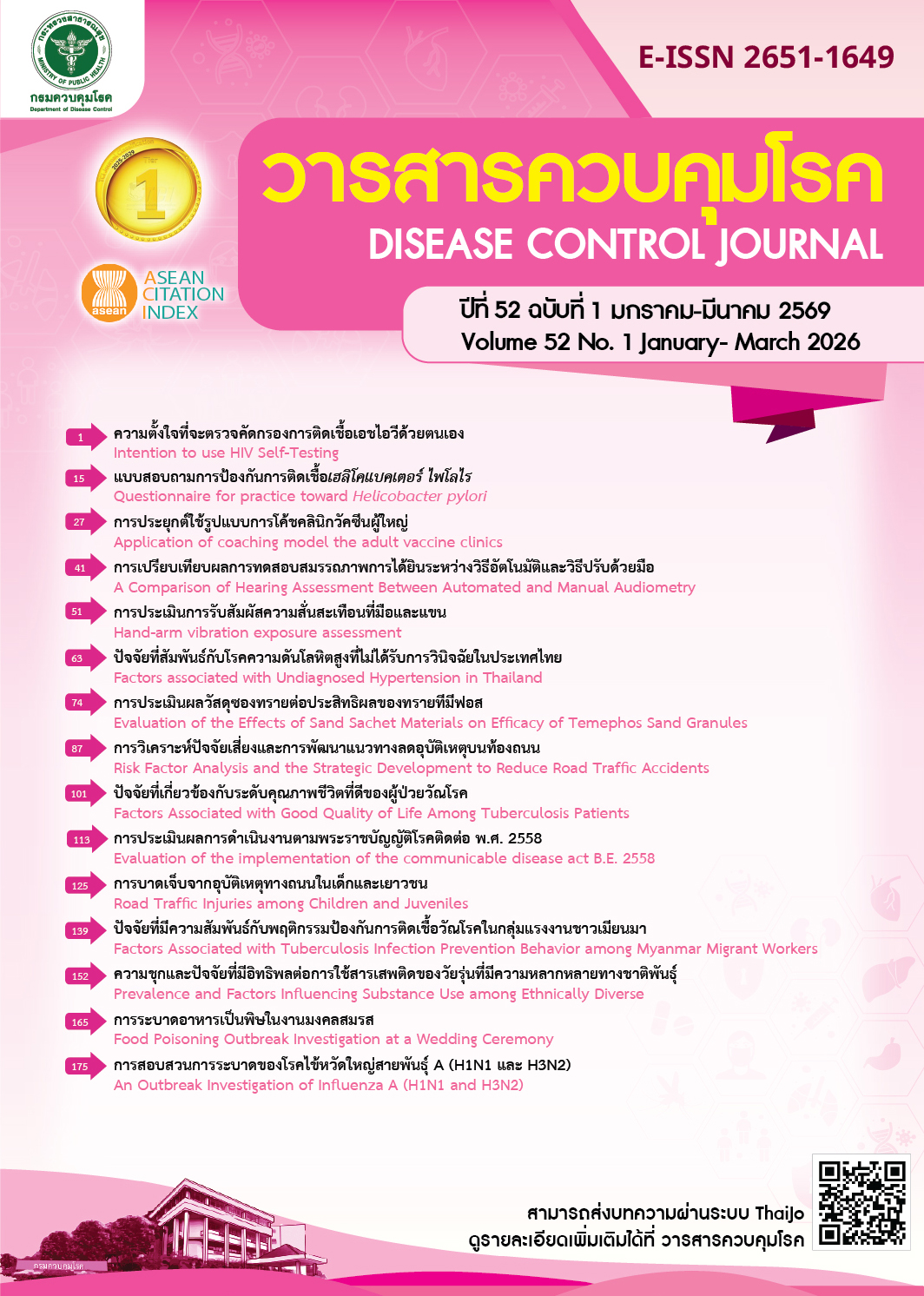
ความชุกและปัจจัยที่มีอิทธิพลต่อการใช้สารเสพติดของวัยรุ่นที่มีความหลากหลาย ทางชาติพันธุ์ในพื้นที่ภาคเหนือตอนบนประเทศไทย
DOI:
https://doi.org/10.14456/dcj.2026.13คำสำคัญ:
การใช้สารเสพติด, วัยรุ่น, ชาติพันธุ์, แบบจำลองเชิงนิเวศวิทยาบทคัดย่อ
ด้วยสภาพสังคมที่มีความหลากหลายด้านวัฒนธรรมและพื้นที่อยู่อาศัยสร้างสถานการณ์เสี่ยงต่อการใช้สารเสพติดในกลุ่มวัยรุ่นได้ง่ายขึ้น การศึกษาเชิงวิเคราะห์แบบภาคตัดขวางมีวัตถุประสงค์เพื่อสำรวจความชุกและปัจจัยที่มีอิทธิพลต่อการใช้สารเสพติด ผู้วิจัยดำเนินการคัดเลือกกลุ่มตัวอย่างเป็นวัยรุ่นที่มีอายุ 15-17 ปี จำนวน 238 คน ด้วยวิธีการสุ่มตัวอย่างอย่างง่าย และรวบรวมข้อมูลโดยใช้แบบสอบถาม ตั้งแต่ ธันวาคม 2567 ถึง กุมภาพันธ์ 2568 วิเคราะห์ข้อมูลโดยใช้สถิติเชิงพรรณนา และการวิเคราะห์ถดถอยโลจิสติก ผลการศึกษาพบว่า ความชุกของการดื่มแอลกอฮอล์มากที่สุด ร้อยละ 56.3 การใช้พืชกระท่อม ร้อยละ 18.5 การใช้ผลิตภัณฑ์ยาสูบ ร้อยละ 13.9 และการใช้กัญชา ร้อยละ 7.1 ตามลำดับ ปัจจัยที่มีผลต่อการใช้ผลิตภัณฑ์ยาสูบ ได้แก่ เพศชาย (AOR=5.8; 95% CI: 2.39-14.39) ดื่มแอลกอฮอล์ (AOR=33.1; 95% CI: 3.06-192.84) และใช้พืชกระท่อม (AOR=3.1; 95% CI: 1.40-8.58) ปัจจัยที่มีผลต่อการดื่มแอลกอฮอล์ ได้แก่ ภาวะซึมเศร้า (AOR=2.3; 95% CI: 1.25-4.34) ปัจจัยระดับระหว่างบุคคล (AOR=0.4; 95% CI: 0.23-0.89) สูบบุหรี่ (AOR=22.2; 95% CI: 2.80-176.16) และใช้พืชกระท่อม (AOR=17.2; 95% CI: 3.83-77.31) ปัจจัยที่มีผลต่อการใช้กัญชา ได้แก่ เพศชาย (AOR=46.6; 95% CI: 6.14-403.02) และใช้พืชกระท่อม (AOR=65.6; 95% CI: 9.54-452.43) และปัจจัยที่มีผลต่อการใช้พืชกระท่อม ได้แก่ สูบบุหรี่ (AOR=2.8; 95% CI: 1.09-7.50) ดื่มแอลกอฮอล์ (AOR=14.4; 95% CI: 3.19-65.80) และใช้กัญชา (AOR=25.5; 95% CI: 4.49-145.01) ผลการศึกษาพบแนวโน้มความชุกของการใช้สารเสพติดที่เพิ่มสูงขึ้น โดยเฉพาะการใช้สารเสพติดหลายชนิดร่วมกัน ควรกำหนดนโยบายและมาตรการควบคุมป้องกันการดื่มแอลกอฮอล์และการใช้พืชกระท่อมในกลุ่มวัยรุ่นอย่างจริงจังและต่อเนื่อง
Downloads
เอกสารอ้างอิง
Frobel W, Grafe N, Meigen C, Vogel M, Hiemisch A, Kiess W, et al. Substance use in childhood and adolescence and its associations with quality of life and behavioral strengths and difficulties. BMC Public Health. 2022;22:275. doi: 10.1186/s12889-022-12586-2
Centers for Disease Control and Prevention. Teenagers (15-17 years of age). [Internet] [cited 2024 Jul 30]. Available from: https://www.cdc.gov/ncbddd/childdevelopment/positiveparenting/adolescence2.html
Ismail R, Manaf MRA, Hassan MR, Nawi AM, Ibrahim N, Lyndon N. et al. Prevalence of drug and substance use among Malaysian youth: a nationwide survey. Int. J. Environ. Res. Public Health. 2022;19(8):4684. doi: 10.3390/ijerph19084684
Mutiso VN, Ndetei DM, Muia NE, Musyimi C, Osborn TL, Kasike R, et al. Prevalence and perception of substance abuse and associated economic indicators and mental health disorders in a large cohort of Kenyan students: towards integrated public health approach and clinical management. BMC Psychiatry. 2022;22(1):191. doi: 10.1186/s12888-022-03817-2
Olashore, AA, Paruk S, Maphorisa T, Mosupiemang B. Pattern of substance use and substance use disorder in adolescent learners at public secondary schools in Gaborone, Botswana. PLoS One. 2022;17(9):e0268961. doi: 10.1371/journal.pone.0268961
World Health Organization. WHO global report on trends in prevalence of tobacco use 2000-2025. 3rd ed. Geneva; 2019.
Pramaunururut P, Anuntakulnathee P, Wangroongsarb P, Vongchansathapat T, Romsaithong K, Rangwanich J, et al. Alcohol consumption and its associated factors among adolescents in a rural community in central Thailand: a mixed-methods study. Scientific Reports. 2022;12:19605. doi: 10.1038/s41598-022-24243-0
Dechsiri B, Pummakanchana Robert O. Drug Trafficking Estimation based on Geo-statistics. Defence. Technology Academic Journal. 2019;1(3):52-61. (in Thai)
Apidechkul T, Chomchoei C, Wongnuch P, Tamornpark R, Upala P, Yeemard F, et al. Associations of childhood experiences and methamphetamine use among Akha and Lahu hill tribe youths in northern Thailand: A cross-sectional study. PLoS ONE. 2020;15(6):e0234923. doi: 10.1371/journal.pone.0234923
Banditrat C, Bodeerat C, Taomitr S. Management of ethnic groups cultural capital based on new normal in Chiang Rai province. Journal of Roi Kaensarn Academi. 2023;8(11):542-59. (in Thai)
Nethibut Y, Luangkaew P. Effects of amending drug laws in the case of cancellation of cannabis plants from the list of category 5 drugs. PaññaPanithan Journal 2023;8(2):239-52. (in Thai)
Lo TW, Yeung JWK, Tam CHL. Substance abuse and public health: a multilevel perspective and multiple responses. Int J Environ Res Public Health. 2020;17(7):2610. doi: 10.3390/ijerph17072610
Felner JK, Haley SJ, Jun HJ, Wisdom JP, Katuska L, Corliss HL. Sexual orientation and gender identity disparities in co-occurring depressive symptoms and probable substance use disorders in a national cohort of young adults. Addictive Behaviors. 2021;117:106817. doi: 10.1016/j.addbeh.2021.106817.
Trucco EM. A review of psychosocial factors linked to adolescent substance use. Pharmacol Biochem Behav. 2020;196:172969. doi: 10.1016/j.pbb.2020.172969.
Fagan AA, Wright EM, Pinchevsky GM. A multi-level analysis of the impact of neighborhood structural and social factors on adolescent substance use. Drug Alcohol Depend. 2015;153: 180-6. doi: 10.1016/j.drugalcdep.2015. 05.022.
Winer JM, Yule AM, Hadland SE, Bagley SM. Addressing adolescent substance use with a public health prevention framework: the case for harm reduction. Ann Med. 2020;54(1):2123-36. doi: 10.1080/07853890.2022.2104922
Daniel WW. Biostatistics: A Foundation for Analysis in the Health Sciences. 7th ed. New York: John Wiley & Sons; 1999.
Bloom BS, Hastings TJ, Madaus GF. Hand Book on Formative and Summative Evaluation of Student Learning. New York: McGraw-Hill Book Company; 1971.
Likert R. The human organization: its management and values. McGraw-Hill; 1967.
Best J. Research in Education. New Jersey: Prentice Hall; 1977.
Assanangkornchai S, Kittirattanapaiboon P, Sutheeadisai W. The ASSIST V3.1 Screening Tool. Bangkok: Community Based Addiction Treatment, ThaiHealth Promotion Foundation; 2011. (in Thai)
Nantasenee P, Thananithisak C. The association between depression and blood pressure in essential hypertensive patients, Jaokunpiboon Pranomtuan Hospital. Phranakhon Rajabhat Res J (Sci Technol). 2019 [cited 2024 Jan 21];14(1):91-104. https://li01.tci-thaijo.org/index.php/PRRJ_Scitech/article/view/110368 (in Thai)
Panyawong W, Pavasuthipaisit C, Santitadakul R. Validation of the Thai version of the Patient Health Questionnaire for Adolescents (PHQ-A) in school setting. J Ment Health Thai. 2022 [cited 2024 Jan 21];30(1):38-48. Available from: https://he01.tci-thaijo.org/index.php/jmht/article/view/250527 (in Thai)
Rothenberg WA, Lansford JE, Chang L, Deckard KD, Giunta LD, Dodge KA, et al. Examining the internalizing pathway to substance use frequency in 10 cultural groups. Addict Behav. 2020;102:106214. doi: 10.1016/j.addbeh.2019.106214
Marklein E, Negriff S, Dorn LD. Pubertal timing, friend smoking, and substance use in adolescent girls. Prev Sci. 2009;10(2):141-50. doi: 10.1007/s11121-008-0120-y
Hoffmann JP. Family Structure, Unstructured Socializing, and Heavy Substance Use among Adolescents. Int J Environ Res Public Health. 2022;19(14):8818. doi: 10.3390/ijerph19148818
Wambeam RA, Canen EL, Linkenbach J, Otto J. Youth misperceptions of peer substance use norms: a hidden risk factor in state and community prevention. Prev Sci. 2014;15(1):75-84. doi:10.1007/s11121-013-0384-8
Halladay J, Woock R, El-Khechen H, Munn C, MacKillop J, Amlung M, et al. Patterns of substance use among adolescents: A systematic review. Drug Alcohol Depend. 2020;216: 108222. doi: 10.1016/j.drugalcdep.2020.108222
Cho SB, Llaneza DC, Adkins AE, Cooke M, Kendler KS, Clark SL, et al. Patterns of substance use across the first year of college and associated risk factors. Front Psychiatry. 2015;6:152. doi: 10.3389/fpsyt.2015.00152
Doherty EA, Moyers SA, Crockett-Barbera EK, Appleseth H, Leffingwell Q, Richards V, et al. Daily patterns of single and poly-substance use among adolescent and young adult females: A day-level latent class analysis. Addict Behav. 2025;169:108394. doi: 10.1016/j.addbeh.2025.108394
ดาวน์โหลด
เผยแพร่แล้ว
รูปแบบการอ้างอิง
ฉบับ
ประเภทบทความ
สัญญาอนุญาต
ลิขสิทธิ์ (c) 2026 วารสารควบคุมโรค

อนุญาตภายใต้เงื่อนไข Creative Commons Attribution-NonCommercial-NoDerivatives 4.0 International License.
บทความที่ลงพิมพ์ในวารสารควบคุมโรค ถือว่าเป็นผลงานทางวิชาการหรือการวิจัย และวิเคราะห์ตลอดจนเป็นความเห็นส่วนตัวของผู้เขียน ไม่ใช่ความเห็นของกรมควบคุมโรค ประเทศไทย หรือกองบรรณาธิการแต่ประการใด ผู้เขียนจำต้องรับผิดชอบต่อบทความของตน