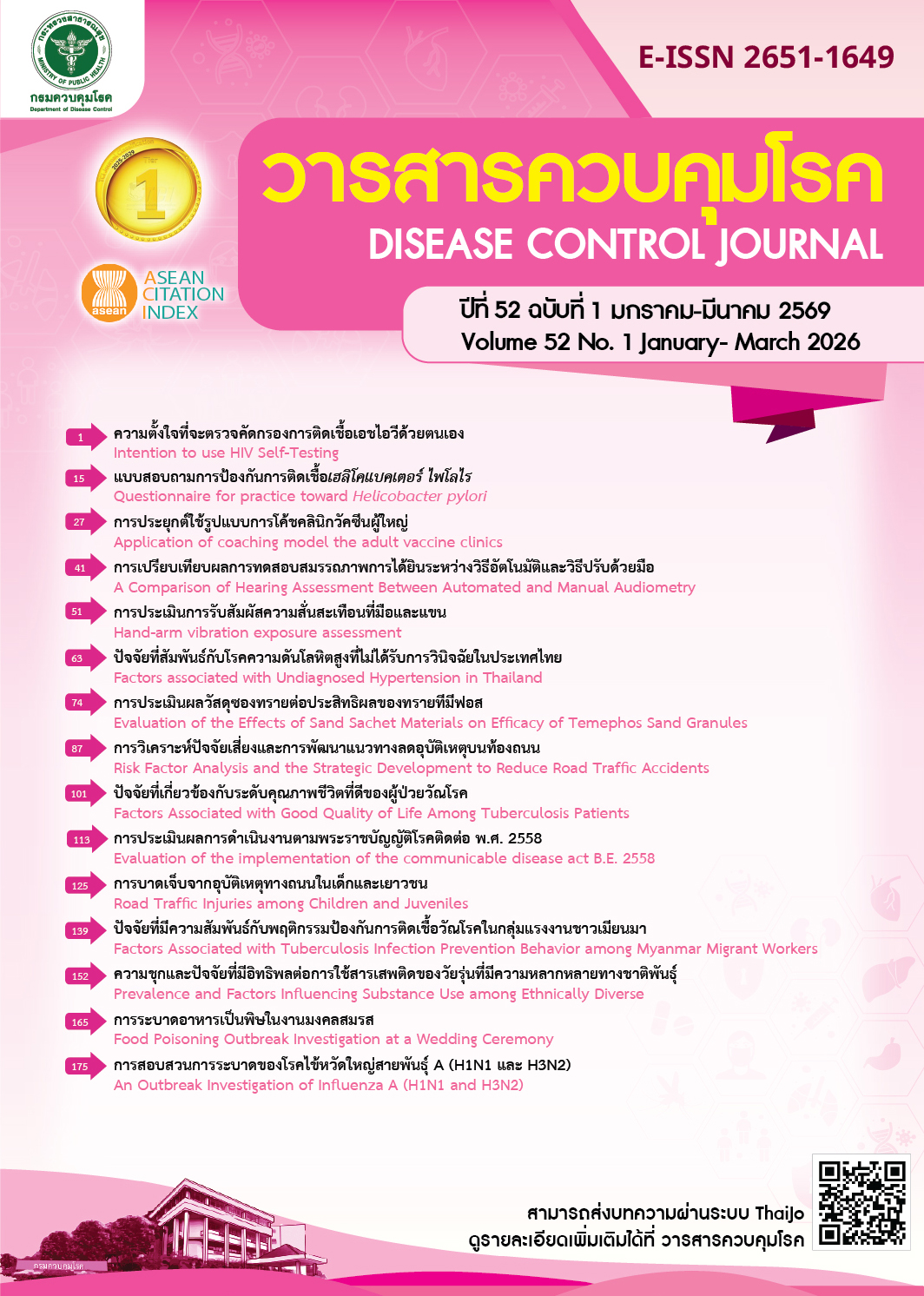
การประเมินผลการดำเนินงานตามพระราชบัญญัติโรคติดต่อ พ.ศ. 2558: บทเรียนสำคัญและทิศทางพัฒนาระบบควบคุมโรคของประเทศไทย
DOI:
https://doi.org/10.14456/dcj.2026.10คำสำคัญ:
พระราชบัญญัติโรคติดต่อ พ.ศ. 2558, แผนปฏิบัติการเฝ้าระวัง ป้องกันและควบคุมโรคติดต่อ หรือโรคระบาด พ.ศ. 2566-2570, การประเมินผลสัมฤทธิ์, ระบบควบคุมโรค, นโยบายสาธารณสุขบทคัดย่อ
การวิจัยแบบผสมผสานครั้งนี้มีวัตถุประสงค์เพื่อประเมินผลการดำเนินงานตามพระราชบัญญัติโรคติดต่อ พ.ศ. 2558 และแผนปฏิบัติการเฝ้าระวัง ป้องกัน และควบคุมโรคติดต่อหรือโรคระบาด พ.ศ. 2566-2570 (ระยะครึ่งแผน) เพื่อถอดบทเรียนและจัดทำข้อเสนอเชิงนโยบายสำหรับพัฒนาระบบควบคุมโรคของประเทศไทย การเก็บข้อมูลเชิงปริมาณได้จากตัวชี้วัดผลสัมฤทธิ์ ขณะที่ข้อมูลเชิงคุณภาพได้จากการวิเคราะห์เอกสารและการสัมภาษณ์เชิงลึกผู้มีส่วนเกี่ยวข้องจำนวน 66 ราย ใน 6 จังหวัด ได้แก่ เชียงราย กาญจนบุรี ชลบุรี กรุงเทพมหานคร สงขลา และอุบลราชธานี ผลการศึกษาเชิงปริมาณพบว่า หลายตัวชี้วัดมีความก้าวหน้าตามเป้าหมาย เช่น การพัฒนาอนุบัญญัติ ระบบเฝ้าระวังโรค และการยกระดับมาตรฐานศูนย์ปฏิบัติการภาวะฉุกเฉิน (Emergency Operations Center: EOC) ส่วนผลการศึกษาเชิงคุณภาพพบว่า ประเทศไทยมีโครงสร้างกลไกควบคุมโรคที่เข้มแข็ง ได้แก่ คณะกรรมการโรคติดต่อจังหวัด หน่วยปฏิบัติการควบคุมโรคติดต่อ และทีมสอบสวนโรคเคลื่อนที่เร็ว (Surveillance and Rapid Response Team: SRRT) รวมถึงเครือข่ายภาคประชาชนที่สามารถตอบสนองต่อโรคระบาดได้อย่างรวดเร็ว อย่างไรก็ตาม ยังพบข้อจำกัดสำคัญ ได้แก่ ความซับซ้อนของโครงสร้าง ความไม่มั่นใจของเจ้าพนักงานควบคุมโรคติดต่อในการใช้อำนาจตามกฎหมาย และข้อจำกัดด้านทรัพยากรและระบบข้อมูล จากผลการศึกษาจึงเสนอแนวทางพัฒนาระบบควบคุมโรคของประเทศไทย 3 ประการ ได้แก่ (1) Decentralize กระจายอำนาจการตัดสินใจแก่ระดับพื้นที่และปรับปรุงกลไกกฎหมายให้ทันสมัย (2) Digitalize พัฒนาระบบข้อมูลและเทคโนโลยีดิจิทัลเพื่อเสริมประสิทธิภาพการเฝ้าระวังและตอบโต้โรค และ (3) Collaborate เสริมสร้างความร่วมมือระหว่างภาครัฐ ท้องถิ่น เอกชน และประชาชน ควบคู่กับการสื่อสารสาธารณะหลายภาษา แนวทางดังกล่าวจะช่วยเสริมความยืดหยุ่นและความยั่งยืนของระบบควบคุมโรคของประเทศในอนาคต
Downloads
เอกสารอ้างอิง
Royal Thai Government Gazette. Communicable Disease Act B.E. 2558 [Internet]. Bangkok. Office of the Prime Minister; 2015 [cited 2025 May 25]. Available from: https://ddc.moph.go.th/law.php?law=1 (in Thai)
Department of Disease Control, Ministry of Public Health. Action Plan for Surveillance, Prevention, and Control of Communicable Diseases B.E. 2566-2570. Nonthaburi: Secretariat Office of the National Communicable Disease Committee, Department of Disease Control, Ministry of Public Health; 2023 (in Thai)
Banpoun V, Phisarnrattanakhun P, Sapoapon C. The Factor on Determinant of Health and Health Behaviors Affected Families and Communities. Journal of Roi Kaensarn Academi [Internet]. 2024 [cited 2025 May 25];9(4):632-48. Available from: https://so02.tci-thaijo.org/index.php/JRKSA/article/view/268867/180009 (in Thai)
Institute for Population and Social Research, Mahidol University. Thai Health 2024: Stress, the Silent Threat of Thai Society. Bangkok: Thai Health Promotion Foundation; 2024 (in Thai)
Mongkolsomlit S, Homkom N, Ivanovitch K. A Survey of Epidemiology of Health and Needs Assessment among Aging People Living in Town Municipality. Journal of Health Science [Internet]. 2022 [cited 2025 May 25];31(2):199-210. Available from: https://thaidj.org/index.php/JHS/article/view/12001/10200 (in Thai)
World Health Organization. Strengthening health security preparedness: The International Health Regulations (2005) [Internet]. Geneva. WHO; 2022 [cited 2025 May 25]. Available from: https://www.ipu.org/resources/publications/handbooks/2022-03/strengthening-health-security-preparedness-international-health-regulations-2005
DAC Network on Development Evaluation. Evaluation Criteria: Adapted Definitions and Principles for Use [Internet]. 2019 [cited 2025 May 25]. Available from: https://one.oecd.org/document/DCD/DAC(2019)58/FINAL/en/pdf
Stufflebeam DL. The CIPP Model for Evaluation. In: Kellaghan T, Stufflebeam DL, editors. International Handbook of Educational Evaluation. Dordrecht: Springer Netherlands; 2003. p. 31-62.
Tokmak HS, Baturay MH, Fadde P. Applying the Context, Input, Process, Product Evaluation Model for evaluation, research, and redesign of an online master’s program. Int Rev Res Open Distrib Learn. 2013;14(3):273-93. doi: 10.19173/irrodl.v14i3.1485
Kusek JZ, Rist RC. Ten steps to a results-based monitoring and evaluation system: A handbook for development practitioners. Washington (DC): World Bank; 2004.
Pawson R, Greenhalgh T, Harvey G, Walshe K. Realist review-a new method of systematic review designed for complex policy interventions. J Health Serv Res Policy. 2005;10(Suppl 1):21-34. doi:10.1258/13558190543085
Hemachudha T, Laothamatas J, Rupprecht CE. Human rabies: a disease of complex neuropathogenetic mechanisms and diagnostic challenges. Lancet Neurol. 2002;1(2):101-9. doi:10.1016/S1474-4422(02)00041-8
World Health Organization. International health regulations (2005) [Internet]. 3rd ed. Geneva: World Health Organization; 2016 [cited 2025 May 25]. Available from: https://www.who.int/publications/i/item/9789241580496
World Health Organization. Strategy for malaria elimination in the Greater Mekong subregion (2015–2030) [Internet]. Geneva: World Health Organization; 2015 [cited 2025 May 25]. Available from: https://www.who.int/publications/i/item/9789290617181
Jones DS, Dicker RC, Fontaine RE, Boore AL, Omolo JO, Ashgar RJ, et al. Building global epidemiology and response capacity with field epidemiology training programs. Emerg Infect Dis. 2017;23(Suppl 1):S158-65. doi: 10.3201/eid2313.170509
ดาวน์โหลด
เผยแพร่แล้ว
รูปแบบการอ้างอิง
ฉบับ
ประเภทบทความ
สัญญาอนุญาต
ลิขสิทธิ์ (c) 2026 วารสารควบคุมโรค

อนุญาตภายใต้เงื่อนไข Creative Commons Attribution-NonCommercial-NoDerivatives 4.0 International License.
บทความที่ลงพิมพ์ในวารสารควบคุมโรค ถือว่าเป็นผลงานทางวิชาการหรือการวิจัย และวิเคราะห์ตลอดจนเป็นความเห็นส่วนตัวของผู้เขียน ไม่ใช่ความเห็นของกรมควบคุมโรค ประเทศไทย หรือกองบรรณาธิการแต่ประการใด ผู้เขียนจำต้องรับผิดชอบต่อบทความของตน