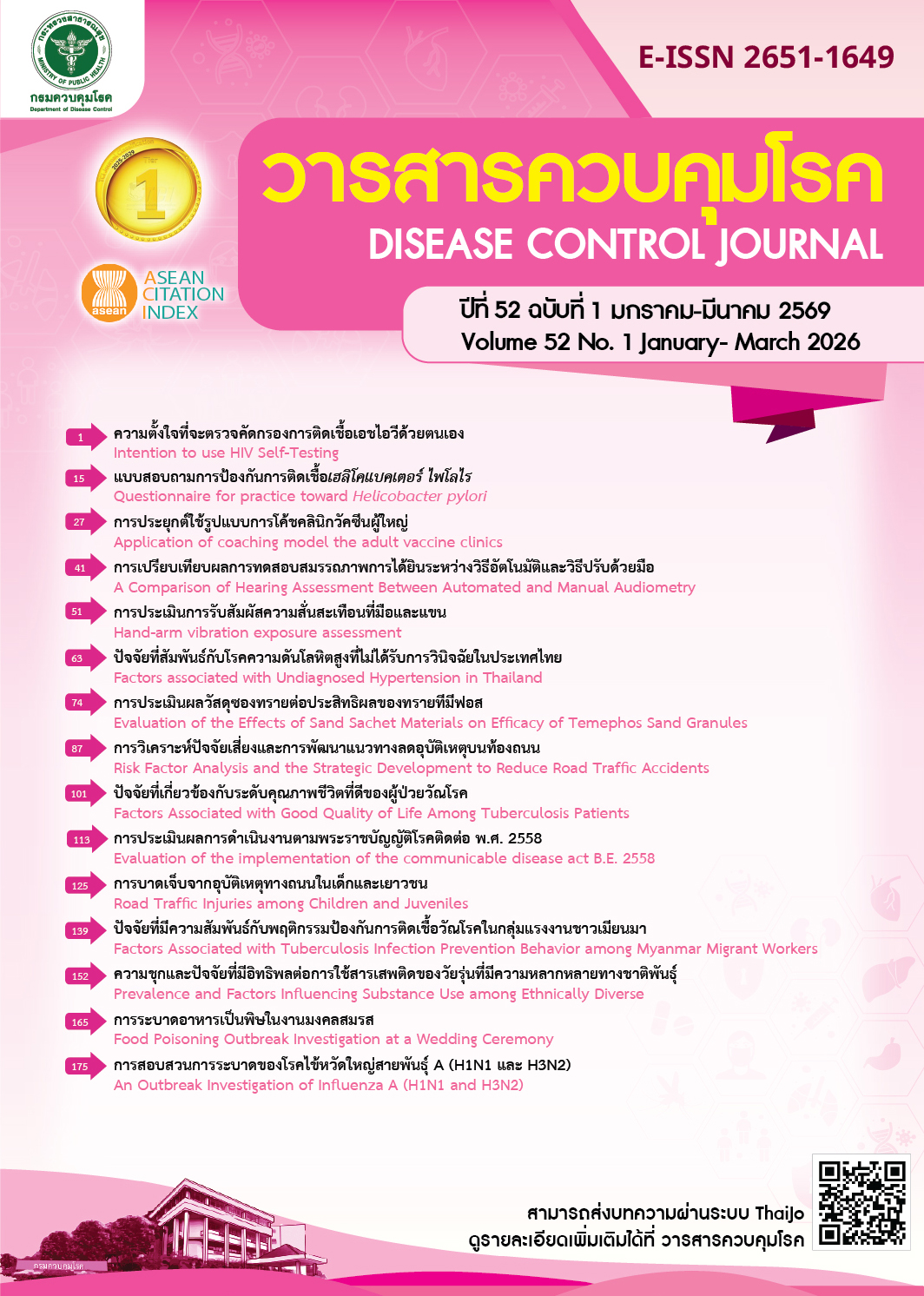
การประเมินผลวัสดุซองทรายต่อประสิทธิผลของทรายทีมีฟอส ในการกำจัดลูกน้ำยุงลายบ้าน
DOI:
https://doi.org/10.14456/dcj.2026.7คำสำคัญ:
ซองทราย, ทรายทีมีฟอส, ลูกน้ำยุงลายบ้านบทคัดย่อ
การใช้ทรายทีมีฟอสในการควบคุมและกำจัดลูกน้ำยุงลายบ้าน (Aedes aegypti) เป็นวิธีที่นิยมและมีประสิทธิผล ซึ่งทรายทีมีฟอสแบบบรรจุซองเป็นอีกหนึ่งรูปแบบผลิตภัณฑ์ของการนำไปใช้ จากข้อมูลการทดสอบประสิทธิภาพชีววิเคราะห์ของทรายทีมีฟอสประเภทซองทรายต่อลูกน้ำยุงลายบ้านระหว่างปี 2559 ถึง 2565 พบว่าไม่มีผลิตภัณฑ์ที่ผ่านเกณฑ์มาตรฐานทดสอบของกรมวิทยาศาสตร์การแพทย์ ดังนั้นงานวิจัยครั้งนี้มีวัตถุประสงค์เพื่อศึกษาคุณสมบัติและคัดเลือกวัสดุสำหรับใช้ทำซองบรรจุทรายทีมีฟอสและเปรียบเทียบอุปกรณ์ทดสอบที่ใช้ในการทดสอบประสิทธิภาพชีววิเคราะห์ของทรายทีมีฟอสต่อลูกน้ำยุงลายบ้าน โดยคัดเลือกบรรจุภัณฑ์ซองทรายที่ทำจากวัสดุชนิดต่าง ๆ และทำการทดสอบโดยมีอุปกรณ์ทดสอบที่ใช้สังเกตการตายของลูกน้ำ 2 แบบ คือ กระชังลอยลูกน้ำและกรงลูกน้ำแบบปล่อยอิสระ จากผลการทดสอบคุณสมบัติวัสดุซองได้เลือกบรรจุภัณฑ์ที่ขายในท้องตลาดมาเป็นตัวแทนจำนวน 1 ตัวอย่างและบรรจุภัณฑ์วัสดุซองชนิดอื่นอีก 1 ตัวอย่าง (ซองไนลอน) นำมาทดสอบประสิทธิภาพชีววิเคราะห์ในสภาพจำลองธรรมชาติ โดยใช้ทรายทีมีฟอส 1% w/w อัตรา 1 ppm ในรูปแบบแตกต่างกันมาทดสอบประสิทธิภาพที่ 24 ชั่วโมงหลังการใช้ทรายทีมีฟอสนาน 24 ชั่วโมงถึง 7 วัน และทุก 30 วัน จนครบระยะเวลา 180 วัน ผลการทดสอบพบว่าร้อยละการตายของลูกน้ำยุงลายบ้านเมื่อทดสอบหลังการใช้ทรายทีมีฟอสในซองทรายที่ขายในท้องตลาดนาน 24 ชั่วโมง และ 7 วัน มีค่าน้อยที่สุดเมื่อเทียบกับการใช้ทรายทีมีฟอสในรูปแบบอื่น และในระยะเวลาการใช้ทรายทีมีฟอสนาน 24 ชั่วโมงจนถึง 120 วัน พบว่า การใช้ทรายทีมีฟอสในซองไนล่อนขนาด 5 กรัม (4 ซอง) มีประสิทธิผลภาพเทียบเท่าการใช้ทรายทีมีฟอสแบบไม่บรรจุซองขนาด 20 กรัม (ชุดควบคุมเชิงบวก) รองลงมาคือ ทรายทีมีฟอสในซองไนล่อนขนาด 20 กรัม นอกจากนี้ จากการทดสอบหลังการใช้ทรายทีมีฟอสทุกรูปแบบนาน 90 วัน เป็นต้นไป พบว่า ร้อยละการตายของลูกน้ำยุงลายบ้านในกรงลูกน้ำแบบปล่อยอิสระมีค่ามากกว่าในกระชังลอยลูกน้ำอย่างมีนัยสำคัญทางสถิติ (p<0.05) ผลการศึกษานี้สามารถบอกได้ว่าไนลอนเหมาะสมที่สุดสำหรับการใช้เป็นบรรจุภัณฑ์ทรายทีมีฟอส และการใช้กรงลูกน้ำแบบปล่อยอิสระช่วยเพิ่มประสิทธิภาพการวัดผลการทดสอบประสิทธิภาพชีววิเคราะห์ในสภาพจำลองธรรมชาติได้มากขึ้น
Downloads
เอกสารอ้างอิง
Hospital for Tropical Diseases. Dengue fever patients 2019 - 2023 [Internet]. 2023 [cited 2023 Jun 3]. Available from: https://www.tropmedhospital.com/knowledge/54126.html (in Thai)
Wilkerson RC, Linton YM, Fonseca DM, Schultz TR, Price DC, Strickman DA. Making mosquito taxonomy useful: a stable classification of tribe Aedini that balances utility with current knowledge of evolutionary relationships. PLoS One. 2015;10(7):1-26. doi: 10.1371/journal.pone.0133602
Kraemer MU, Sinka ME, Duda KA, Mylne AQ, Shearer FM, Barker CM, et al. The global distribution of the arbovirus vectors Aedes aegypti and Ae. albopictus. Elife [Internet]. 2015 [cited 2023 May 10];4:1-8. Available from: https://www.ncbi.nlm.nih.gov/pubmed/26126267.
Schaffner F, Mathis A. Dengue and dengue vectors in the WHO European region: past, present, and scenarios for the future. Lancet Infect Dis. 2014;14:1271-1280. doi: 10.1016/S1473-3099(14)70834-5
Bureau of Vector Borne Diseases. Evaluation project of Thailand's dengue fever surveillance, prevention, and control program: annual report from Bureau of Vector Borne Diseases 2017. [Internet]. 2017 [cited 2023 Jun 11]. Available from: https://ddc.moph.go.th/uploads/ckeditor/6f4922f45568161a8cdf4ad2299f6d23/files/Report/Annual%20Report/2560.pdf (in Thai)
Paeporn P, Sathantriphop S, Sripho W, Ya-umphan P, Vivon M, Nilmanee L. Laboratory and field evaluation on the efficacy of temephos for larval control of insecticide resistant strains of the dengue vector Aedes aegypti L. Diseases Control Journal. 2021 [cited 2023 Jun 11] 47(1):734-45 Available from: https://he01.tci-thaijo.org/index.php/DCJ/article/view/246478/170375 (in Thai)
The Council of State. Hazardous Substance Act B.E.1992. Thai government gazette. 1992;109:1-17. (in Thai)
Pharma Chemicals. How to make "abate" [Internet]. 2019 [cited 2022 Aug 15]. Available from: https://www.framacm.com. (in Thai)
World Health Organization. Guidelines for laboratory and field testing of mosquito larvicides. Geneva: World Health Organization; 2005. [cited 2022 Aug 15]. Available from: https://www.who.int/publications/i/item/WHO-CDS-WHOPES-GCDPP-2005.13
Bang YH, Tonn RJ. Evaluation of 1% abate (OMS - 768) sand granules for the control of Aedes aegypti larvae in portable water. Bull World Health Organ. 1969;121:1-10.
Abbott WS. A method of computing the effectiveness of an insecticide. J. Econ. Entomol. 1925;18(2):265-7.
Hangzhou Longhuida New Materials Co.,Ltd. Revealing the composition of nylon tea bags: what are they made of? [Internet]. 2023 [cited 2024 May 10]. Available from: https://www.th.teabagpacking.com/info/revealing-the-composition-of-nylon-tea-bags-w-88932474.html
Jha DK, Dhekne PP, Patwardhan AW. Characterization and evaluation of tea bag papers. J Food Sci Technol [Internet]. 2020 [cited 2023 May 10]. Available from: https://www.ncbi.nlm.nih.gov/pubmed/32624608
Saeung M, Ngoen-Klan R, Thanispong K, Muenworn V, Bangs MJ, Chareonviriyaphap T. Susceptibility of Aedes aegypti and Aedes albopictus (Diptera: Culicidae) to temephos in Thailand and surrounding countries. J Med Entomol. 2020;57(4):1207-20. doi: 10.1093/jme/tjaa035
Makruen T, Krutbut J, Khamsawads C, Chompoosri J, Rojanawiwat A. Resistance status to insecticide temephos in Aedes aegypti larvae from dengue risk areas in Thailand. Journal of the Office of Disease Prevention and Control 9 Nakhon Ratchasima. 2025 [cited 2025 Jan 8];31(1):18-29. Available from: https://he02.tci-thaijo.org/index.php/ODPC9/article/view/263703 (in Thai)
Ya-ooup K, Kulhong B, Soonchan P. Efficacy of fishes for control Aedes aegypti larvae. Journal of the Office of Disease Prevention and Control 7 Khon Kaen. 2015 [cited 2024 Jun 17];22(1):49-55. Available from: https://he01.tci-thaijo.org/index.php/jdpc7kk/article/view/164459/119215 (in Thai)
Digma JR, Sumalde AC, Salibay CC. Laboratory evaluation of predation of Toxorhynchites amboinensis (Diptera: Culicidae) on three mosquito vectors of arboviruses in the Philippines. Bio Control. 2019;137:104009. doi: 10.1016/j.biocontrol.2019.104009
Tepnow W, Chaona N, Rithjeen D, Parnkrow S. Susceptibility to temephos, alphacypermethrin, deltamethrin, lambda-cyhalothrin and cypermethrin to Aedes aegypti in Buriram Province. Journal of the Office of Disease Prevention and Control 9 Nakhon Ratchasima. 2018 [cited 2024 Jun 3];24(2):17-25. Available from: https://he02.tci-thaijo.org/index.php/ODPC9/article/view/188230/147484 (in Thai)
ดาวน์โหลด
เผยแพร่แล้ว
รูปแบบการอ้างอิง
ฉบับ
ประเภทบทความ
สัญญาอนุญาต
ลิขสิทธิ์ (c) 2026 วารสารควบคุมโรค

อนุญาตภายใต้เงื่อนไข Creative Commons Attribution-NonCommercial-NoDerivatives 4.0 International License.
บทความที่ลงพิมพ์ในวารสารควบคุมโรค ถือว่าเป็นผลงานทางวิชาการหรือการวิจัย และวิเคราะห์ตลอดจนเป็นความเห็นส่วนตัวของผู้เขียน ไม่ใช่ความเห็นของกรมควบคุมโรค ประเทศไทย หรือกองบรรณาธิการแต่ประการใด ผู้เขียนจำต้องรับผิดชอบต่อบทความของตน