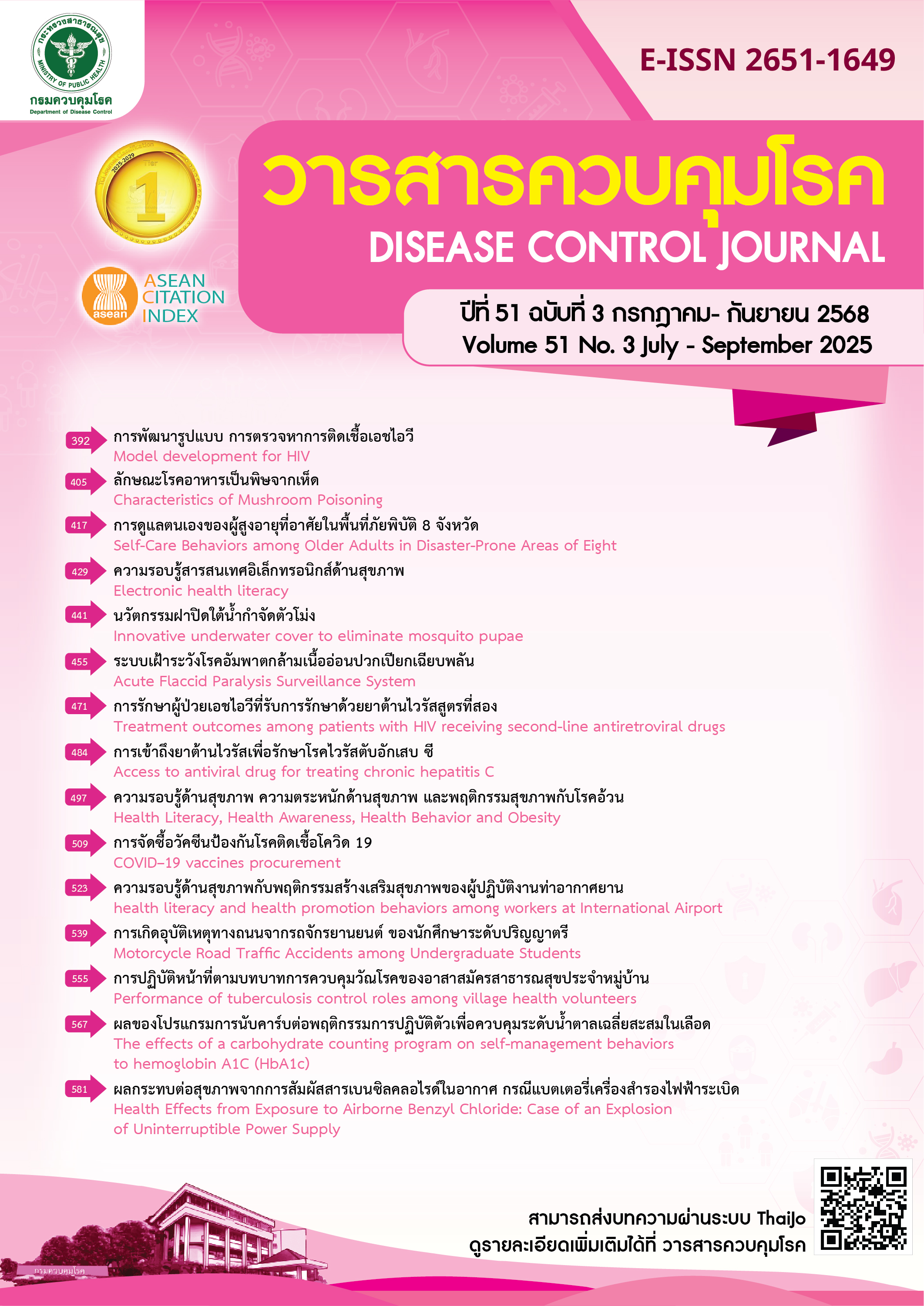
ปัจจัยที่ส่งผลต่อการรักษาผู้ป่วยเอชไอวีที่รับการรักษาด้วยยาต้านไวรัสสูตรที่สอง
DOI:
https://doi.org/10.14456/dcj.2025.38คำสำคัญ:
ผู้ติดเชื้อเอชไอวี, ยาต้านไวรัสสูตรที่สอง, ผลการรักษา, การกดเชื้อไวรัส, ความร่วมมือในการกินยาต้านไวรัสบทคัดย่อ
การศึกษาครั้งนี้มีวัตถุประสงค์เพื่อประเมินร้อยละของความสำเร็จในการกดปริมาณไวรัสในผู้ติดเชื้อเอชไอวี ให้ต่ำกว่า 50 ก๊อบปี้ต่อมิลลิลิตร ที่ 1 ปี และศึกษาปัจจัยที่เกี่ยวข้องกับความสำเร็จในการกดปริมาณไวรัสเอชไอวีในกระแสเลือด หลังได้รับการรักษาด้วยยาต้านไวรัสสูตรที่สอง โดยเป็นการศึกษาย้อนหลังจากเวชระเบียนผู้ติดเชื้อที่ได้รับยาต้านไวรัสสูตรที่สอง และตรวจพบปริมาณไวรัสเอชไอวีในกระแสเลือดมากกว่า 1,000 ก๊อบปี้ต่อมิลลิลิตร วิเคราะห์ข้อมูลโดยใช้สถิติเชิงพรรณนา และวิเคราะห์การถดถอยลอจิสติกพหุคูณผลการศึกษาพบว่าร้อยละของความสำเร็จในการกดปริมาณไวรัสเอชไอวีในกระแสเลือดที่ 1 ปี เท่ากับ 35.9 (95% CI=28.0-43.8) ปัจจัยที่เกี่ยวข้องกับความสำเร็จในการกดปริมาณไวรัสเอชไอวีในกระแสเลือดให้ต่ำกว่า 50 ก๊อบปี้ต่อมิลลิลิตร ได้แก่ ผู้ติดเชื้อที่อายุระหว่าง 25-34 ปี (ORadj=12.1, 95%CI=1.4-103.4) อายุระหว่าง 35-49 ปี (ORadj=9.0, 95%CI= 1.2-66.5) การเปลี่ยนสูตรยาต้านไวรัสภายในระยะเวลาน้อยกว่า 30 วัน (ORadj= 4.5, 95%CI=1.1-18.0) และความร่วมมือในการกินยาต้านไวรัสอย่างสม่ำเสมอหลังเกิดภาวะการรักษาล้มเหลว (ORadj=11.0, 95% CI=3.4-35.5) จากผลการศึกษาชี้ให้เห็นถึงความจำเป็นในการยกระดับการพัฒนาคุณภาพการดูแลผู้ติดเชื้อเอชไอวี โดยเน้นการเปลี่ยนสูตรยาต้านไวรัสโดยเร็วหลังพบภาวะล้มเหลวในการรักษาด้านเชื้อไวรัส และการส่งเสริมความร่วมมือในการกินยาต้านไวรัสสูตรที่สองอย่างสม่ำเสมอและต่อเนื่อง
Downloads
เอกสารอ้างอิง
Department of Disease Control (TH). HIV Info HUB [Internet]. Ministry of Public Health. 2562 [cited 2025 Jul 20]. Available from: https://hivhub.ddc.moph.go.th (in Thai)
National Health Security Office (TH). NAP Web Report [Internet]. National Health Security Office [cited 2025 Jul 20]. Available from: https://www.nhso.go.th/th/agency-th/online-service (in Thai)
World Health Organization (WHO). The public health response to pretreatment HIV drug resistance [Internet]. World Health Organization. 2017 [cited 2023 Jul 16]. Available from: https://www.hst.org.za/publications/NonHST%20Publications/The%20Public%20Health%20Response%20to%20Pretreatment%20HIV%20Drug%20Resistance.pdf
Ruxrungtham K, Chokephaibulkit K, Chetchotisakd P, Chariyalertsak S, Kiertburanakul S, Putcharoen O, et al. National guidelines for HIV diagnosis, treatment and prevention, Thailand 2021/2022 [Internet]. Department of Disease Control, Ministry of Public Health (TH). 2022 [cited 2023 Jul 15]. Available from: https://www.thaiaidssociety.org/wp-content/uploads/2023/03/HIV-AIDS-Guideline-2564_2565_ED2.pdf (in Thai)
Ngamjarus C. n4Studies: sample size calculation for an epidemiological study on a smart device. Siriraj Med J. 2016;68(3):160-70 (in Thai)
Wedajo S, Degu G, Deribew A, Ambaw F. Treatment failure, death, and predictors among PLWHIV on second-line antiretroviral therapy in Dessie Comprehensive Specialized Hospital, northeast Ethiopia: a retrospective cohort study. PLoS One. 2022;17(6):e0269235.
May Myat Win, Maek-a-nantawat W, Phonrat B, Kiertiburanakul S, Sungkanuparph S. Virologic and immunologic outcomes of the second-line regimens of antiretroviral therapy among HIV-infected patients in Thailand. J Int Assoc Physicians AIDS Care. 2011;10(1):57-63.
Sudsila P, Teeraananchai S, Kiertiburanakul S, Lertpiriyasuwat C, Triamwichanon R, Gatechompol S, et al. Treatment outcomes after switching to second-line anti-retroviral therapy: results from the Thai National Treatment Program. J Int Assoc Provid AIDS Care. 2023;22:1-11.
Hailu D, Jara D, Edin A, Awol A, Ayele A, Fekadu Y, et al. Viral load suppression and associated factors among HIV-infected patients on second-line antiretroviral therapy at public health facilities of West Guji and Borena zones, Southern Ethiopia: facility-based cross-sectional study. medRxiv [Internet]. 2024 [cited 2025 Feb 20]. Available from: https://doi.org/10.1101/2024.04.02.24305217
Asare K, Sookrajh Y, van der Molen J, Khubone T, Lewis L, Lessells RJ, et al. Clinical outcomes with second-line dolutegravir in people with virological failure on first-line non-nucleoside reverse transcriptase inhibitor-based regimens in South Africa: a retrospective cohort study. Lancet Glob Health. 2024;12(2):e282-91.
Nyaboke R, Ramadhani HO, Lascko T, Awuor P, Kirui E, Koech E, et al. Factors associated with adherence and viral suppression among patients on second-line antiretroviral therapy in an urban HIV program in Kenya. SAGE Open Med. 2023;11:1-9.
Bezabhe WM, Chalmers L, Bereznicki LR, Peterson GM. Adherence to antiretroviral therapy and virologic failure: a meta-analysis. Medicine (Baltimore). 2016;95(15):e3361.
Wagner Z, Mukasa B, Nakakande J, Stecher C, Saya U, Linnemayr S. Impact of the COVID-19 pandemic on use of HIV care, antiretroviral therapy adherence, and viral suppression: an observational cohort study from Uganda. J Acquir Immune Defic Syndr. 2021;88(5):448-56.
World Health Organization. Policy brief: update of recommendations on first-and second-line antiretroviral regimens [Internet]. World Health Organization. 2019 [cited 2023 Jul 16]. Available from: https://iris.who.int/handle/10665/325892
Wedajo S, Getu D, Amare D, Ambaw F. Rate of viral re-suppression and retention to care among PLHIV on second-line antiretroviral therapy at Dessie Comprehensive Specialized Hospital, Northeast Ethiopia: a retrospective cohort study. HIV AIDS (Auckl). 2021;13:877-87.
Ramadhani HO, Bartlett JA, Thielman NM, Pence BW, Kimani SM, Maro VP, et al. Association of first-line and second-line antiretroviral therapy adherence. Open Forum Infect Dis. 2014;1(2):ofu079.
Shushtari ZJ, Salimi Y, Sajjadi H, Paykani T. Effect of social support interventions on adherence to antiretroviral therapy among people living with HIV: a systematic review and meta-analysis. AIDS Behav. 2023;27(5): 1619-35.
Musayón-Oblitas Y, Crcamo C, Gimbel S. Counseling for improving adherence to antiretroviral treatment: a systematic review. AIDS Care. 2018;31(1):4-13.
Bonner K, Mezochow A, Roberts T, Ford N, Cohn J. Viral load monitoring as a tool to reinforce adherence: a systematic review. J Acquir Immune Defic Syndr. 2013;64(1):74-8.
Kroidl A, Burger T, Urio A, Mugeniwalwo R, Mgaya J, Mlagalila F, et al. High turnaround times and low viral resuppression rates after reinforced adherence counselling following a confirmed virological failure diagnostic algorithm in HIV-infected patients on first-line antiretroviral therapy from Tanzania. Trop Med Int Health. 2020;25(5):579-89.
Levison JH, Orrell C, Losina E, Lu Z, Freedberg KA, Wood R. Early outcomes and the virological effect of delayed treatment switching to second-line therapy in an antiretroviral roll-out program in South Africa. Antivir Ther. 2011;16(6):853-61.
Bulage L, Ssewanyana I, Nankabirwa V, Nsubuga F, Kihembo C, Pande G, et al. Factors associated with virological non-suppression among HIV-positive patients on antiretroviral therapy in Uganda, August 2014-July 2015. BMC Infect Dis. 2017;17(1):326.
ดาวน์โหลด
เผยแพร่แล้ว
รูปแบบการอ้างอิง
ฉบับ
ประเภทบทความ
สัญญาอนุญาต
ลิขสิทธิ์ (c) 2025 วารสารควบคุมโรค

อนุญาตภายใต้เงื่อนไข Creative Commons Attribution-NonCommercial-NoDerivatives 4.0 International License.
บทความที่ลงพิมพ์ในวารสารควบคุมโรค ถือว่าเป็นผลงานทางวิชาการหรือการวิจัย และวิเคราะห์ตลอดจนเป็นความเห็นส่วนตัวของผู้เขียน ไม่ใช่ความเห็นของกรมควบคุมโรค ประเทศไทย หรือกองบรรณาธิการแต่ประการใด ผู้เขียนจำต้องรับผิดชอบต่อบทความของตน