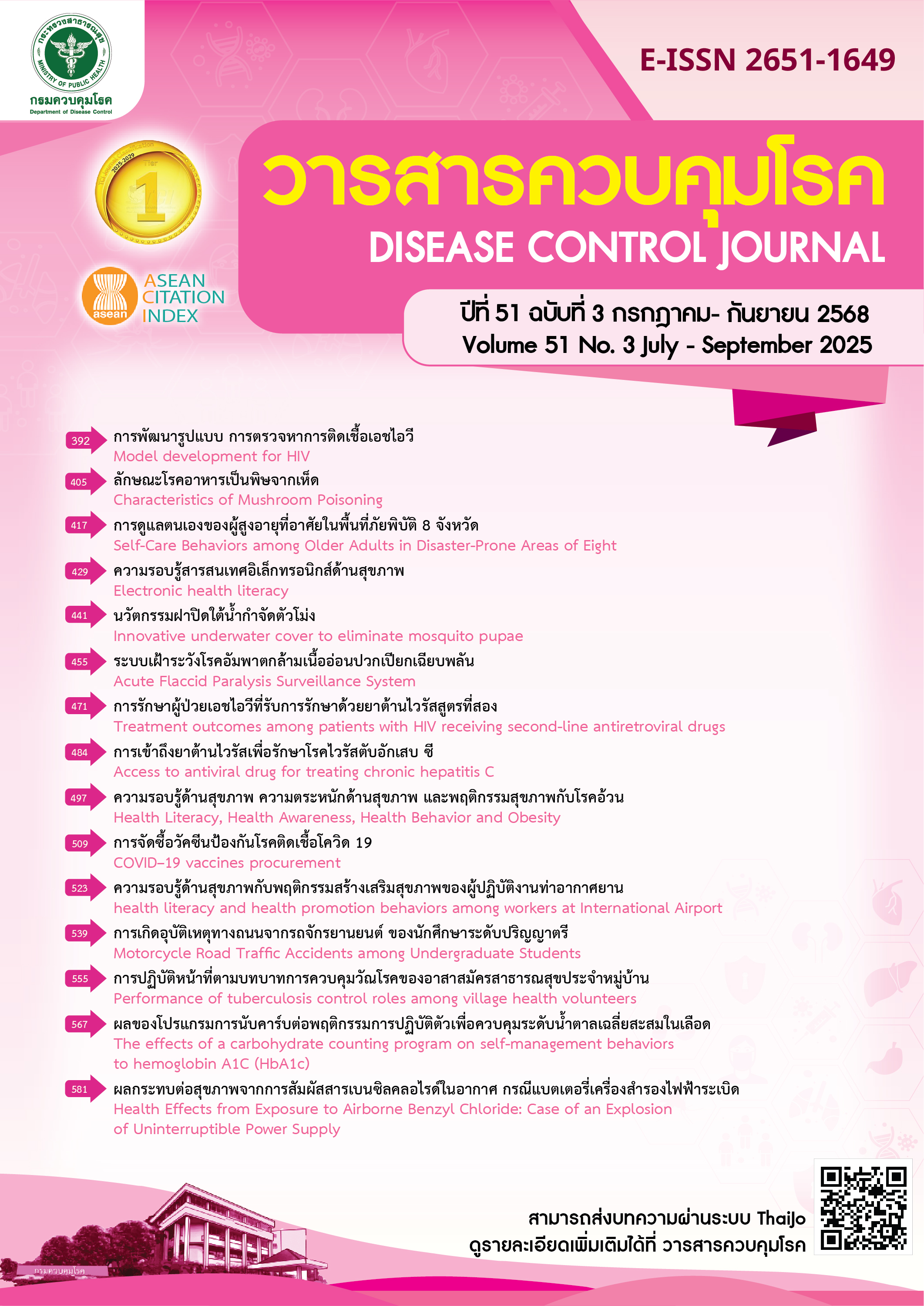
การประเมินระบบเฝ้าระวังโรคอัมพาตกล้ามเนื้ออ่อนปวกเปียกเฉียบพลัน ในพื้นที่เขตสุขภาพที่ 8
DOI:
https://doi.org/10.14456/dcj.2025.37คำสำคัญ:
ประเมินระบบเฝ้าระวัง, AFP, โรคอัมพาตอ่อนปวกเปียกเฉียบพลันบทคัดย่อ
การประเมินครั้งนี้มีวัตถุประสงค์เพื่อศึกษากระบวนการดำเนินงานเฝ้าระวัง Acute flaccid paralysis (AFP) ประเมินระบบเฝ้าระวังทั้งเชิงปริมาณและเชิงคุณภาพ พร้อมข้อเสนอแนะการดำเนินงาน AFP เป็นการศึกษาเชิงพรรณนาแบบภาคตัดขวาง เก็บข้อมูลของโรงพยาบาล 8 แห่ง ใน 4 จังหวัด ภายในเขตสุขภาพที่ 8 ใช้แบบทบทวนเวชระเบียนผู้ป่วยอายุต่ำกว่า 15 ปี ในกลุ่มโรคที่เกี่ยวข้อง (37 โรค) ย้อนหลัง 2 ปี (ปี 2566-2567) และกลุ่มโรคทั่วไป ย้อนหลัง 1 ปี (ปี 2567) และใช้แบบสัมภาษณ์ผู้เกี่ยวข้องระดับโรงพยาบาล จังหวัด และระดับเขต ผลการศึกษา พบว่าโรงพยาบาลมีแนวทางเฝ้าระวัง AFP และดำเนินงานร่วมกันหลายฝ่าย มีแพทย์ พยาบาลคัดกรอง ผู้ป่วยและรายงานไปยังเจ้าหน้าที่ระบาดวิทยา ผลทบทวนเวชระเบียน 2,605 ราย อัตราส่วนเพศชายต่อหญิง 1.21 : 1 ค่ามัธยฐานอายุ 7 ปี (ต่ำสุด 1 เดือน, สูงสุด 14 ปี) เป็นกลุ่มอายุ 10-14 ปี มากที่สุด ร้อยละ 31.74 พบผู้ป่วยที่เข้าได้ตามนิยาม 11 ราย มีรายงาน 1 ราย ค่าความไวของการรายงานอยู่ในระดับต่ำ (ร้อยละ 9.09) โดยเฉพาะโรงพยาบาลขนาดใหญ่ที่มีความครบถ้วนของการรายงานน้อย ส่วนความแม่นยำ ความเป็นตัวแทน ความทันเวลา และคุณภาพข้อมูล อยู่ในระดับดี เก็บอุจจาระผู้ป่วยครบ 2 ครั้ง มีการสอบสวนโรคและรายงานทันเวลา แต่ยังขาดการติดตามอาการผู้ป่วยและการค้นหาเชิงรุก ผลสัมภาษณ์เจ้าหน้าที่ที่เกี่ยวข้องเห็นความสำคัญและประโยชน์ของระบบเฝ้าระวัง แต่ยังขาดการทบทวนความเข้าใจในนิยามแนวทางเฝ้าระวังร่วมกันภายใน
หน่วยงาน แพทย์ พยาบาลไม่สงสัย AFP จึงไม่ได้รายงาน ทำให้การเฝ้าระวัง AFP ไม่สอดคล้องตามเกณฑ์ ข้อเสนอแนะ โรงพยาบาลควรทบทวนความรู้ความเข้าใจในนิยามและแนวทางเฝ้าระวังแก่บุคลากรที่เกี่ยวข้องและค้นหาผู้ป่วยเชิงรุกเพื่อเพิ่มโอกาสในการตรวจพบผู้ป่วยมากขึ้น ภายใต้การกำกับติดตามและสนับสนุนของระดับจังหวัด ระดับเขตเร่งรัด ติดตาม พร้อมหามาตรการกระตุ้นระบบเฝ้าระวัง AFP ให้สอดคล้องตามเกณฑ์
Downloads
เอกสารอ้างอิง
Yujarern P, Warinsathian P, Raschamroensuk A, Raschamroensuk P. Polio eradication manual. 1st ed. Nonthaburi: Department of Disease Control; 2005. (in Thai)
Tangcharoensin S. Completeness assessment of acute flaccid paralysis case reporting, Thailand, 2012-2013. Weekly pidemiological Surveillance Report. 2015;46(8):113-6. (in Thai)
Bureau of Epidemiology (TH). Acute flaccid paralysis (AFP) surveillance guideline [Internet]. Nonthaburi: Department of Disease Control; 2022 [cited 2024 Sep 1]. Available from: https://ddc.moph.go.th/uploads/ckeditor2/files/Surveillanceguidelines AFP+form.pdf (in Thai)
The Global Polio Eradication Initiative. Polio Today [Internet]. [cited 2024 Jan 26]. Available from: https://szu.gov.cz/wp-content/uploads/2023/05/19_Polio_Global_update_10May2023-002.pdf
World Health Organization. Poliomyelitis (polio) [Internet]. [cited 2024 Jan 25]. Available from:https: //www.who.int/health-topics/poliomyelitis#tab=tab_1
Ministry of Public Health (TH). Thailand polio eradication strategic plan 2020–2023 [Internet]. [cited 2024 Sep 1]. Available from: https://ddc.moph.go.th/uploads/publish/1157720210624085652.pdf (in Thai)
Sirikhut P. Polio outbreak in the Philippines 2019. PIDST Gazette. 2020;26(1):6-8. (in Thai)
Bureau of Epidemiology (TH). Acute flaccid paralysis (AFP) surveillance situation, January 1 -December 31, 2023 [Internet]. Nonthaburi: Department of Disease Control; 2024 [cited 2024 Sep 1]. Available from: https://ddc.moph.go.th/uploads/ckeditor2/files/AFP%202566.pdf (in Thai)
HDC Database, Ministry of Public Health (TH). OPV and IPV vaccine coverage in Health Region 8 [Internet]. Ministry of Public Health; 2024 [cited 2024 Sep 1]. Available from: https://hdc.moph.go.th/center/public/standard-report/73daf277928bc32a1b3c8e772192543c/4df360514655f79f13901ef1181ca1c7 (in Thai)
Bureau of Epidemiology. Report on supervision and monitoring of AFP, measles, rubella, and congenital rubella syndrome surveillance operations under the international elimination program, Aug 21-25, 2023, Health Region 8, Nakhon Phanom, Bueng Kan, Nong Khai. (in Thai)
Bureau of Epidemiology (TH). Disease definitions and guidelines for reporting notifiable and surveillance diseases in Thailand. 1st ed. Nonthaburi: Bureau of Epidemiology; 2020. (in Thai)
Office of Disease Prevention and Control 7th, Khon Kaen. Evaluation of AFP surveillance system, Health Region 7, 2018. (in Thai)
Tangcharoensin S. Acute flaccid paralysis surveillance, Thailand, 2008-2012. Weekly Epidemiological Surveillance Report. 2015;46 (19):289-94. (in Thai)
Bureau of Epidemiology, Department of Disease Control. Reporting of Priority Diseases Guideline, Thailand. Nonthaburi: Department of Disease Control; 2012. (in Thai)
Tangcharoensin S, Areechokchai D. Acute flaccid paralysis surveillance, Thailand, January–September 2012. Weekly Epidemiological Surveillance Report. 2012;43(9):726–8. (in Thai)
Sirikhetkon S. Evaluation of the COVID-19 surveillance system in Bangkok. Journal of Public Health and Health Education. 2022;2(1):34-48. (in Thai)
Division of Digital Surveillance Development (TH), International Communicable Disease Control. Forecast and risk assessment of international health threats [Internet]. Nonthaburi: Department of Disease Control; 2024 [cited 2024 Sep 1]. Available from: https://ddc.moph.go.th/uploads/ckeditor2/files/Predictive%20and%20Risk%20Assessment%20ฉบับที่%201_67%20Polio.pdf (in Thai)
Bureau of Epidemiology (TH). Acute flaccid paralysis (AFP): Annual surveillance report 2022 [Internet]. Nonthaburi: Department of Disease Control; 2023 [cited 2024 Sep 1]. Available from: https://apps-doe.moph.go.th/boeeng/annual/Annual_Report_2565.pdf (in Thai)
Bureau of Epidemiology (TH). Acute flaccid paralysis (AFP): Annual surveillance report 2021 [Internet]. Nonthaburi: Department of Disease Control; 2022 [cited 2024 Sep 1]. Available from: https://apps-doe.moph.go.th/boeeng/download/AW_AESR_2564.pdf (in Thai)
ดาวน์โหลด
เผยแพร่แล้ว
รูปแบบการอ้างอิง
ฉบับ
ประเภทบทความ
สัญญาอนุญาต
ลิขสิทธิ์ (c) 2025 วารสารควบคุมโรค

อนุญาตภายใต้เงื่อนไข Creative Commons Attribution-NonCommercial-NoDerivatives 4.0 International License.
บทความที่ลงพิมพ์ในวารสารควบคุมโรค ถือว่าเป็นผลงานทางวิชาการหรือการวิจัย และวิเคราะห์ตลอดจนเป็นความเห็นส่วนตัวของผู้เขียน ไม่ใช่ความเห็นของกรมควบคุมโรค ประเทศไทย หรือกองบรรณาธิการแต่ประการใด ผู้เขียนจำต้องรับผิดชอบต่อบทความของตน