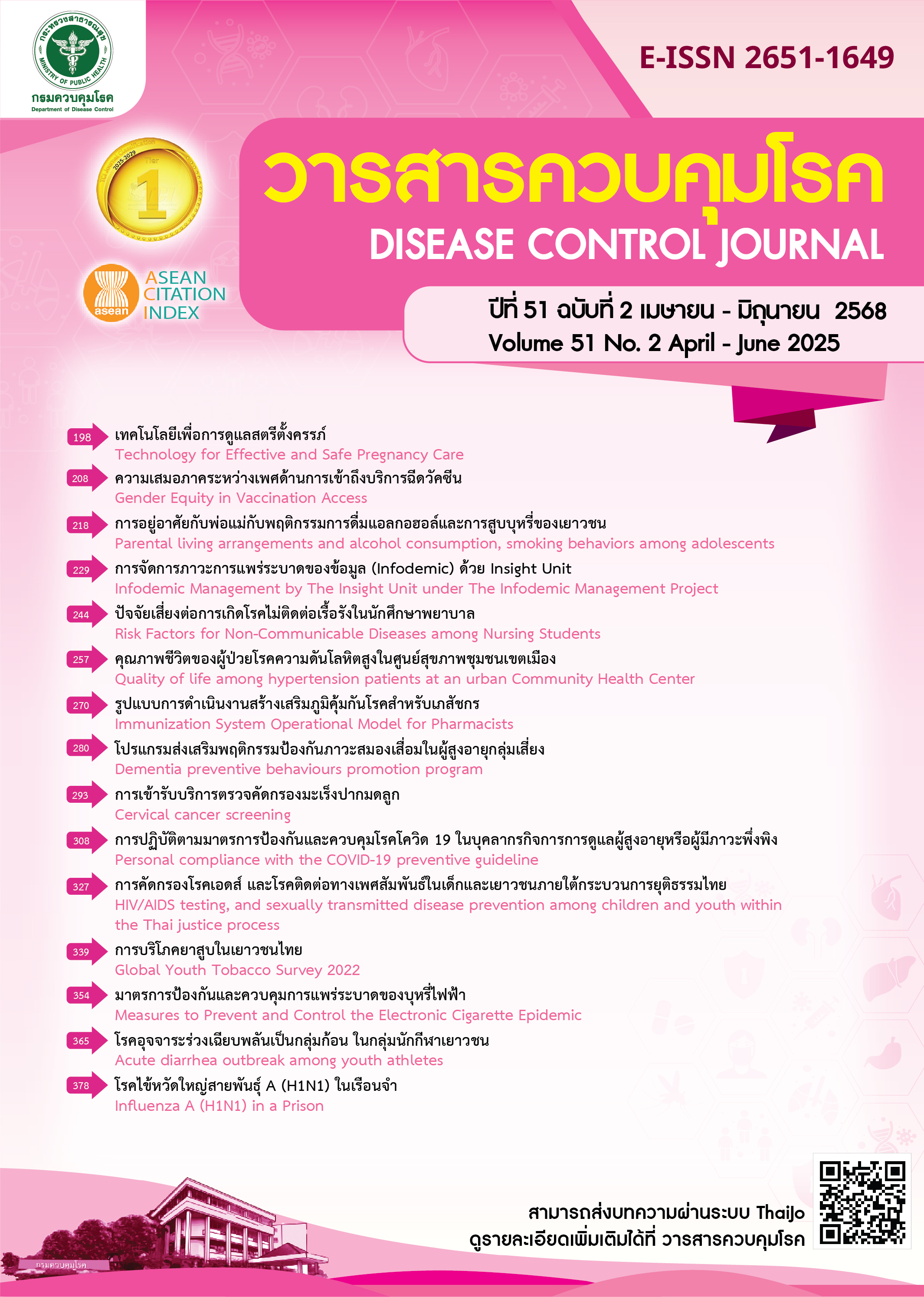
ปัจจัยที่มีความสัมพันธ์กับการปฏิบัติตามมาตรการป้องกันและควบคุมโรคโควิด 19 ในบุคลากรกิจการการดูแลผู้สูงอายุหรือผู้มีภาวะพึ่งพิง กรุงเทพมหานคร ประเทศไทย
DOI:
https://doi.org/10.14456/dcj.2025.26คำสำคัญ:
กิจการการดูแลผู้สูงอายุหรือผู้มีภาวะพึ่งพิง, โควิด 19, มาตรการป้องกันและควบคุมโรคโควิด 19บทคัดย่อ
การวิจัยเชิงวิเคราะห์ภาคตัดขวางนี้มีวัตถุประสงค์เพื่อศึกษาปัจจัยที่สัมพันธ์กับการปฏิบัติตามมาตรการควบคุมโรคโควิด 19 ของบุคลากรกิจการดูแลผู้สูงอายุหรือผู้มีภาวะพึ่งพิงในกรุงเทพมหานคร กลุ่มตัวอย่างจำนวน 374 คน เก็บข้อมูลโดยใช้แบบสอบถามที่พัฒนาจากแบบจำลองเชิงสังคมนิเวศ (socio-ecological model) ครอบคลุมปัจจัยส่วนบุคคล ระหว่างบุคคล และระดับชุมชน/องค์กร วิเคราะห์ข้อมูลด้วยสถิติเชิงพรรณนาและการถดถอยโลจิสติกพหุคูณ กำหนดระดับนัยสำคัญทางสถิติที่ 0.05 ผลการศึกษาพบว่า ปัจจัยที่มีความสัมพันธ์อย่างมีนัยสำคัญทางสถิติกับการปฏิบัติตามมาตรการฯ ได้แก่ อาชีพ/ตำแหน่งงาน โดยกลุ่มผู้ดำเนินการมีการปฏิบัติน้อยกว่ากลุ่มผู้ให้บริการ (ผู้ดูแลผู้สูงอายุ) 8.6 เท่า (95% CI: 0.1-0.2) ผู้ที่มีทัศนคติเชิงบวกเกี่ยวกับโรคโควิด 19 ปฏิบัติตามมาตรการดีกว่าผู้ที่มีทัศนคติเชิงลบ 3.9 เท่า (95% CI: 1.4-4.2) ผู้ที่ได้รับแรงกระตุ้นทางสังคมมีการปฏิบัติตามมาตรการฯ สูงกว่า 3.3 เท่า (95% CI: 1.7-6.1) และผู้ที่เคยผ่านการฝึกอบรมมีการปฏิบัติตามมาตรการฯ ดีกว่าผู้ที่ไม่เคยอบรม 6.7 เท่า (95% CI: 1.3-10.9) ดังนั้น ควรสร้างความตระหนักในการปฏิบัติตามมาตรการฯในกลุ่มผู้ประกอบการและผู้ดำเนินการสร้างทัศนคติเชิงบวกต่อโรคโควิด 19 สถานประกอบการควรมีการจัดอบรมอย่างสม่ำเสมอ ควบคู่กับการสร้างการมีส่วนร่วมของครอบครัวบุคลากรในการสนับสนุนพฤติกรรมสุขภาพ และควรมีกลไกความร่วมมือในการสนับสนุนทรัพยากรและเวชภัณฑ์ที่จำเป็นให้สถานประกอบการที่ขาดแคลน และสนับสนุนทางวิชาการเพื่อยกระดับมาตรฐานการดูแลผู้สูงอายุในสถานประกอบการ
Downloads
เอกสารอ้างอิง
Li Q, Guan X, Wu P, Wang X, Zhou L, Tong Y, et al. Early transmission dynamics in Wuhan, China, of novel coronavirus-infected pneumonia. N Engl J Med. 2020;382(13):1199-207.
Kampf G, Bruggemann Y, Kaba HEJ, Steinmann J, Pfaender S, Scheithauer S, et al. Potential sources, modes of transmission and effectiveness of prevention measures against SARS-CoV-2. J Hosp Infect. 2020;106(4):678-97.
World Health Organization. COVID-19 epidemiological update-edition 169 [Internet]. Geneva: World Health Organization; 2024 [cited 2025 Apr 3]. Available from: https://www.who.int/publications/m/item/covid-19-epidemiological-update-edition-169
Ministry of Public Health of Thailand. Number of novel coronavirus (COVID-19) confirmed, recovered, and death cases in Thailand as of March 17, 2024 [Internet]. 2024 [cited 2025 Jan 23]. Available from: https://www.statista.com/statistics/1099913/thailand-number-of-novel-coronavirus-cases/ (in Thai)
Department of Disease Control, Ministry of Public Health. COVID-19 situation in Thailand [Internet]. Nonthaburi: Ministry of Public Health; 2024 Jun 17 [cited 2025 Apr 3]. Available from: https://ddc.moph.go.th/uploads/ckeditor2//files/ (in Thai)
Kulsoontorn K, Wingpat K, Bodeerat C. Guidelines for caring the elderly during a COVID-19 pandemic. J Roi Kaensarn Academi. 2021;6(11):288-302 (in Thai)
Center for COVID-19 Situation Administration. COVID-19 situation report. Nonthaburi: COVID-19 Information Center; 2021. (in Thai)
Department of Disease Control, Ministry of Public Health, Thailand. Guideline for disease control in quarantine facilities. Nonthaburi: Department of Disease Control; 2021. (in Thai)
Department of Health Service Support. Announcement of the Emergency Operations Center for Medical and Public Health on the case of COVID-19. Nonthaburi: Department of Health Service Support; 2020. (in Thai)
Rimer BK, Glanz K. Theory at a glance: a guide for health promotion practice. Bethesda, MD: National Cancer Institute, US Department of Health and Human Services; 2005.
Moran KR, Del Valle SY. A meta-analysis of the association between gender and protective behaviors in response to respiratory epidemics and pandemics. PLoS One. 2016;11(10):e0164541.
Zhong BL, Luo W, Li HM, Zhang QQ, Liu XG, Li WT, et al. Knowledge, attitudes, and practices towards COVID-19 among Chinese residents during the rapid rise period of the COVID-19 outbreak: a quick online cross-sectional survey. Int J Biol Sci. 2020;16(10):1745-52.
Saqlain M, Munir MM, Rehman SU, Gulzar A, Naz S, Ahmed Z, et al. Knowledge, attitude, practice and perceived barriers among healthcare workers regarding COVID-19: a cross-sectional survey from Pakistan. J Hosp Infect. 2020;105(3):419-23.
Almohammed OA, Aldwihi LA, Alragas AM, Almoteer AI, Gopalakrishnan S, Alqahtani NM. Knowledge, attitude, and practices associated with COVID-19 among healthcare workers in hospitals: a cross-sectional study in Saudi Arabia. Front Public Health. 2021;9:643053.
Kassie BA, Adane A, Tilahun YT, Kassahun EA, Ayele AS, Belew AK. Knowledge and attitude towards COVID-19 and associated factors among health care providers in Northwest Ethiopia. PLoS One. 2020;15(8):e0238415.
Lai X, Wang M, Qin C, Tan L, Ran L, Chen D, et al. Coronavirus disease 2019 (COVID-2019) infection among health care workers and implications for prevention measures in a tertiary hospital in Wuhan, China. JAMA Netw Open. 2020;3(5):e209666.
Wu Z, McGoogan JM. Characteristics of and important lessons from the coronavirus disease 2019 (COVID-19) outbreak in China: summary of a report of 72,314 cases from the Chinese Center for Disease Control and Prevention. JAMA. 2020;323(13):1239-42.
Hussen H, Alemu ZA. Risk of COVID-19 infection and associated factors among healthcare workers: a cross-sectional study at Eka Kotebe treatment center in Ethiopia. Int J Gen Med. 2021;14:1763-72.
Ki HK, Han SK, Son JS, Park SO. Risk of transmission via medical employees and importance of routine infection-prevention policy in a nosocomial outbreak of Middle East respiratory syndrome (MERS): a descriptive analysis from a tertiary care hospital in South Korea. BMC Pulm Med. 2019;19(1):190.
Liu W, Tao ZW, Wang L, Yuan ML, Liu K, Zhou L, et al. Analysis of factors associated with disease outcomes in hospitalized patients with 2019 novel coronavirus disease. Chin Med J (Engl). 2020;133(9):1032-8.
Papagiannis D, Malli F, Raptis DG, Papathanasiou IV, Fradelos EC, Daniil Z, et al. Assessment of knowledge, attitudes, and practices towards new coronavirus (SARS-CoV-2) of health care professionals in Greece before the outbreak period. Int J Environ Res Public Health. 2020;17(14):4925.
Vaishya R, Sibal A, Malani A, Prasad KH. SARS-CoV-2 infection after COVID-19 immunization in healthcare workers: A retrospective, pilot study. Indian J Med Res. 2021;153(5&6):550-4.
Ejeh FE, Saidu AS, Owoicho S, Maurice NA, Jauro S, Madukaji L, et al. Knowledge, attitude, and practice among healthcare workers towards COVID-19 outbreak in Nigeria. Heliyon. 2020;6(11):e05557.
Ran L, Chen X, Wang Y, Wu W, Zhang L, Tan X. Risk factors of healthcare workers with coronavirus disease 2019: a retrospective cohort study in a designated ospital of Wuhan in China. Clin Infect Dis. 2020;71(16):2218-21.
Zhong BL, Luo W, Li HM, Zhang QQ, Liu XG, Li WT, et al. Knowledge, attitudes, and practices towards COVID-19 among Chinese residents during the rapid rise period of the COVID-19 outbreak: a quick online cross-sectional survey. Int J Biol Sci. 2020;16(10):1745-52.
Kolahchi Z, De Domenico M, Uddin LQ, Cauda V, Grossmann I, Lacasa L, et al. COVID-19 and its global economic impact. Adv Exp Med Biol. 2021;1318:825-37.
Daniel WW, Cross CL. Biostatistics: a foundation for analysis in the health sciences. New York: Wiley & Sons; 1995.
Sombutteera K, Thavornpitak Y. Response rate and factors associating mailed questionnaire response rate in nursing sciences and public health research. KKU Research Journal (Graduate Studies). 2015;15(1):105-13. (in Thai)
Dhama K, Khan S, Tiwari R, Sircar S, Bhat S, Malik YS, et al. Coronavirus disease 2019 -COVID-19. Clin Microbiol Rev. 2020;33(4):e00028-20.
Alraddadi BM, Al-Salmi HS, Jacobs-Slifka K, Slayton RB, Estivariz CF, Geller AI, et al. Risk factors for middle east respiratory syndrome coronavirus infection among healthcare personnel. Emerg Infect Dis. 2016;22(11):1915-20.
Chu DK, Akl EA, Duda S, Solo K, Yaacoub S, Schünemann HJ, et al. Physical distancing, face masks, and eye protection to prevent person-to-person transmission of SARS-CoV-2 and COVID-19: a systematic review and meta-analysis. Lancet. 2020;395(10242):1973-87.
Kamacooko O, Kitonsa J, Bahemuka UM, Kibengo FM, Wajja A, Basajja V, et al. Knowledge, attitudes, and practices regarding COVID-19 among healthcare workers in Uganda: a cross-sectional survey. Int J Environ Res Public Health. 2021;18(13):7004.
Al Maskari Z, Al Blushi A, Khamis F, Al Tai A, Al Salmi I, Al Harthi H, et al. Characteristics of healthcare workers infected with COVID-19: a cross-sectional observational study. Int J Infect Dis. 2021;102:32-6.
Alajmi J, Jeremijenko AM, Abraham JC, Alishaq M, Concepcion EG, Butt AA, et al. COVID-19 infection among healthcare workers in a national healthcare system: The Qatar experience. Int J Infect Dis. 2020;100:386-9.
Al Abri ZGH, Al Zeedi M, Al Lawati AA. Risk factors associated with COVID-19 infected healthcare workers in Muscat Governorate, Oman. J Prim Care Community Health. 2021;12:2150132721995454.
Oksanen LAH, Sanmark E, Oksanen SA, Anttila VJ, Paterno JJ, Lappalainen M, et al. Sources of healthcare workers' COVID-19 infections and related safety guidelines. Int J Occup Med Environ Health. 2021;34(2):239-49.
Tian C, Lovrics O, Vaisman A, Chin KJ, Tomlinson G, Lee Y, et al. Risk factors and protective measures for healthcare worker infection during highly infectious viral respiratory epidemics: A systematic review and meta-analysis. Infect Control Hosp Epidemiol. 2022;43(5):639-50.
Deesawat C, Geerapong P, Pensirinapa N. Factors affecting safety behaviors for preventing novel coronavirus-2019 infection among personnel in Buriram Hospital. Regional Health Promotion Center 9 Journal. 2021;15(38):399-413. (in Thai)
ดาวน์โหลด
เผยแพร่แล้ว
รูปแบบการอ้างอิง
ฉบับ
ประเภทบทความ
สัญญาอนุญาต
ลิขสิทธิ์ (c) 2025 วารสารควบคุมโรค

อนุญาตภายใต้เงื่อนไข Creative Commons Attribution-NonCommercial-NoDerivatives 4.0 International License.
บทความที่ลงพิมพ์ในวารสารควบคุมโรค ถือว่าเป็นผลงานทางวิชาการหรือการวิจัย และวิเคราะห์ตลอดจนเป็นความเห็นส่วนตัวของผู้เขียน ไม่ใช่ความเห็นของกรมควบคุมโรค ประเทศไทย หรือกองบรรณาธิการแต่ประการใด ผู้เขียนจำต้องรับผิดชอบต่อบทความของตน