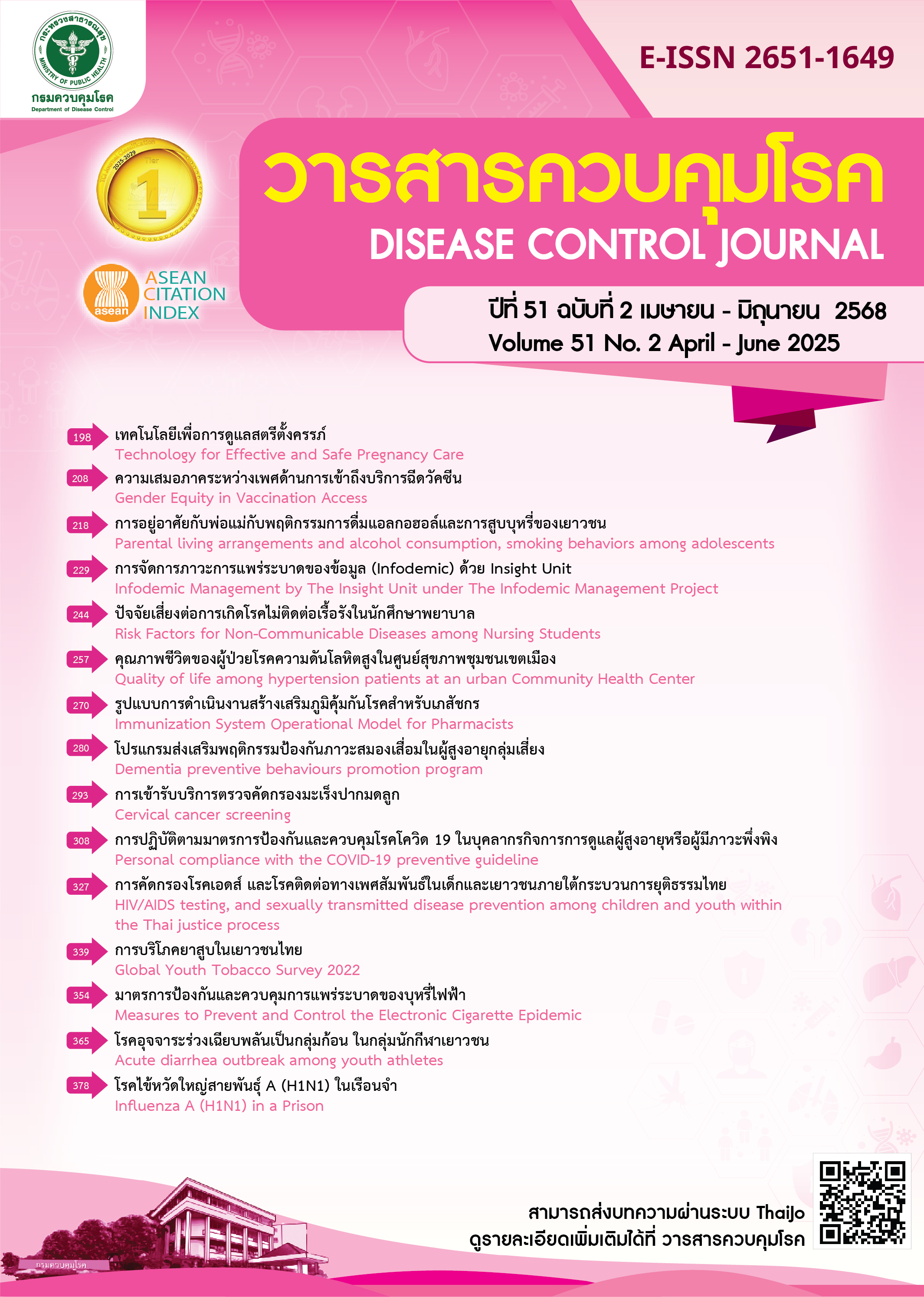
การสำรวจการบริโภคยาสูบในเยาวชนไทย พ.ศ. 2565 เพื่อพัฒนานโยบายควบคุมยาสูบของประเทศไทย
DOI:
https://doi.org/10.14456/dcj.2025.28คำสำคัญ:
การสูบบุหรี่, การสำรวจการบริโภคยาสูบในเยาวชน, ประเทศไทยบทคัดย่อ
การศึกษานี้มีวัตถุประสงค์เพื่อติดตามสถานการณ์เกี่ยวกับพฤติกรรมการบริโภคผลิตภัณฑ์ยาสูบของเยาวชนที่มีอายุ 13-15 ปี ของประเทศไทย โดยประชากรเป้าหมาย เป็นนักเรียนที่มีอายุ 13-15 ปี ในโรงเรียนสังกัดสำนักงานคณะกรรมการการศึกษาขั้นพื้นฐาน และสำนักงานคณะกรรมการส่งเสริมการศึกษาเอกชน จำนวน 6,752 คน
ผลการสำรวจพบว่า นักเรียนใช้ผลิตภัณฑ์ยาสูบทุกชนิด (ได้แก่ บุหรี่ซิกาแรต ซิการ์ และยาเส้น) เป็นประจำ ร้อยละ 12.5 ใช้บุหรี่ซิกาแรต ร้อยละ 8.1 ทั้งนี้พบว่าปัจจุบันมีนักเรียนร้อยละ 17.6 สูบบุหรี่ไฟฟ้าเป็นประจำ พบการสัมผัสควันบุหรี่ที่บ้าน ร้อยละ 26.0 ที่โรงเรียน ร้อยละ 45.6 ในช่วง 30 วันที่ผ่านมานักเรียนเคยเห็นการโฆษณาหรือการส่งเสริมการขายบุหรี่ซองหรือผลิตภัณฑ์ยาสูบอื่นๆ บนอินเทอร์เน็ต ร้อยละ 31.7 เคยเห็นโฆษณาส่งเสริมการขายบุหรี่ไฟฟ้า บนสื่อสังคมออนไลน์ ร้อยละ 48.0 และเห็นการส่งเสริมการขายผลิตภัณฑ์ยาสูบ ณ จุดขาย ร้อยละ 25.6 ทั้งนี้ยังพบอีกว่านักเรียนเคยได้รับบุหรี่หรือผลิตภัณฑ์ยาสูบฟรีจากตัวแทนจำหน่ายบุหรี่ ร้อยละ 11.1 จากผลการสำรวจสะท้อนให้เห็นถึงสถานการณ์การสูบบุหรี่ไฟฟ้าของนักเรียน เพิ่มขึ้นจากปี พ.ศ. 2558 ถึง 5.3 เท่า โดยเพิ่มขึ้นจากร้อยละ 3.3 เป็นร้อยละ 17.6 กลยุทธ์ทางการตลาดของอุตสาหกรรมยาสูบ โดยเฉพาะโฆษณาในช่องทางออนไลน์ มุ่งเน้นกลุ่มเด็กและเยาวชนมากขึ้น และค่านิยมในการใช้ชีวิตและทัศนคติเชิงลบต่อการสูบบุหรี่ของเด็กและเยาวชนเปลี่ยนแปลงไป ประเทศไทยจำเป็นต้องมีการดำเนินมาตรการการป้องกันและควบคุมการแพร่ระบาดบุหรี่ไฟฟ้าในประเทศ เพื่อให้เกิดการควบคุมการแพร่ระบาดของบุหรี่ไฟฟ้าอย่างจริงจัง และยกระดับขึ้นเป็นการดำเนินงานระดับชาติจึงได้มีการจัดทำมาตรการการป้องกัน และควบคุมการแพร่ระบาดบุหรี่ไฟฟ้าในประเทศไทย โดยมีวัตถุประสงค์ป้องกันและควบคุมการแพร่ระบาดบุหรี่ไฟฟ้าในกลุ่มเด็กและเยาวชน
Downloads
เอกสารอ้างอิง
National Statistical Office (TH), Social Statistics Division. Health behavior of population survey 2021. Bangkok: Social Statistics Division, National Statistic Office; 2021. (in Thai)
World Health Organization. WHO global report on trends in prevalence of tobacco use 2000-2030. [Internet]. [cited 2025 May 22]. Available from: https://iris.who.int/bitstream/handle/10665/375711/9789240088283-eng.pdf?sequence=1
World Health Organization. WHO global report on trends in prevalence of tobacco use 2000–2030. Geneva: World Health Organization; 2024.
Ministry of Public Health (TH). Thailand 2015 global school based-student health survey. Nonthaburi: Ministry of Public Health; 2015. (in Thai)
Ministry of Public Health (TH). Report on the survey of tobacco consumption among Thai youth 2009: Under global youth tobacco survey, 2009. Nonthaburi: Ministry of Public Health; 2009. (in Thai)
Chotbenjamaporn P, Haruhansapong V, Jumriangrit P, Pitayarangsarit S, Agarwal N, Garg R. Tobacco use among Thai students results from the 2015 global youth tobacco survey. Indian Journal of Public Health. 2017;61(5):40-6
Phetphum C, Prajongjeep A, Youngiam W, Thawatchaijareonying K. Susceptibility to smoking and determinants among never-smoking high school students in Thailand. Tob Induc Dis. 2023;21:02.
Global Youth Tobacco Survey Collaborative Group. Global Youth Tobacco Survey (GYTS): Fact sheet template, version 1.1. Atlanta, GA: Centers for Disease Control and Prevention, 2015.
Tan Y L, Dorotheo U. ASEAN tobacco control atlas. 6th ed. Bangkok: Southeast Asia Tobacco Control Alliance; 2024.
Krüsemann EJZ, Boesveldt S, De Graaf K, Talhout R. An e-liquid flavor wheel: a shared vocabulary based on systematically reviewing e-liquid flavor classifications in literature. Nicotine Tob Res [Internet]. 2019 [cited 2022 Jun 8];21(10):1310-9. Available from: https://academic.oup.com/ntr/article/21/10/1310/4999218.
Marynak KL, Gammon DG, Rogers T, Coats EM, Singh T, King BA. Sales of nicotine-containing electronic cigarette products: United States, 2015. American Journal of Public Health. 2017;107(5):702–5.
Ministry of Public Health (TH), Department of Disease Control, Bureau of Tobacco Control. Tobacco products control Act B.E. 2560 (2017). Nonthaburi: Office of Tobacco Products Control Committee; 2017. (in Thai)
Chidera NO, John O, Walid S, Dolapo AO, Chidinma U, Lisa O, et al. A review of smoking cessation interventions: efficacy, strategies for implementation, and future directions. Cureus. 2024;16(1):e52102.
World Health Organization. Young people using e-cigarettes at rates higher than adults in many countries. [Internet]. [cited 2025 May 22]. Available from: https://www.who.int/news/item/23-05-2024-tobacco-and-nicotine-industry-tactics-addict-youth-for-life
World Health Organization. Tobacco and nicotine industry tactics: addicting youth for life [Internet]. [cited 2024 Jun 15]. Available from: https://www.who.int/thailand/news/detail/23-05-2567-tobacco-and-nicotine-industry-tactics-addict-youth-for-life.
Barnoya J, Colditz G, Moreland-Russell S, Cyr J, Snider D, Schootman M. Prevalence of cigarette advertising and other promotional strategies at the point of sale in St Louis, Missouri: Analysis by store type and distance from a school. Prev Chronic Dis. 2014;11:130150.
Bar-Zeev Y, Berg CJ, Khayat A, Romm KF, Wysota CN, Abroms LC, et al. IQOS marketing strategies at point-of-sales: a cross-sectional survey with retailers. Tob Control. 2023;32(e2):e198–204.
Warren CW, Asma S, Lee J, Lea V, Mackay J. Global tobacco surveillance system: the GTSS Atlas. Atlanta: CDC Foundation; 2009.
Loysmut S. Spotting e-cigarette and vapes in social media: a continuing problem to tobacco product advertising and marketing control. Tob Induc Dis. 2022;19(Suppl 1):A121.
Ranker LR, Wu J, Hong T, Wijaya D, Benjamin EJ, Bhatnagar A, et al. Social media use, brand engagement, and tobacco product initiation among youth: evidence from a prospective cohort study. Addict Behav. 2024;154:108000.
Lee J, Tan ASL, Porter L, Young-Wolff KC, Carter-Harris L, Salloum RG. Association between social media use and vaping among Florida adolescents, 2019. Prev Chronic Dis. 2021;18:200550.
Robertson L, Cameron C, McGee R, Marsh L, Hoek J. Point-of-sale tobacco promotion and youth smoking: a meta-analysis. Tob Control. 2016;25(e2):e83–9.
Donaldson EA, Robinson JN, Nguyen Zarndt A. Association between free tobacco product sample receipt and tobacco use in youth and adults in the PATH study. Prev Med (Baltim). 2020;131:105951.
Wakefield MA, Loken B, Hornik RC. Use of mass media campaigns to change health behavior. Lancet. 2010;376(9748):1261-71.
ดาวน์โหลด
เผยแพร่แล้ว
รูปแบบการอ้างอิง
ฉบับ
ประเภทบทความ
สัญญาอนุญาต
ลิขสิทธิ์ (c) 2025 วารสารควบคุมโรค

อนุญาตภายใต้เงื่อนไข Creative Commons Attribution-NonCommercial-NoDerivatives 4.0 International License.
บทความที่ลงพิมพ์ในวารสารควบคุมโรค ถือว่าเป็นผลงานทางวิชาการหรือการวิจัย และวิเคราะห์ตลอดจนเป็นความเห็นส่วนตัวของผู้เขียน ไม่ใช่ความเห็นของกรมควบคุมโรค ประเทศไทย หรือกองบรรณาธิการแต่ประการใด ผู้เขียนจำต้องรับผิดชอบต่อบทความของตน