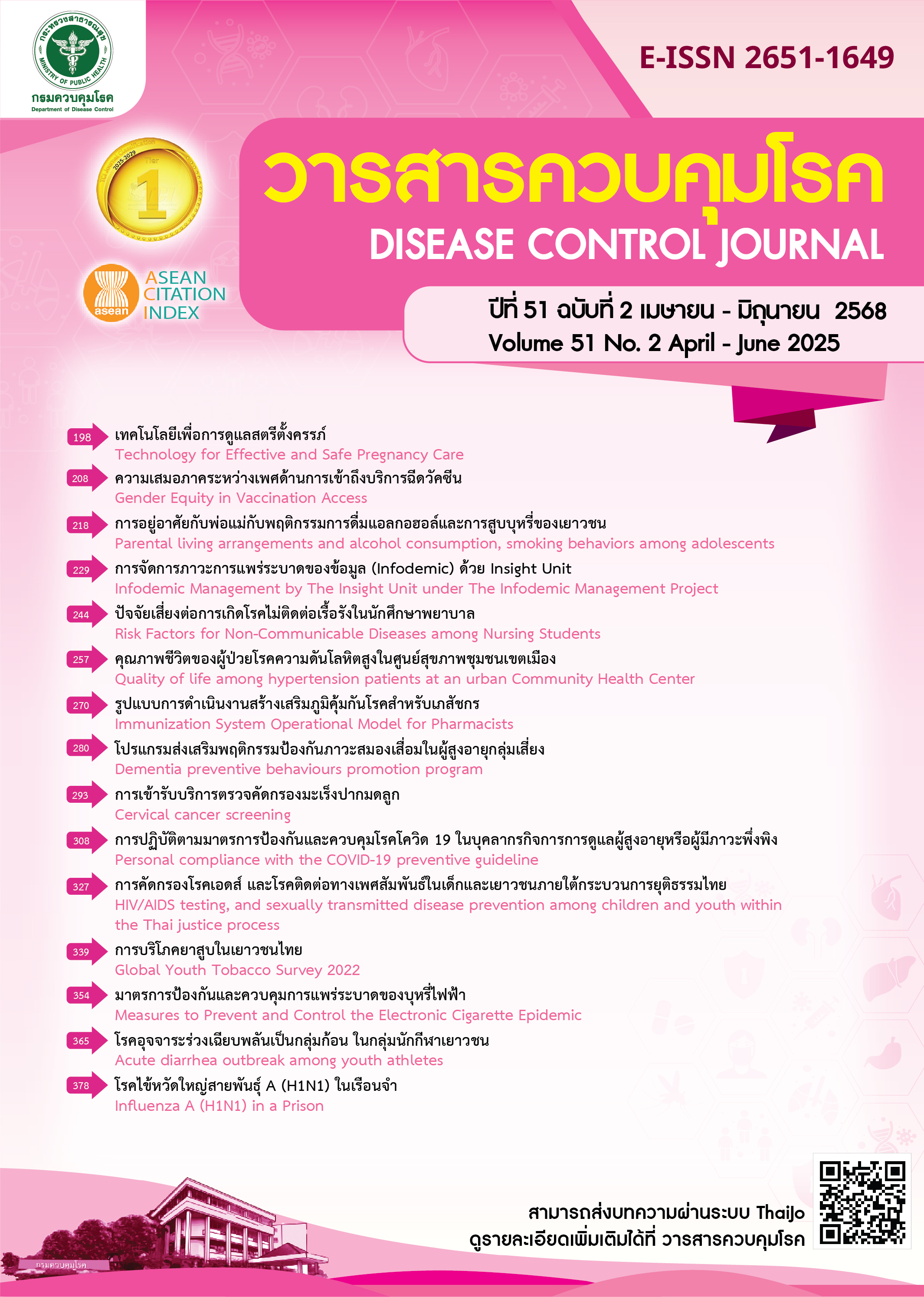
การสอบสวนโรคอุจจาระร่วงเฉียบพลันเป็นกลุ่มก้อน ในกลุ่มนักกีฬาเยาวชน ณ ที่พักนักกีฬาชั่วคราว โรงเรียน A อำเภอเมือง จังหวัดเชียงราย มิถุนายน 2567
DOI:
https://doi.org/10.14456/dcj.2025.30คำสำคัญ:
อุจจาระร่วงเฉียบพลัน, เชื้อ Escherichia coli, การระบาดเป็นกลุ่มก้อน, กีฬาเยาวชนบทคัดย่อ
เมื่อวันที่ 8 มิถุนายน 2567 งานป้องกันควบคุมโรคและระบาดวิทยา โรงพยาบาลเชียงรายประชานุเคราะห์ ได้รับแจ้งจากห้องฉุกเฉินว่าพบนักกีฬาเยาวชนมาตรวจด้วยอาการถ่ายเหลว ปวดท้อง อาเจียน จำนวนหลายราย จึงได้ดำเนินการสอบสวนและควบคุมโรค เพื่อยืนยันการระบาด ศึกษาลักษณะทางระบาดวิทยา ค้นหาสาเหตุของการระบาด รวมถึงกำหนดมาตรการควบคุมและป้องกันโรค วิธีการศึกษาเป็นแบบเชิงพรรณนาและเชิงวิเคราะห์โดยวิธี retrospective cohort study เก็บข้อมูลและค้นหาผู้ป่วยเพิ่มเติม โดยนิยามผู้ป่วย คือ ครูหรือนักกีฬาในที่พักนักกีฬาชั่วคราวโรงเรียน A มีอาการอย่างน้อย 2 ข้อ ได้แก่ ไข้ ถ่ายเหลว คลื่นไส้/อาเจียน ปวดท้อง ตั้งแต่วันที่ 3 ถึง 16 มิถุนายน 2567 ศึกษาสภาพแวดล้อมและเก็บตัวอย่างอุจจาระและสิ่งแวดล้อมส่งเพาะเชื้อแบคทีเรีย ผลการศึกษาพบครูและนักกีฬาเยาวชนทั้งหมด 118 ราย มีผู้ป่วยที่เข้านิยาม 41 ราย อัตราป่วยร้อยละ 34.7 ซึ่งเป็นนักกีฬาเยาวชนทั้งหมด ผลเพาะเชื้อพบ Escherichia coli ในอุจจาระของผู้ป่วย น้ำแข็งในถังแช่วัตถุดิบ และน้ำดื่มในกระติกน้ำแข็ง พบอาหารที่สงสัยว่าเป็นสาเหตุของการระบาด คือ ข้าวกล่องที่ครูผู้ฝึกสอนเป็นผู้ปรุง (adjusted odds ratio (aOR)=4.06, 95% CI=1.16-14.19, p<0.05) และน้ำดื่มในกระติกน้ำแข็ง (aOR=7.29, 95% CI=1.89-28.04, p<0.05) จากการสำรวจสิ่งแวดล้อมพบว่า การจัดเก็บวัตถุดิบและสุขอนามัยไม่ได้มาตรฐานตามหลักสุขาภิบาลอาหารและน้ำ มาตรการควบคุมโรคที่ดำเนินการ ได้แก่ ให้หยุดดื่มน้ำในกระติก ยกเลิกการปรุงอาหารภายในที่พักนักกีฬา ให้สุขศึกษาเรื่องสุขาภิบาลอาหารและน้ำแก่ผู้เกี่ยวข้อง พบว่าผู้ป่วยลดลงและไม่พบผู้ป่วยเพิ่มเติมก่อนสิ้นสุดการแข่งขัน ทั้งนี้หากมีการจัดงานแข่งขันกีฬาลักษณะคล้ายกันนี้ในครั้งถัดไปควรมีการเตรียมพร้อมสถานที่และทรัพยากร และให้ความรู้ด้านสุขาภิบาลแก่ผู้เกี่ยวข้อง พร้อมทั้งจัดตั้งคณะตรวจประเมินสุขอนามัยให้ได้มาตรฐานก่อนเริ่มการแข่งขันเพื่อเป็นการป้องกันไม่ให้เกิดการระบาดซ้ำอีก
Downloads
เอกสารอ้างอิง
Department of Disease Control (TH), Division of Epidemiology. National disease surveillance (Report 506) [Internet]. [cited 2024 Dec 20]. Available from: http://doe1.moph.go.th/surdata/index.php (in Thai)
Wolin J, Friedman MS. EMS mass gatherings [Internet]. Treasure Island (FL): StatPearls Publishing; 2023 [cited 2025 Apr 9]. Available from: https://www.statpearls.com/point-ofcare/158746
Maitongngam K, Kaewpradab Y. Epidemiological characteristics and risk factors of cluster outbreaks food poisoning and acute diarrhea in Thailand during the year 2018 - 2022. Institute for Urban Disease Control and Prevention Journal. 2024;9:175-90. (in Thai)
Department of Disease Control (TH), Division of Epidemiology. Event-based surveillance [Internet]. [cited 2025 Apr 10]. Available from: https://ebs-ddce.ddc.moph.go.th/eventbase/user/login (in Thai)
Hosmer DW, Lemeshow S, Sturdivant RX. Applied logistic regression. 3rd ed. Hoboken, NJ: Wiley; 2013.
Mossong J, Decruyenaere F, Moris G, Ragimbeau C, Olinger CM, Johler S, et al. Investigation of a Staphylococcal food poisoning outbreak combining case-control, traditional typing and whole genome sequencing methods, Luxembourg, June 2014. Euro Surveill. 2015;20(45).
Thanesanukul L, Kerdsang P, Hansing S. Investigation of an outbreak of acute diarrheal disease in a primary school, Nonthaburi Province, 13 February-7 March 2018. Weekly Epidemiological Surveillance Report. 2018;51(8):113-20. (in Thai)
Kiratisin P. Escherichia coli: a hidden threat in food 2011 [Internet]. Bangkok: Faculty of Medicine Siriraj Hospital; 2011 [cited 2024 Dec 20]. Available from: https://www.si.mahidol.ac.th/th/healthdetail.asp?aid=885 (in Thai)
Department of Medical Sciences (TH), National Institute of Health. Escherichia coli [Internet]. 2014 [cited 2024 Dec 20]. Available from: https://nih.dmsc.moph.go.th/data/data/fact_sheet/12_57.pdf (in Thai)
Centers for Disease Control and Prevention. Escherichia coli, diarrheagenic [Internet]. 2024 [cited 2024 Dec 20]. Available from: https://wwwnc.cdc.gov/travel/yellowbook/2024/infections-diseases/escherichia-coli-diarrheagenic#:~:text=Clinical%20Presentation-,Diarrheagenic%20E.,range%20of%201%E2%80%9310%20days
Chuekwon K, Choopeng P, Boonwong N. Efficacy of Kratom (Mitragyna speciosa Korth.) leaf on inhibition of Salmonella typhimurium and Escherichia coli in chicken meat. Naresuan Agriculture Journal. 2024;21(1):1-13. (in Thai)
Komol J, Chennay C, Kengthong T. Outbreak investigation of Escherichia Coli diarrhea among military academy school students in Prachaup Kiri Khan. Journal of Bamrasnaradura Infectious Diseases Institute. 2018;12(3):124-35. (in Thai)
Pongseed T, Settheetham D. Food sanitation situation of Chinese noodle establishments in Khampalai Sub-district, Mueang District, Mukdahan Province. KKU Journal for Public Health Research. 2019;12(1):22-31. (in Thai)
Department of Disease Control (TH), Division of Epidemiology. Surveillance of Escherichia coli outbreak in 2011. Weekly Epidemiological Surveillance Report. 2011;42(24):369-73. (in Thai)
Pisek S, Tanprasert S, Sitthi W, Ardkam B, Phanawadee M, Makaroon J, et al. A food poisoning outbreak in the policemen at the Royal Thai Government House, Bangkok, March 2011. Weekly Epidemiological Surveillance Report. 2012;43(20):305-12. (in Thai)
World Health Organization. E. coli [Internet]. 2018 [cited 2024 Dec 20]. Available from: https://www.who.int/news-room/fact-sheets/detail/e-coli.
Department of Health (TH), Bureau of Food and Water Sanitation. Food handler. 4th ed. Bangkok: Keawjawjom Printing & Publishing Suan Sunandha Rajabhat University; 2014. (in Thai)
ดาวน์โหลด
เผยแพร่แล้ว
รูปแบบการอ้างอิง
ฉบับ
ประเภทบทความ
สัญญาอนุญาต
ลิขสิทธิ์ (c) 2025 วารสารควบคุมโรค

อนุญาตภายใต้เงื่อนไข Creative Commons Attribution-NonCommercial-NoDerivatives 4.0 International License.
บทความที่ลงพิมพ์ในวารสารควบคุมโรค ถือว่าเป็นผลงานทางวิชาการหรือการวิจัย และวิเคราะห์ตลอดจนเป็นความเห็นส่วนตัวของผู้เขียน ไม่ใช่ความเห็นของกรมควบคุมโรค ประเทศไทย หรือกองบรรณาธิการแต่ประการใด ผู้เขียนจำต้องรับผิดชอบต่อบทความของตน