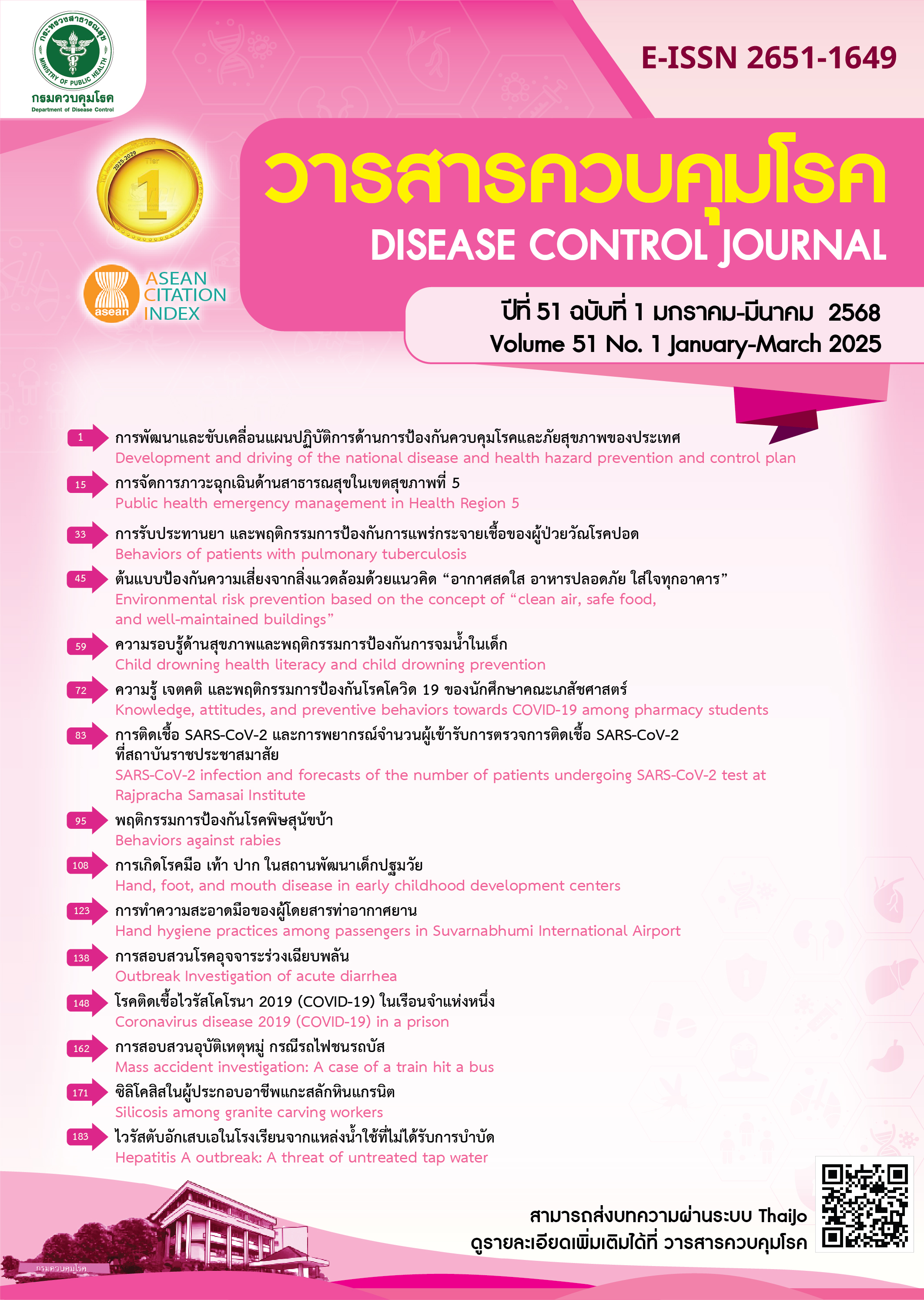
การศึกษาความสัมพันธ์ระหว่างความรู้ เจตคติ และพฤติกรรมการป้องกัน โรคโควิด 19 ของนักศึกษาคณะเภสัชศาสตร์ในกรุงเทพมหานครและปริมณฑล
DOI:
https://doi.org/10.14456/dcj.2025.6คำสำคัญ:
โควิด 19, นักศึกษาเภสัชศาสตร์, ความรู้, เจตคติ, ประสิทธิผลของมาตรการป้องกันโรคบทคัดย่อ
การวิจัยเชิงสำรวจนี้มีวัตถุประสงค์เพื่อศึกษาความสัมพันธ์ระหว่างความรู้ เจตคติ และพฤติกรรมการป้องกันโรคโควิด 19 ของนักศึกษาเภสัชศาสตร์ 340 คน จาก 8 มหาวิทยาลัยในเขตกรุงเทพฯ และปริมณฑล เก็บข้อมูลโดยใช้แบบสอบถามออนไลน์ ระหว่างเดือนมกราคม-มีนาคม 2565 วิเคราะห์ข้อมูลโดยใช้สถิติเชิงพรรณนา และสัมประสิทธิ์สหสัมพันธ์สเปียร์แมน ผลการวิจัยพบว่า กลุ่มตัวอย่างร้อยละ 51.2 เป็นเพศหญิง อายุเฉลี่ย 21.32±2.03 ปี ร้อยละ 52.9 เรียนสาขาวิชาวิทยาศาสตร์เภสัชกรรม ส่วนใหญ่ร้อยละ 95.5 ได้รับข้อมูลข่าวสารจากสื่อสังคมออนไลน์ นักศึกษามีความรู้เกี่ยวกับโรคโควิด 19 ในระดับดีมาก (13.44±2.77 จากคะแนนเต็ม 15 คะแนน) มีเจตคติในระดับดี (3.92±0.47 จากคะแนนเต็ม 5 คะแนน) และมีพฤติกรรมการป้องกันโรคในระดับดี (2.04±0.48 จากคะแนนเต็ม 3 คะแนน) ความรู้มีความสัมพันธ์ทางบวกกับเจตคติ (r=0.165, p<0.05) และเจตคติมีความสัมพันธ์ทางบวกกับพฤติกรรม (r=0.641, p<0.05) แต่ไม่พบความสัมพันธ์ระหว่างความรู้กับพฤติกรรม ผลการวิจัยนี้ชี้ให้เห็นว่าการสร้างเจตคติที่ดีอาจมีความสำคัญมากกว่าการให้ความรู้เพียงอย่างเดียวในการเปลี่ยนแปลงพฤติกรรมการป้องกันโรค โดยเฉพาะในกลุ่มนักศึกษาวิทยาศาสตร์สุขภาพที่มีความรู้พื้นฐานด้านสุขภาพสูงอยู่แล้ว การศึกษานี้เป็นข้อมูลพื้นฐานสำหรับการวิจัยเกี่ยวกับพฤติกรรมสุขภาพในกลุ่มนักศึกษาด้านวิทยาศาสตร์สุขภาพต่อไป
Downloads
เอกสารอ้างอิง
Department of Disease Control (TH). Public Health Measures and Problems in Prevention and Control of COVID-19 among Travelers [Internet]. Nonthaburi: Department of Disease Control; 2021 [cited 2021 Aug 14]. 4 p. Available from: https://ddc.moph.go.th/uploads/files/2017420210820025238.pdf (in Thai)
Center for COVID-19 Situation Administration (CCSA) (TH). COVID-19 Situation Zones [Internet]. Bangkok: Ministry of Higher Education, Science, Research and Innovation; 2021 [cited 2021 May 1]. 1 p. Available from: https://www.mhesi.go.th/index.php/en/content_page/item/3530-19-1-6.html (in Thai)
Department of Disease Control (TH), Emergency Operation Center. Coronavirus Disease 2019 Situation Report No. 731 [Internet]. Nonthaburi: Department of Disease Control; 2021 [cited 2022 Jan 7]. 3 p. Available from: https://ddc.moph.go.th/viralpneumonia/file/situation/situation-no731-070165.pdf (in Thai)
World Health Organization Thailand. Thailand COVID-19 situation report no. 221: The novel coronavirus disease 2019 (COVID-19) [Internet]. Nonthaburi: WHO Thailand; 2022 [cited 2022 Feb 2]. 20 p. Available from: https://cdn.who.int/media/docs/default-source/searo/thailand/2022_02_02_tha-sitrep-221-covid-19-th.pdf?sfvrsn=97f3bf7b_5 (in Thai)
Department of Disease Control (TH), Emergency Operation Center. Coronavirus Disease 2019 Situation Report No. 541 [Internet]. Nonthaburi: Department of Disease Control; 2021 [cited 2021 Jun 27]. Available from: https://ddc.moph.go.th/viralpneumonia/file/situation/situation-no541-270664.pdf (in Thai)
Sousa Pinto G, Hung M, Okoya F, Uzman N. FIP's response to the COVID-19 pandemic: Global pharmacy rises to the challenge. Res Soc Adm Pharm. 2021;17(1):1929-33.
Bhagavathula AS, Aldhaleei WA, Rahmani J, Mahabadi MA, Bandari DK. Knowledge and perceptions of COVID-19 among health care workers: cross-sectional study. JMIR Public Health Surveill. 2020;6(2):e19160.
Taghrir MH, Borazjani R, Shiraly R. COVID-19 and Iranian medical students; a survey on their related-knowledge, preventive behaviors and risk perception. Arch Iran Med. 2020;23(4):249-54.
Peng Y, Pei C, Zheng Y, Wang J, Zhang K, Zheng Z, et al. A cross-sectional survey of knowledge, attitude and practice associated with COVID-19 among undergraduate students in China. BMC Public Health 2020;20(1):1292.
Cochran WG. Sampling Techniques. 3rd ed. New York: John Wiley & Sons; 1977.
Rav-Marathe K, Wan TTH, Marathe S. A systematic review on the KAP-O framework for diabetes education and research. Med Res Archives. 2016;4(1):1-21.
Bloom BS. Learning for mastery. Instruction and curriculum. Regional education laboratory for the Carolinas and Virginia, topical papers and reprints, Number 1. Eval Comment. 1968;1(2):1-12.
Best JW. Research in education. 4th ed. New Jersey: Prentice Hall; 1981.
Ritcharoon P. Principles of educational measurement and evaluation. 9th ed. Bangkok: House of Chemist; 2014. (in Thai)
Khumsaen N. Knowledge, Attitudes, and Preventive Behaviors of COVID-19 among People Living in Amphoe U-thong, Suphanburi Province. Journal of Prachomklao College of Nursing, Phetchaburi Province. 2021;4(1):33-48. (in Thai)
Azlan AA, Hamzah MR, Sern TJ, Ayub SH, Mohamad E. Public knowledge, attitudes, and practices towards COVID-19: A cross-sectional study in Malaysia. PLoS One. 2020;15(5):e0233668.
Zhong BL, Luo W, Li HM, Zhang QQ, Liu XG, Li WT, et al. Knowledge, attitudes, and practices towards COVID-19 among Chinese residents during the rapid rise period of the COVID-19 outbreak: a quick online cross-sectional survey. Int J Biol Sci. 2020;16(10):1745-52.
Reuben RC, Danladi MM, Saleh DA, Ejembi PE. Knowledge, attitudes and practices towards COVID-19: an epidemiological survey in North -Central Nigeria. J Community Health. 2021;46(3):457-70.
Alhazmi A, Ali MHM, Mohieldin A, Aziz F, Osman OB, Ahmed WA. Knowledge, attitudes and practices among people in Saudi Arabia regarding COVID-19: A cross-sectional study. J Public Health Res. 2020;9(3):1867.
Ngwewondo A, Nkengazong L, Ambe LA, Ebogo JT, Mba FM, Goni HO, et al. Knowledge, attitudes, practices of/towards COVID 19 preventive measures and symptoms: A cross-sectional study during the exponential rise of the outbreak in Cameroon. PLoS Negl Trop Dis. 2020;14(9):e0008700.
Phansuma D, Boonruksa P. Knowledge, Attitudes, and Preventive Behaviors of COVID-19 among Residents in Pru Yai Sub-district, Muang District, Nakhon Ratchasima Province. Srinagarind Medical Journal. 2021;36(5):597-604. (in Thai)
Yue S, Zhang J, Cao M, Chen B. Knowledge, attitudes and practices of COVID-19 among urban and rural residents in China: a cross-sectional study. J Community Health. 2021;46(2):286-91.
Zhang M, Zhou M, Tang F, Wang Y, Nie H, Zhang L, et al. Knowledge, attitude, and practice regarding COVID-19 among healthcare workers in Henan, China. Journal of Hospital Infection. 2020;105(2):183-7.
Schwartz SH. The justice of need and the activation of humanitarian norms. Journal of Social Issues. 1975;31(3):111-36.
Ajzen I. The theory of planned behavior. Organ Behav Hum Decis Process. 1991;50(2):179-211.
Sriratanaprapat J, Klommek J. Knowledge, Attitudes, and Practices towards COVID-19 among Working-Age Population in Muak Lek Subdistrict, Muak Lek District, Saraburi Province. Journal of The Royal Thai Army Nurses. 2022;23(1):437-45. (in Thai)
Li X, Liu Q. Social Media Use, eHealth Literacy, Disease Knowledge, and Preventive Behaviors in the COVID-19 Pandemic: Cross-Sectional Study on Chinese Netizens. J Med Internet Res. 2020;22(10):e19684.
Saud M, Mashud M, Ida R. Usage of social media during the pandemic: Seeking support and awareness about COVID-19 through social media platforms. Journal of Public Affairs. 2020;20(4):e2417.
ดาวน์โหลด
เผยแพร่แล้ว
รูปแบบการอ้างอิง
ฉบับ
ประเภทบทความ
สัญญาอนุญาต
ลิขสิทธิ์ (c) 2025 วารสารควบคุมโรค

อนุญาตภายใต้เงื่อนไข Creative Commons Attribution-NonCommercial-NoDerivatives 4.0 International License.
บทความที่ลงพิมพ์ในวารสารควบคุมโรค ถือว่าเป็นผลงานทางวิชาการหรือการวิจัย และวิเคราะห์ตลอดจนเป็นความเห็นส่วนตัวของผู้เขียน ไม่ใช่ความเห็นของกรมควบคุมโรค ประเทศไทย หรือกองบรรณาธิการแต่ประการใด ผู้เขียนจำต้องรับผิดชอบต่อบทความของตน