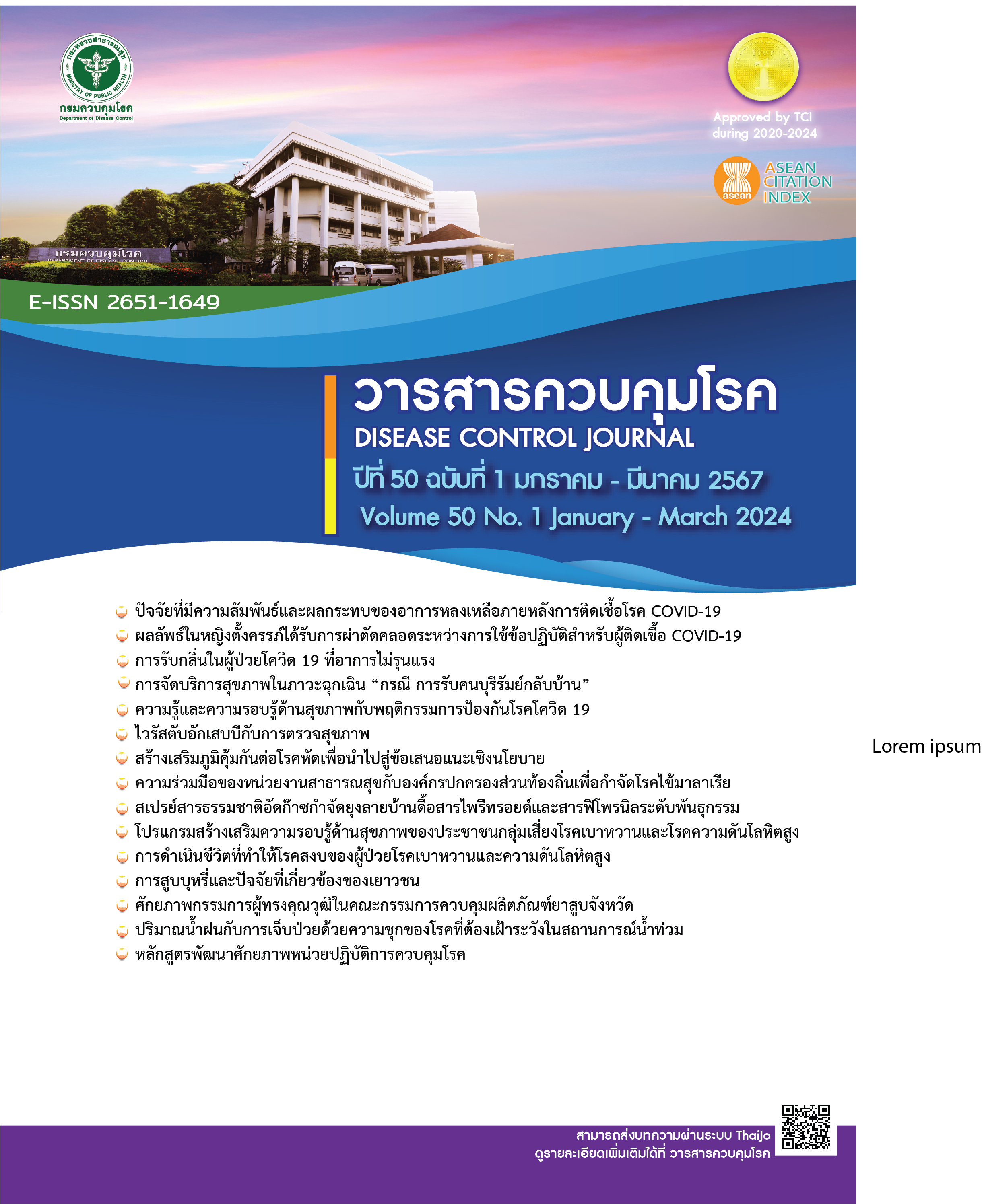
ผลของโปรแกรมสร้างเสริมความรอบรู้ด้านสุขภาพของ ประชาชนกลุ่มเสี่ยงโรคเบาหวานและโรคความดันโลหิตสูง จังหวัดนครสวรรค์
DOI:
https://doi.org/10.14456/dcj.2024.10คำสำคัญ:
กลุ่มเสี่ยงโรคเบาหวาน, กลุ่มเสี่ยงโรคความดันโลหิตสูง, ความรอบรู้ด้านสุขภาพบทคัดย่อ
โรคเบาหวานและโรคความดันโลหิตสูงเป็นโรคไม่ติดต่อเรื้อรัง เป็นปัญหาสุขภาพที่สำคัญระดับประเทศและระดับโลก สาเหตุสำคัญ คือ พฤติกรรมการบริโภคอาหารที่ไม่เหมาะสม การนอนดึก การไม่ออกกำลังกาย การมีความเครียดสูง การดื่มเครื่องดื่มแอลกอฮอล์ และการสูบบุหรี่ พฤติกรรมเหล่านี้สามารถป้องกันได้หากประชาชนมีความรอบรู้ด้านสุขภาพ ซึ่งเป็นปัจจัยสำคัญในการดูแลสุขภาพของตนเอง และส่งผลต่อพฤติกรรมและผลลัพธ์ทางสุขภาพ การวิจัยกึ่งทดลองนี้ทำการศึกษากลุ่มตัวอย่างกลุ่มเดียว โดยวัดผลก่อนและหลังการทดลอง มีวัตถุประสงค์เพื่อศึกษาผลของโปรแกรมสร้างเสริมความรอบรู้ด้านสุขภาพของประชาชนกลุ่มเสี่ยงโรคเบาหวานและโรคความดันโลหิตสูงในจังหวัดนครสวรรค์ โดยประยุกต์ใช้แนวคิดความรอบรู้ด้านสุขภาพในการออกแบบโปรแกรม และเครื่องมือในการเก็บรวบรวมข้อมูล กลุ่มตัวอย่างเป็นประชาชนอายุ 35-70 ปี ได้รับการคัดกรองความเสี่ยงโรคเบาหวานและโรคความดันโลหิตสูงจากโรงพยาบาลส่งเสริมสุขภาพตำบลเกยไชย อำเภอชุมแสง จังหวัดนครสวรรค์ ในปี 2565 จำนวน 30 คน จากผลการศึกษาพบว่ากลุ่มตัวอย่างมีคะแนนเฉลี่ยของความรอบรู้ด้านสุขภาพ และพฤติกรรมการป้องกันโรคเบาหวานและโรคความดันโลหิตสูง หลังทดลองมากกว่าก่อนการทดลองอย่างมีนัยสำคัญทางสถิติ (p-values<0.001) ดังนั้นหน่วยงานสาธารณสุขทุกระดับควรสนับสนุนการดำเนินงานสร้างเสริมความรอบรู้ด้านสุขภาพโรคเบาหวานและโรคความดันโลหิตสูงในทุกองค์ประกอบให้กับกลุ่มเสี่ยงโรคเบาหวานและโรคความดันโลหิตสูง เพื่อช่วยให้กลุ่มเสี่ยงมีพฤติกรรมป้องกันโรคและความรอบรู้ด้านสุขภาพที่ดี อันจะนำไปสู่การป้องกันการเกิดผู้ป่วยโรคเบาหวานและโรคความดันโลหิตสูงรายใหม่ได้
Downloads
เอกสารอ้างอิง
Department of Disease Control (TH), Bureau of Non-communicable Diseases. Strategy to reduce salt and sodium consumption in Thailand 2016-2025. Bangkok: Office of Printing Affairs, War Veterans Organization under royal patronage; 2016. (in Thai)
International Diabetes Federation. IDF Diabetes Atlas [Internet]. 2017 [cited 2022 Jun 18]. Available from: https://diabetesatlas.org/
World Health Organization (WHO). A global brief on hypertension: silent killer, global public health crisis: World Health Day 2013 [Internet] 2013. [cited 2022 Jun 18]. Available from: https://www.who.int/publications/i/item/a-global-brief-on-hypertension-silent-killer-global-public-health-crisis-world-health-day-2013
Health Data Center (HDC). Service plan data report, Non-communicable Diseases branch [Internet] 2022. [cited 2022 Jun 22]. Available from: https://hdcservice.moph.go.th/hdc/reports/page.php?cat_id=b2b59e64c4e6c92d4b1ec16a599d882b (in Thai)
World Health Organization. Health promotion glossary. Geneva: Marilyn Langfeld; 1998.
Kaeodumkoeng K. Health literacy: access, understand and appilcation. 2nd ed. Bangkok: Mahidol University; 2018. (in Thai)
Kaeodumkoeng K. Health literacy: functional, interactive and critical. Bangkok: Amarin printing and publishing public company limited; 2019. (in Thai)
Cochran WG. Sampling Techniques. 2nd ed. New York: John Wiley and Son; 1963.
Norasing M, Thanomphan S. Health literacy and health behavior in patients with uncontrolled blood sugar level or blood pressure: a case study of Nakornping Hospital, Chiang Mai. Journal of Nakornping Hospital. 2019;10(1):35-50. (in Thai)
Likert R. The method of constructing and attitude scale. In: Fishbein M, editor. Readings in Attitude Theory and Measurement. New York: John Wiley & Sons; 1967. P.90-5.
Bloom S. Human characteristics and school learning. New York: McGraw-Hill; 1976.
Nutbeam D. Health literacy as a public health goal: a challenge for contemporary health education and communication strategies into the 21st century. Health promotion international. 2000;15:259-67.
Department of Health Service Support (TH), Health Education Division. Promoting and evaluating health literacy and health behavior. Nonthaburi: Department of Health Service Support; 2018. (in Thai)
Pantong U, Kajornwattanakul P. Effects of an empowerment program on selfcare behaviors, HbA1c and clinical outcomes in uncontrolled type 2 diabetes patients. Nursing Journal of the Ministry of Public Health. 2020;30(1):14-24. (in Thai)
Suwannasri J, Iemsawasdikul W, Potisupsuk C. Effects of a self-care behavior development
program for Diabetes Mellitus patients at Kut Chum district, Yasothon province. Thai Journal of Nursing. 2020;69(4):40-9. (in Thai)
Choeisuwan V. Health Literacy: Concept and Application for Nursing Practice. Royal Thai Navy Medical Journal. 2017;44(3):183-97. (in Thai)
Roma W, Mukda S, Kloiiam S. Survey project health literacy of Thai people aged 15 years and over, year 2017 (Phase1) [Internet]. Department of Health, Ministry of Public Health; 2017 [cited 2021 Jul 28]. Available from: https://kb.hsri.or.th/dspace/handle/11228/5216 (in Thai)
Saentecha P, Saentecha P. The Effectiveness of a Program for Health Literacy Development in the Patients with Type 2 Diabetes. Thai Journal of Health Education. 2020;43(2):150-64. (in Thai)
Kongthaworn K. Effectiveness of an empowerment program to reduce the risk of developing high blood pressure. in the at-risk group of people in Nong Takhong Subdistrict, Pong Nam Ron District Chanthaburi Province [Internet]. 2019. [cited 2022 Aug 18]. Available from: http://pongnamron.thaiddns.com:10838/doc/wichakan/Research/Research_2562HTPongnamron.pdf (in Thai)
Indhraratana A. Health literacy of health professionals. Journal of The Royal Thai Army Nurses. 2014;15(3):174-8. (in Thai)
ดาวน์โหลด
เผยแพร่แล้ว
รูปแบบการอ้างอิง
ฉบับ
ประเภทบทความ
สัญญาอนุญาต
ลิขสิทธิ์ (c) 2024 วารสารควบคุมโรค

อนุญาตภายใต้เงื่อนไข Creative Commons Attribution-NonCommercial-NoDerivatives 4.0 International License.
บทความที่ลงพิมพ์ในวารสารควบคุมโรค ถือว่าเป็นผลงานทางวิชาการหรือการวิจัย และวิเคราะห์ตลอดจนเป็นความเห็นส่วนตัวของผู้เขียน ไม่ใช่ความเห็นของกรมควบคุมโรค ประเทศไทย หรือกองบรรณาธิการแต่ประการใด ผู้เขียนจำต้องรับผิดชอบต่อบทความของตน