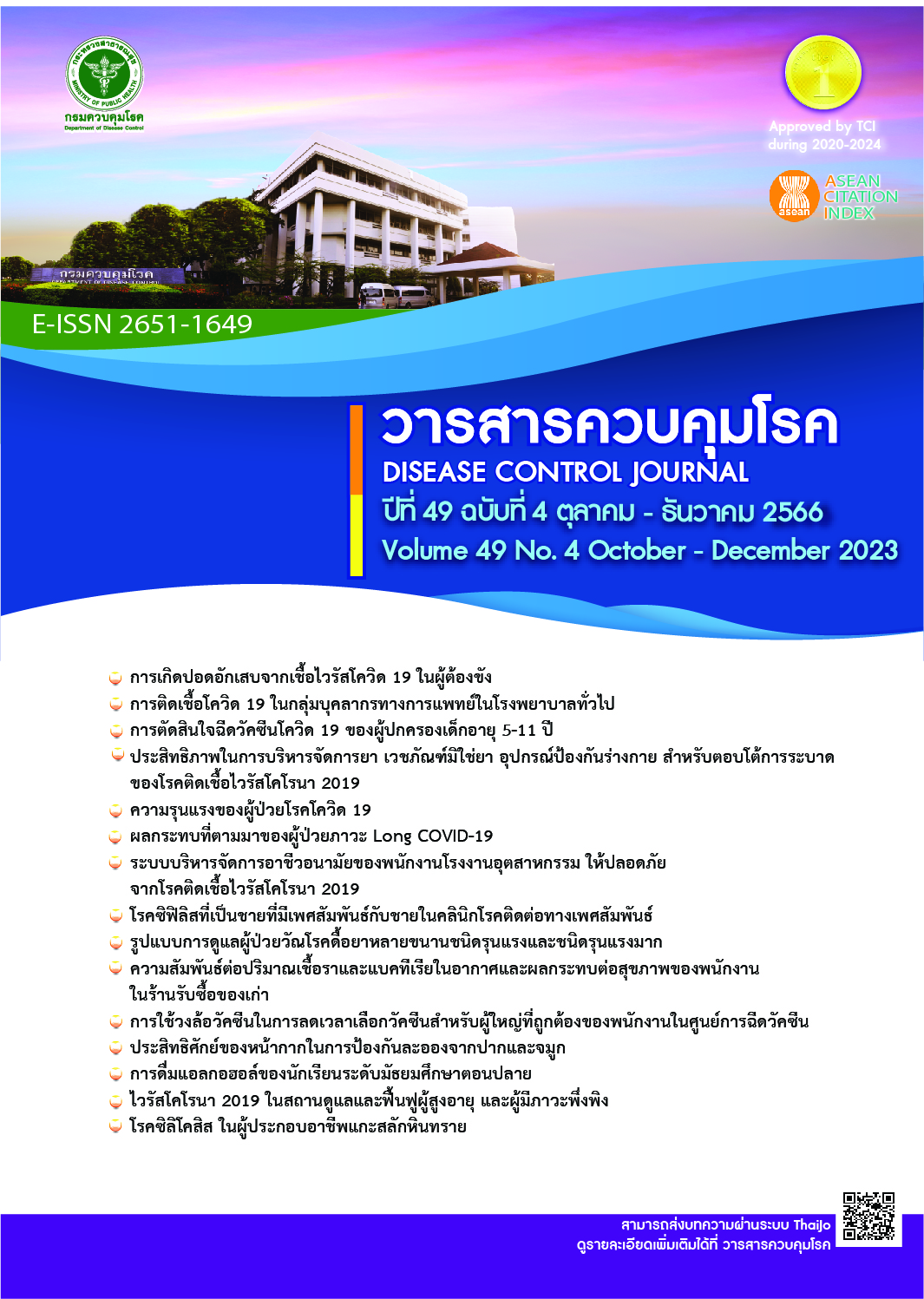
การศึกษาผลกระทบที่ตามมาของผู้ป่วยภาวะ Long COVID ในจังหวัดบุรีรัมย์
DOI:
https://doi.org/10.14456/dcj.2023.61คำสำคัญ:
ลองโควิด, อาการผิดปกติ, ผลกระทบ, จังหวัดบุรีรัมย์บทคัดย่อ
การวิจัยครั้งนี้มีวัตถุประสงค์เพื่อศึกษาพฤติกรรมการดำรงชีวิตก่อนและหลังการติดเชื้อไวรัสโคโรนา 2019 ของผู้ป่วยภาวะ Long COVID เพื่อศึกษาอาการผิดปกติหรือภาวะแทรกซ้อนที่เป็นภายหลังการติดเชื้อไวรัสโคโรนา 2019 เพื่อศึกษาระดับผลกระทบของการแสดงอาการผิดปกติหรือภาวะแทรกซ้อนที่เป็นภายหลังการติดเชื้อไวรัสโคโรนา 2019 และเพื่อเปรียบเทียบสัดส่วนการเกิดผลกระทบของการแสดงอาการผิดปกติหรือภาวะแทรกซ้อนที่เป็นภายหลังการติดเชื้อไวรัสโคโรนา 2019 ตามปัจจัยส่วนบุคคลของผู้ป่วยภาวะ Long COVID ในจังหวัดบุรีรัมย์ กลุ่มตัวอย่าง คือ ประชาชนที่เคยติดเชื้อไวรัสโคโรนา 2019 จำนวน 400 คน โดยใช้วิธีการสุ่มตัวอย่างแบบลูกโซ่ เครื่องมือที่ใช้ในงานวิจัย คือ แบบสอบถาม และวิเคราะห์ข้อมูลด้วย ความถี่ ร้อยละ และสถิติทดสอบไคสแควร์
ผลการวิจัย พบว่าพฤติกรรมการดำรงชีวิตของผู้ป่วยก่อนและหลังการติดเชื้อของผู้ตอบแบบสอบถามส่วนใหญ่
ไม่ต่างกัน โดยอาการผิดปกติหรือภาวะแทรกซ้อนที่เป็นภายหลังการติดเชื้อ 5 อันดับแรก ได้แก่ อ่อนเพลีย ไอเรื้อรัง นอนไม่หลับ เวียนศีรษะ กล้ามเนื้ออ่อนแรง ปวดตามตัว และข้อกระดูก ตามลำดับ ซึ่งระดับผลกระทบของอาการผิดปกติที่มีต่อร่างกายหรือการใช้ชีวิตในระดับที่ค่อนข้างน้อย และเมื่อเปรียบเทียบสัดส่วนการเกิดผลกระทบของการแสดงอาการผิดปกติหรือภาวะแทรกซ้อนที่เป็นภายหลังการติดเชื้อไวรัสโคโรนา 2019 พบว่าสัดส่วนของปัจจัยส่วนบุคคลที่แตกต่างกันทำให้มีระดับผลกระทบของการแสดงอาการที่ตามมาทั้งด้านสุขภาพร่างกายและด้านการใช้ชีวิต แตกต่างกันอย่างมีนัยสำคัญทางสถิติ (p<0.05)
Downloads
เอกสารอ้างอิง
Ministry of Public Health (TH). Progress report on the COVID-19 situation [Internet]. World Health Organizaton Thailand; 2022 [cited 2022 Aug 16]. 24 p. Available from: https://cdn.who.int/media/docs/default-source/searo/thailand/2022_06_08_tha-sitrep-239-covid-19_th.pdf?sfvrsn=2d393008_1 (in Thai)
Huang C, Wang Y, Li X, Ren L, Zhao J, Hu Y, et al. Clinical features of patients infected with 2019 novel coronavirus in Wuhan, China. Lancet [Internet]. 2020 [cited 2022 Aug 16]; 395(10223):497-506. Available from: https: //doi.org/10.1016/S0140-6736(20) 30183-5
Li X, Ma X. Acute respiratory failure in COVID-19: is it "typical" ARDS?. Crit care [Internet]. 2020 [cited 2022 Aug 20];24(1) :198. Available from: https://ccforum.biomedcentral.com/articles/ 10.1186/s13054-020-02911-9
Chierakul N. Suspected pneumonia COVID for the people. Moh Chao Ban. 2021;43(509):16-22. (in Thai)
Huang C, Huang L, Wang Y, Li X, Ren L, Gu X, et al. 6-month consequences of COVID-19 in patients discharged from hospital: a cohort study. Lancet [Internet]. 2021 [cited 2022 Aug 20];397(10270):220-32. Available from: https://doi.org/10.1016/S0140-6736(20)32656-8
Tantipasawasin P, Tantipasawasin S. Post-COVID condition (Long COVID). Chonburi Hospital Journal [Internet]. 2022 [cited 2022 Jun 29];47(1):67-84 p. Available from: https://thaidj.org/index.php/CHJ/article/view/11958 (in Thai)
Raveendran AV, Jayadevan R, Sashidharan S. Long COVID: An overview. Diabetes Metab Syndr [Internet]. 2021 [cited 2022 Oct 3];15(3):869-75. Available from: https://doi.org/10.1016/j.dsx.2021.04.007
Greenhalgh T, Knight M, A'Court C, Buxton M, Husain L. Management of post-acute COVID-19 in primary care. BMJ [Internet]. 2020 [cited 2022 Oct 3];370, m3026. Available from: https://doi.org/10.1136/bmj.m3026
Centers for Disease Control and Prevention. Long COVID or post-COVID conditions [Internet]. CDC; 2022 [cited 2022 Oct 3]. Available from: https://www.cdc.gov/coronavirus/2019-ncov/long-term-effects/index.html
Yong SJ. Long COVID or post-COVID-19 syndrome: putative pathophysiology, risk factors, and treatments. Infect Dis (Lond). 2022; 53(10):737-54.
Institute of Medical Research and Technology Assessment (TH). Long-Term impact on health of people who have been sick of COVID-19 and guidelines for health service provision. Journal of The Department of Medical Services [Internet]. 2022 [cited 2022 Dec 5];47(2):5-8 p. Available from: https://he02.tci-thaijo.org/index.php/JDMS/article/view/258247 (in Thai)
Cochran WG. Sampling techniques. 3rd ed. New York: John Wiley & Sons; 1977.
Srisa-ard B. Interpretation when using the estimation scale data collection tool. JEM-MSU. 1996;1(2):64-70. (in Thai)
Devellis RF. Scale development: theory and applications. 3rd ed. New York: Sage Publications; 2012.
Chantasorn U. Nonparametrics. Bangkok: Physics Center Publisher; 1998. (in Thai)
Ziauddeen N, Gurdasani D, O’Hara ME, Hastie C, Roderick P, Yao G, et al. Characteristics and impact of Long Covid: Findings from an online survey. PLoS One [Internet]. 2022 [cited 2022 Dec 5];17(3):e0264331. Available from: https://doi.org/10.1371/journal.pone. 0264331
Wangchalabovorn M, Weerametachai S, Leesri T. Prevalence of Post COVID-19 Conditions in SARS-CoV-2 Infected Patients at 3-month telephone follow-up. Regional Health Promotion Center 9 Journal [Internet]. 2022. [cited 2022 Dec 7];16(1):265-84 p. Available from: https://he02.tci-thaijo.org/index.php/RHPC9Journal/article/view/255986 (in Thai)
Channarong M. Factors Relating to Post Discharge Persistence of Symptoms After Hospitalization Among Persons with Coronavirus Disease 2019. Journal of Health and Nursing Education [Internet]. 2022. [cited 2022 Dec 7];28(1):1-6 p. Available from: https://he02.tci-thaijo.org/index.php/Jolbcnm/article/view/257651 /176186 (in Thai)
ดาวน์โหลด
เผยแพร่แล้ว
รูปแบบการอ้างอิง
ฉบับ
ประเภทบทความ
สัญญาอนุญาต
ลิขสิทธิ์ (c) 2023 วารสารควบคุมโรค

อนุญาตภายใต้เงื่อนไข Creative Commons Attribution-NonCommercial-NoDerivatives 4.0 International License.
บทความที่ลงพิมพ์ในวารสารควบคุมโรค ถือว่าเป็นผลงานทางวิชาการหรือการวิจัย และวิเคราะห์ตลอดจนเป็นความเห็นส่วนตัวของผู้เขียน ไม่ใช่ความเห็นของกรมควบคุมโรค ประเทศไทย หรือกองบรรณาธิการแต่ประการใด ผู้เขียนจำต้องรับผิดชอบต่อบทความของตน