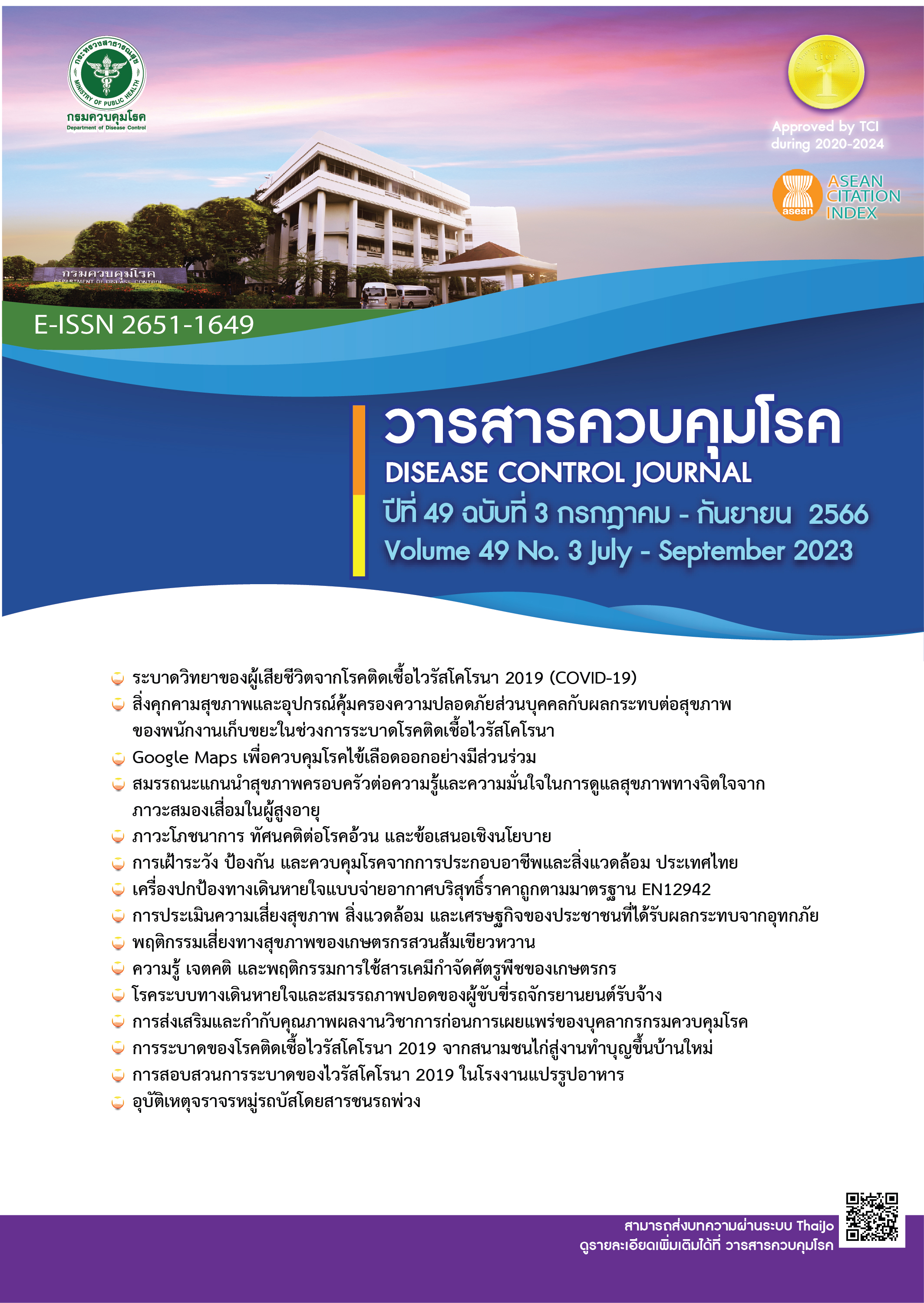
ภาวะโภชนาการ ทัศนคติต่อโรคอ้วน และข้อเสนอเชิงนโยบาย ต่อการเฝ้าระวังโรคอ้วนในบุคลากรมหาวิทยาลัยราชภัฏเชียงใหม่
DOI:
https://doi.org/10.14456/dcj.2023.45คำสำคัญ:
ดัชนีมวลกาย, ทัศนคติ, โรคอ้วน, ข้อเสนอเชิงนโยบายบทคัดย่อ
การวิจัยแบบผสานวิธีนี้มีวัตถุประสงค์เพื่อสำรวจภาวะโภชนาการ ทัศนคติต่อโรคอ้วน และสังเคราะห์ ข้อเสนอเชิงนโยบายต่อการเฝ้าระวังโรคอ้วน ใช้วิธีการศึกษาแบบผสานวิธี กลุ่มตัวอย่างในการวิจัยครั้งนี้เป็นบุคลากรในมหาวิทยาลัยราชภัฏเชียงใหม่ จำนวน 251 คน รวมถึงตัวแทนจากผู้มีส่วนได้ส่วนเสีย จำนวน 8 คน รวบรวมข้อมูลโดยแบบสอบถาม การสัมภาษณ์แบบไม่เป็นทางการ และการสัมมนาเชิงปฏิบัติการแบบมีส่วนร่วม วิเคราะห์ข้อมูลโดยใช้สถิติเชิงพรรณนา การวิเคราะห์การถดถอยพหุแบบเส้นตรง และการวิเคราะห์เชิงเนื้อหา ผลการศึกษา พบว่า ค่าเฉลี่ยดัชนีมวลกายของบุคลากรเท่ากับ 23.87+4.33 โดยบุคลากร ร้อยละ 6.37 ภาวะโภชนาการขาด ร้อยละ 41.83 ภาวะโภชนาการปกติ และร้อยละ 51.79 ภาวะโภชนาการเกิน ค่าเฉลี่ยคะแนน Beliefs About Obese Persons Scale (BAOP) เท่ากับ 14.96+4.01 เมื่อวิเคราะห์อำนาจการพยากรณ์ดัชนีมวลกายของบุคลากร มีตัวแปรที่สามารถอธิบายความผันแปรของดัชนีมวลกาย 1 ตัวแปรย่อย ได้แก่ อายุ (Beta=0.089, p=0.011) โดยร่วมกันพยากรณ์ดัชนีมวลกายได้ร้อยละ 25.2 อย่างมีนัยสำคัญทางสถิติ (p=0.05) ทั้งนี้ผู้มีส่วนได้ส่วนเสียเสนอแนะนโยบายด้านการเฝ้าระวังโรคอ้วนโดยการส่งเสริมพฤติกรรมการรับประทานอาหารที่เหมาะสม การสนับสนุนการออกกำลังกาย และการคัดกรองดัชนีมวลกายในกลุ่มบุคลากรอย่างต่อเนื่อง
Downloads
เอกสารอ้างอิง
World Obesity Federatio. Prevalence of obesity [Internet]. 2019 [cited 2021 Jul 26]. Available from: https://www.worldobesity.org/about/about -obesity/prevalence-of-obesity
World Health Organization. Obesity and Overweight [Internet]. 2020 [cited 2021 Jul 30]. Available from: https://www.who.int/news-room/fact-sheets/detail/obesity-and-overweight
Aekplakorn W, Inthawong R, Kessomboon P, Sangthong R, Chariyalertsak S, Putwatana P, et al. Prevalence and trends of obesity and association with socioeconomic status in Thai adults:
national health examination surveys, 1991-2009. Journal of Obesity. doi: 10.1155/2014 /410259 (in Thai)
Baker P, Friel S. Processed foods and the nutrition transition: evidence from Asia. Obesity Reviews. 2014;15(7):564-77.
Sakboonyarat B, Pornpongsawad C, Sangkool T, Phanmanas C, Kesonphaet N, Tangthongtawiet N, et al. Trends, prevalence and associated factors of obesity among adults in a rural community in Thailand: serial cross-sectional surveys, 2012 and 2018. BMC Public Health. 2020;20:850.
Tongdee S. An association between obesity and cardiovascular risk diseases among healthcare workers in Somdejphrajaotaksin Maharaj Hospital. Journal of the Phrae Hospital. 2019;27(1):38-50. (in Thai)
Morland K, Diez Roux AV, Wing S. Supermarkets, other food stores, and obesity: the atherosclerosis risk in communities study. Am J Prev Med 2006;30(4):333-9.
Chalao P, Loahasiriwong W, Udompanich S, Prachuntasen K. Situations and factors related to overweight and obesity among health personnel of Sub-District Health Promoting Hospitals, Sakonnakhon Province. The Journal of Baromarajonani College of Nusing, Nakhonratchasima. 2017;23(2):5-17. (in Thai)
Jaitae S. Nutritional status and attitudes towards obesity among personnel at Chiang Mai Rajabhat University [Master of Public Health]. Chiang Mai: Chiang Mai University; 2008. 51 p. (in Thai)
Olshansky SJ, Passaro DJ, Hershow RC, Layden J, Carnes BA, Brody J, et al. A potential decline in life expectancy in the United States in the 21st century. N Engl J Med. 2005;352(11):1138-45.
Daniel WW. Biostatistics: basic concepts and methodology for the health sciences (9th ed). New York: John Wiley & Sons; 2010.
Allison DB, Vincent CB, Harold EY. The measurement of attitudes toward and beliefs about obese persons. Int J Eat Disord. 1991;10(5):599-607.
Ozden D, Sibel AB, Artuner D. Validity and reliability of the Turkish version of the attitudes toward obese persons scale and the beliefs about obese persons scale. Clin Nurs Stud. 2014;2(4):105-17.
Center for Disease Control and Prevention. Body Mass Index (BMI) [Internet]. 2020 [cited 2020 Jun 30]. Available from:https://www.cdc.gov/healthyweight/assessing/bmi/index.html
Matthew BM, Michael AH, Johnny S. Qualitative data analysis: a methods sourcebook. 3rd edition. Arizona: SAGE Publications; 2014.
Chanidtar A. A study of the relationship between dietary habits and body mass index of faculty of medicine Vajira hospital, Navamindradhiraj University personnels. Journal of urban medicine. 2019;63(1):41-54. (in Thai)
Poonnak P. Work ability assessment and related factors among health workers in Chaopraya Yomraj Hospital. Dis Control J. 2021;47(1):58-71. (in Thai)
Kim JH, Sakong J. Life style and perception of obesity of male white collar workers. Korean J Community Nutr. 2006;11(4):479-87.
Rongmuang D. Body weight and shape self-schema, body image satisfaction, and eating disorder behaviors among young adult women, Suratthani. Journal of nurses’ association of Thailand, north-eastern division. 2013;31(4):170-80. (in Thai)
Pakin W. Knoledge, food consumption and nutritional status of softball players, Chiang Mai university 2015 [Master of science (Nutrition education)]. Chiang Mai: Chiang Mai University; 2015. (in Thai)
ดาวน์โหลด
เผยแพร่แล้ว
รูปแบบการอ้างอิง
ฉบับ
ประเภทบทความ
สัญญาอนุญาต
ลิขสิทธิ์ (c) 2023 วารสารควบคุมโรค

อนุญาตภายใต้เงื่อนไข Creative Commons Attribution-NonCommercial-NoDerivatives 4.0 International License.
บทความที่ลงพิมพ์ในวารสารควบคุมโรค ถือว่าเป็นผลงานทางวิชาการหรือการวิจัย และวิเคราะห์ตลอดจนเป็นความเห็นส่วนตัวของผู้เขียน ไม่ใช่ความเห็นของกรมควบคุมโรค ประเทศไทย หรือกองบรรณาธิการแต่ประการใด ผู้เขียนจำต้องรับผิดชอบต่อบทความของตน