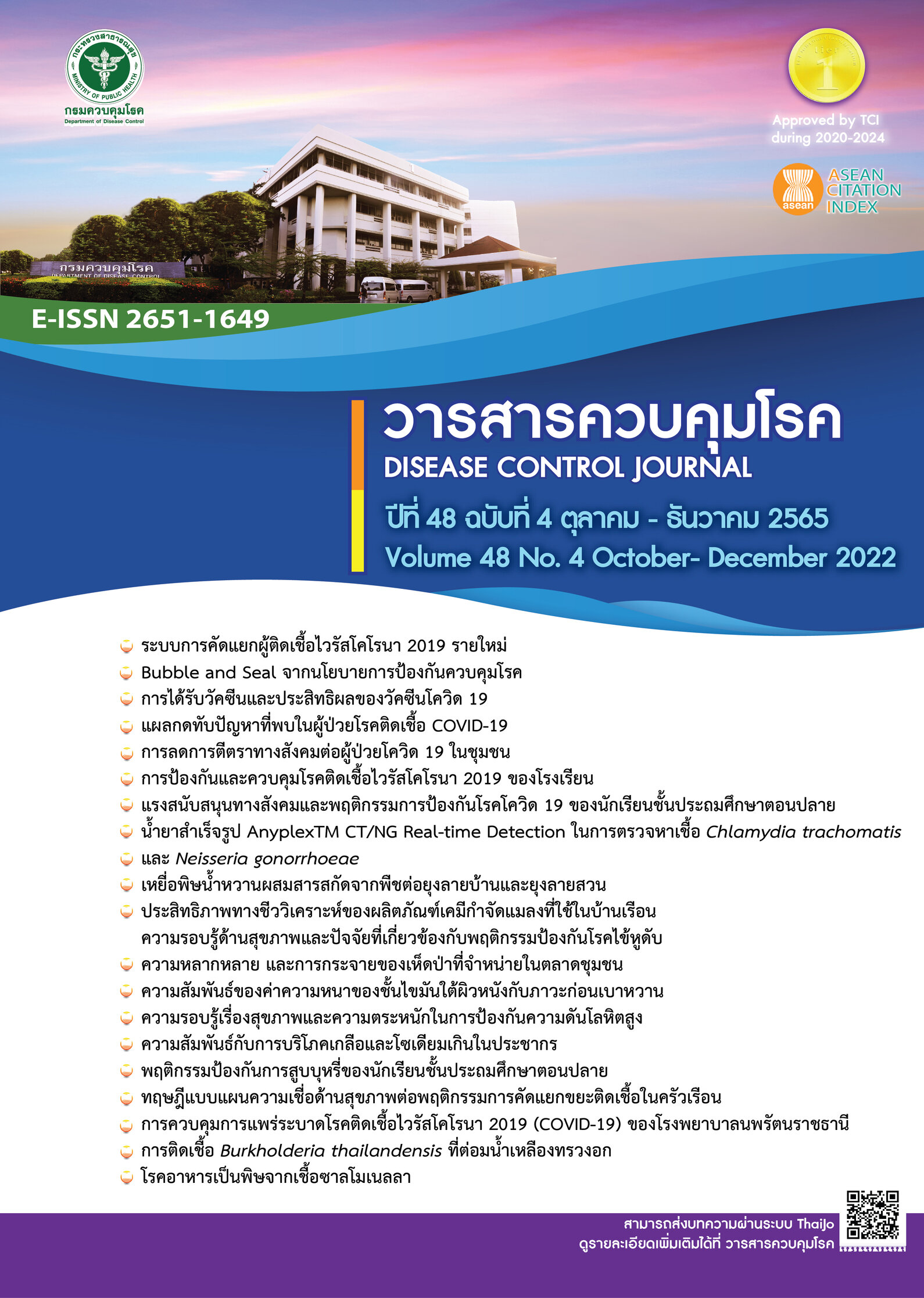
แผลกดทับในผู้ป่วยโรคติดเชื้อ COVID-19 ในหอผู้ป่วยวิกฤต : กรณีศึกษาระหว่างการระบาดระยะที่ 1
DOI:
https://doi.org/10.14456/dcj.2022.63คำสำคัญ:
โรคติดเชื้อ Covid-19, แผลกดทับ, คะแนนบราเดน, ภาวะโภชนาการบทคัดย่อ
การระบาดของโรคติดเชื้อ COVID-19 เป็นวิกฤตสุขภาพระดับโลกและเป็นความท้าทายที่สุดในยุคนี้ ซึ่งมีผลกระทบต่อผู้ป่วย ญาติ และบุคลากรทางการแพทย์ โดยมีผลกับค่าใช้จ่าย ร่างกาย จิตใจ และการดูแลภาวะแทรกซ้อนแผลกดทับ การวิจัยครั้งนี้มีวัตถุประสงค์เพื่อรายงานอุบัติการณ์ และปัจจัยที่มีผล กับการเกิดแผลกดทับในโรคติดเชื้อ COVID-19 ในแผนกผู้ป่วยวิกฤตโรงพยาบาลรามาธิบดีจักรีนฤบดินทร์ กรณีศึกษาระหว่างการระบาดระยะที่ 1 ในประเทศไทย จำนวน 18 ราย วิเคราะห์ข้อมูลโดยใช้สถิติ ได้แก่ ความถี่ ร้อยละ ค่าเฉลี่ย ค่ามัธยฐาน และส่วนเบี่ยงเบนมาตรฐาน และวิเคราะห์ปัจจัยที่มีความสัมพันธ์ กับการเกิดแผลกดทับ ในผู้ป่วยโรคติดเชื้อ COVID-19 ทำการศึกษาตั้งแต่วันที่ 1 มกราคม-31 กรกฎาคม 2563 จากเวชระเบียนอิเล็กทรอนิกส์ของผู้ป่วยย้อนหลัง ผลการศึกษา พบว่า ผู้ป่วยวิกฤตที่ติดเชื้อ COVID-19 เกิดแผลกดทับ 5 ราย (ร้อยละ 27.78) ปัจจัยที่มีความสัมพันธ์กับการเกิดแผลกดทับ ได้แก่ ภาวะโภชนาการ (p=0.004) คะแนนบราเดน (p=0.008) ระยะเวลาที่นอนรักษาตัวในหอผู้ป่วยวิกฤต (p=0.036) การใส่ท่อช่วยหายใจ (p=0.002) การได้รับยา vasopressor (p=0.002) และการได้รับยา sedative drug (p=0.002) ผลการศึกษาชี้ให้เห็นว่าปัญหาแผลกดทับในหน่วยผู้ป่วยวิกฤตมีความสำคัญ ดังนั้นผู้ป่วยวิกฤตควรได้รับการรักษาอย่างเหมาะสมเพื่อป้องกันภาวะแทรกซ้อนที่จะเกิดขึ้นต่อไป
Downloads
เอกสารอ้างอิง
Yuanjai A, Unruan K, Woramalee S, Watcharakasemsuntron J. A case of coronavirus disease 2019: Case Report. Siriraj Med Bull. 2020;13(2):155-63. (in Thai)
Manmana S, Iamsirithaworn S, Uttayamakul S. Coronavirus Disease-19 (COVID-19). Bamrasnaradura Infect Dis Inst. 2020;14(2):1-10. (in Thai)
Berlin DA, Gulick RM, Martinez FJ. Severe COVID-19. N Engl J Med. 2020;383:2451-60.
Ahtiala M, Soppi E, Wiksten A, Koskela H, Gronlund JA. Occurrence of pressure ulcers and risk factors in a mixed medical-surgical ICU-a cohort study. J Intensive Care Soc. 2014;15(4):340-3.
Massachusetts General Hospital. Analgesia & Sedation in COVID-19: A Stepwise Approach for MGH [Internet]. 2020 [cited 2021 Aug 1]. Available from: https://www.massgeneral.org/assets/MGH/pdf/news/coronavirus/COVID-19-sedation-summary-guideline.pdf
James A. Russell. Vasopressor therapy in critically ill patients with shock. Intensive Care Med. 2019;45:1503–17.
Team V, Team L, Jones A, Teede H, Weller CD. Pressure injury prevention in COVID-19 patients with acute respiratory distress syndrome. Front Med. 2021;7:1-8.
Sala JJ, Mayampurath A, Solmos S, Vonderheid SC, Banas M, Souza AD, et al. Predictors of pressure injury development in critically ill adults: A retrospective cohort study. Intensive Crit Care Nurs. 2021;62:1-6.
Lavin W, Yooyadmak P, Praepataraprasit R. The nutritional status and association of new pressure ulcer in patients who transfer from in-patient ward to intensive care unit (ICU). Nurs Health Sci. 2020;43(3):161-71. (in Thai)
Nualsrithong P, Katnimit C, Muansatit T. The results of using starch Tanaka powder in preventing pressure injury stage 1 in the elderly at male surgical ward at Vachira Phuket hospital. Reg Med J. 2017;31(1):179-89.
Qaddumi JAS, Almahmoud O. Pressure ulcers prevalence and potential risk factors among intensive care unit patients in governmental hospitals in Palestine: a cross-sectional study. Open Public Health J. 2019;12:121-6.
Bootthumpan O, Lavin W. Association between risk factors and pressure injury patients in cardiac care unit : A retrospective matched-paired case control study design. Mahidol R2R e-Journal. 2020;7:140-8. (in Thai)
Dongpho P. Effectiveness of clinical practice guidelines implementation for pressure sore preventation. Thammasat Medical Journal. 2019;19(2):315-23. (in Thai)
Labeau SO, Afonso E, Benbenishty J, Blackwood B, Boulanger C, Brett SJ, et al. Prevalence, associated factors and outcomes of pressure injuries in adult intensive care unit patients: the Decub ICUs study. Intensive Care Med. 2021;47:160–9.
Wasse CL, Delhougne G, Gayle JA, Dreyfus J, Larson B. Risk of readmissions, mortality, and hospital-acquired conditions across hospital-acquired pressure injury (HAPI) stages in a US National hospital discharge database. Int Wound J. 2020;17(6):1924-34.
Vetrano DL, Landi F, Buyser SL, Carfì A, Zuccala G, Mirko Petrovic, et al. Predictors of length of hospital stay among older adults admitted to acute care wards: a multicentre observational study. Eur J Case Rep Intern Med. 2014;25:56-62.
Lim ML, Ang SY. Impact of hospital-acquired pressure injuries on hospital costs - experience of a tertiary hospital in Singapore. Wound practice and research. 2017;25(1):42-7.
Matozinhos FP, Melendez GV, Tiensoli SD, Moreira AD, Gomes FSL. Factors associated with the incidence of pressure ulcer during hospital stay. Rev Esc Enferm USP. 2017;51:1-7.
Bhirommuang N, Komindr S, Jayanama K. Impact of nutritional status on length of stay and hospital costs among patients admitted to a tertiary care hospital in Thailand. Asia Pac J Clin Nutr. 2019;28(2):252-9.
Dıaz-Caro I, Gomez-Heras SG. Incidence of hospital-acquired pressure ulcers in patients with "minimal risk" according to the "Norton-MI" scale PLOS ONE. 2020:1-16.
Deng X, Yu T, Hu A. Predicting the risk for hospital-acquired pressure ulcers in critical care patients. Crit Care Nurse. 2017;37(4):1-11.
Cox J. Predictive power of the Braden scale for pressure sore risk in adult critical care patients: A Comprehensive Review. J Wound Ostomy Continence Nurs. 2012;39(6):613-21.
Apostolopoulou E, Tselebis A, Terzis K, Kamarinou E, Lambropoulos L, Kalliakmanis A. Pressure ulcer incidence and risk factors in ventilated intensive care patients. Health Sci J. 2014;8(3):333-42.
Department of Medicine service (TH). (Personal Protective Equipment, PPE) [Internet]. 2020 [cited 2021 Aug 1]. Available from: ddc.moph.go.th/viralpneumonia/file/g_ health_care/g07_ppe_200463.pdf (in Thai)
ดาวน์โหลด
เผยแพร่แล้ว
รูปแบบการอ้างอิง
ฉบับ
ประเภทบทความ
สัญญาอนุญาต
ลิขสิทธิ์ (c) 2022 วารสารควบคุมโรค

อนุญาตภายใต้เงื่อนไข Creative Commons Attribution-NonCommercial-NoDerivatives 4.0 International License.
บทความที่ลงพิมพ์ในวารสารควบคุมโรค ถือว่าเป็นผลงานทางวิชาการหรือการวิจัย และวิเคราะห์ตลอดจนเป็นความเห็นส่วนตัวของผู้เขียน ไม่ใช่ความเห็นของกรมควบคุมโรค ประเทศไทย หรือกองบรรณาธิการแต่ประการใด ผู้เขียนจำต้องรับผิดชอบต่อบทความของตน