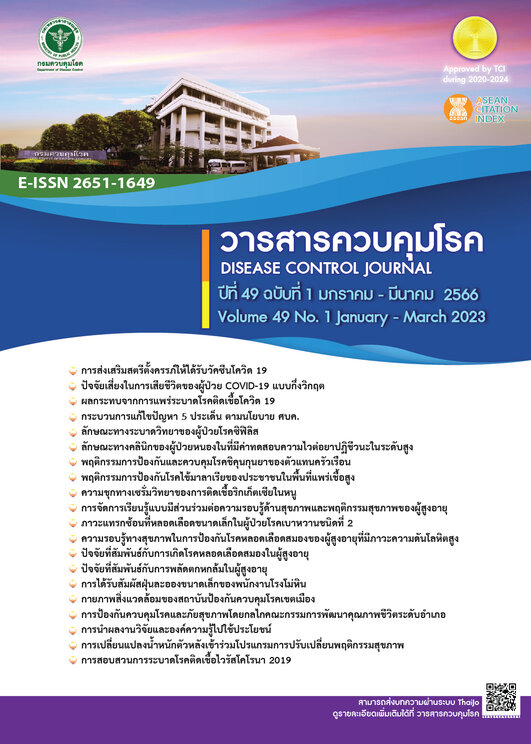
ภาวะแทรกซ้อนที่หลอดเลือดขนาดเล็กในผู้ป่วยโรคเบาหวานชนิดที่ 2 ที่ควบคุมระดับน้ำตาลในเลือดไม่ดี โรงพยาบาลสมุทรปราการ: การวิเคราะห์การรอดชีพ
DOI:
https://doi.org/10.14456/dcj.2023.11คำสำคัญ:
โรคเบาหวานชนิดที่ 2, ผู้ป่วยเบาหวานควบคุมน้ำตาลไม่ดี, ภาวะแทรกซ้อนที่หลอดเลือดขนาดเล็กบทคัดย่อ
โรคเบาหวานเป็นภาวะสาธารณสุขที่ยังคงเป็นปัญหาสำคัญของทั่วโลก ผู้ป่วยที่ไม่สามารถควบคุมน้ำตาลในเลือดได้ดีทำให้มีความเสี่ยงต่อการเกิดภาวะแทรกซ้อนจากเบาหวาน งานวิจัยนี้มีวัตถุประสงค์เพื่อประมาณระยะเวลาการเกิดภาวะแทรกซ้อนที่หลอดเลือดแดงขนาดเล็ก และระบุปัจจัยการเกิดภาวะแทรกซ้อนที่หลอดเลือดแดงขนาดเล็กในผู้ป่วยโรคเบาหวานชนิดที่ 2 ที่ควบคุมระดับในเลือดได้ไม่ดี ในโรงพยาบาลสมุทรปราการ โดยการรวบรวมประวัติของผู้ป่วยโรคเบาหวานชนิดที่ 2 ที่ขึ้นทะเบียนรักษาโรคเบาหวาน ตั้งแต่วันที่ 1 ตุลาคม พ.ศ. 2559 ถึง 30 กันยายน พ.ศ. 2563 จำนวน 1,006 ราย ที่มีประวัติการควบคุมระดับน้ำตาลในเลือดได้ไม่ดี จากผลการศึกษาพบว่า มีผู้ป่วยเกิดภาวะแทรกซ้อนร้อยละ 17.2 การเกิดภาวะแทรกซ้อนที่ไตมีค่าเฉลี่ยระยะเวลาการเกิดโรคสั้นที่สุด 2.14 ปี จากการวิเคราะห์การรอดชีพพบว่า ปัจจัยที่มีความสัมพันธ์อย่างมีนัยสำคัญทางสถิติกับการเกิดภาวะแทรกซ้อนที่หลอดเลือดแดงขนาดเล็ก ได้แก่ เพศ (HR=1.40; p=0.037),สิทธิการรักษา (HR=1.87; p=0.011) และการใช้อินซูลิน (HR=1.69; p=0.006) การระบุลักษณะของผู้ป่วยเบาหวานที่ควบคุมน้ำตาลไม่ดี เป็นแนวทางในการคัดกรองเพื่อเตรียมพร้อมการให้แนวทางการป้องกันการเกิดภาวะแทรกซ้อนที่หลอดเลือดขนาดเล็กได้อย่างทันเวลา
Downloads
เอกสารอ้างอิง
Diabetes association of Thailand. Clinical practice guideline for diabetes 2017. 3rd ed. Pathum Thani: Diabetes association of Thailand; 2017. (in Thai)
Ogurtsova K, da Rocha Fernandes JD, Huang Y, Linnenkamp U, Guariguata L, Cho NH, et al. IDF Diabetes Atlas: Global estimates for the prevalence of diabetes for 2015 and 2040. Diabetes Res Clin Pract. 2017;128:40-50.
Saeedi P, Petersohn I, Salpea P, Malanda B, Karuranga S, Unwin N, et al. Global and egional diabetes prevalence estimates for 2019 and projections for 2030 and 2045: Results from the International Diabetes Federation Diabetes Atlas, 9th ed. Diabetes Res Clin Pract. 2019;157:1-9(107843).
Cho NH, Shaw JE, Karuranga S, Huang Y, da Rocha Fernandes JD, Ohlrogge AW, et al. IDF Diabetes Atlas: Global estimates of diabetes prevalence for 2017 and projections for 2045. Diabetes Res Clin Pract. 2018;138:271-81.
Khan MAB, Hashim MJ, King JK, Govender RD, Mustafa H, Al Kaabi J. Epidemiology of Type 2 Diabetes Global Burden of Disease and Forecasted Trends. J Epidemiol Glob Health. 2020;10(1):107-11.
Laotaveerungrueng N, Wanthong S, Wannachalee T, Lertwattanarak R. Prevalence of chronic microvascular complications and diabetic foot problems in patients with diabetes mellitus at siriraj hospital. J Med Assoc Thai. 2018;101(10):1349-55 (in Thai).
Zhang P, Lu J, Jing Y, Tang S, Zhu D, Bi Y. Global epidemiology of diabetic foot ulceration: a systematic review and meta-analysis. Ann Med. 2017;49(2):106-16.
Hoque S, Muttalib MA, Islam MI, Happy AT. Evaluation of Different HbA1c Levels To Assess the Risk of Peripheral Neuropathy Among Type 2 Diabetic Patients Along With Other Conventional Risk Factors. Bangladesh Med Res Counc Bul. 2016;42:95-103.
Karki DB, Yadava SK, Pant S, Thusa N, Dangol E, S1 G. Prevalence of Sensory Neuropathy in Type 2 Diabetes Mellitus and Its Correlation with Duration of Disease. Kathmandu Univ Med J (KUMJ). 2016;14(54):120-24.
Gray N, Picone G, Sloan F, Yashkin A. Relation between BMI and diabetes Mellitus and its complications among US older adults. South Med J. 2015;108(1):29-36.
Papanas N, Ziegler D. Risk Factors and Comorbidities in Diabetic Neuropathy: An Update 2015. Rev Diabet Stud. 2015;12(1-2):48-62.
Aisha Q, Sumera S, Lubna N, Ghazala Y, Nazish I. Prevalence of Risk Factors Promoting Diabetic Neuropathy: Pak J Neurological Sci. 2019;14(2):16-23.
Laiteerapong N, Ham SA, Gao Y, Moffet HH, Liu JY, Huang ES, et al. The Legacy Effect in Type 2 Diabetes: Impact of Early Glycemic Control on Future Complications (The Diabetes & Aging Study). Diabetes Care. 2019;42(3):416-26.
Liu X, Xu Y, An M, Zeng Q. The risk factors for diabetic peripheral neuropathy: A meta-analysis. PloS one. 2019;14(2):e0212574.
Sabanayagam C, Banu R, Chee ML, Lee R, Wang YX, Tan G, et al. Incidence and progression of diabetic retinopathy: a systematic review. Lancet Diabetes Endocrinol. 2019;7(2):140-9.
El Haddad OA, Saad MK. Prevalence and risk factors for diabetic retinopathy among Omani diabetics. Br J Ophthalmol. 1998;82(8):901-6.
Strategy and Planning Division, Office of the Ministry of Public Health permanent seretary (TH). Public health resources information report 2019. n.p.; 2019
Hoque S, Muttalib MA, Islam MI, Happy AT. Evaluation of Different HbA1c Levels to Assess the Risk of Peripheral Neuropathy Among Type 2 Diabetic Patients Along with Other Conventional Risk Factors. Bangladesh Med Res Counc Bul. 2016;42:95-103.
Singh SS, Roeters-van Lennep JE, Lemmers RFH, van Herpt TTW, Lieverse AG, Sijbrands EJG, et al. Sex difference in the incidence of microvascular complications in patients with type 2 diabetes mellitus: a prospective cohort study. Acta Diabetol. 2020;57(6):725-32.
Huo X, Zhang J, Guo X, Lu J, Li J, Zhao W, et al. Gender Difference in the Association of Early- vs. Late-Onset Type 2 Diabetes with Non-Fatal Microvascular Disease in China: A Cross-sectional Study. Front Endocrinol (Lausanne). 2018;9:1-15.
Orem DE. Nursing: Concepts of practice Health Promotion. WHO Publication. 1988.
Hurst C, Thinkhamrop B, Tran HT. The Association between Hypertension Comorbidity and Microvascular Complications in Type 2 Diabetes Patients: A Nationwide Cross-Sectional Study in Thailand. Diabetes Metab J. 2015;39(5):395-404.
Zhao H, Shu L, Huang W, Wang W, Song G. Difference Analysis of Related Factors in Macrovascular and Microvascular Complications In Chinese Patients With Type 2 Diabetes Mellitus: A Case-Control Study Protocol. Diabetes Metab Syndr Obes. 2019;12:2193-200.
ดาวน์โหลด
เผยแพร่แล้ว
รูปแบบการอ้างอิง
ฉบับ
ประเภทบทความ
สัญญาอนุญาต
ลิขสิทธิ์ (c) 2023 วารสารควบคุมโรค

อนุญาตภายใต้เงื่อนไข Creative Commons Attribution-NonCommercial-NoDerivatives 4.0 International License.
บทความที่ลงพิมพ์ในวารสารควบคุมโรค ถือว่าเป็นผลงานทางวิชาการหรือการวิจัย และวิเคราะห์ตลอดจนเป็นความเห็นส่วนตัวของผู้เขียน ไม่ใช่ความเห็นของกรมควบคุมโรค ประเทศไทย หรือกองบรรณาธิการแต่ประการใด ผู้เขียนจำต้องรับผิดชอบต่อบทความของตน