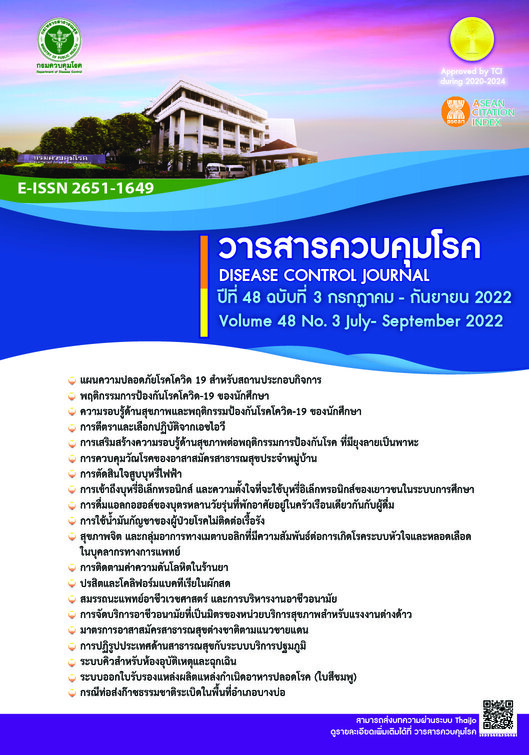
การรับรู้ ทัศนคติ การเข้าถึงบุหรี่อิเล็กทรอนิกส์ และความตั้งใจที่จะใช้บุหรี่อิเล็กทรอนิกส์ของเยาวชนในระบบการศึกษา ภาคเหนือ ประเทศไทย
DOI:
https://doi.org/10.14456/dcj.2022.47คำสำคัญ:
การรับรู้, ทัศนคติ, การเข้าถึงบุหรี่อิเล็กทรอนิกส์, ความตั้งใจที่จะใช้บุหรี่อิเล็กทรอนิกส์, เยาวชนบทคัดย่อ
การวิจัยเชิงพรรณนานี้มีวัตถุประสงค์เพื่อศึกษาการรับรู้ ทัศนคติ การเข้าถึงบุหรี่อิเล็กทรอนิกส์ ความตั้งใจที่จะใช้บุหรี่อิเล็กทรอนิกส์ และปัจจัยที่มีความสัมพันธ์กับความตั้งใจที่จะใช้บุหรี่อิเล็กทรอนิกส์ของเยาวชนในระบบการศึกษา ภาคเหนือของประเทศไทย กลุ่มตัวอย่างจำนวน 1,328 คน ใช้วิธีการสุ่มแบบหลายขั้นตอน เครื่องมือที่ใช้คือแบบสอบถามให้กลุ่มตัวอย่างตอบด้วยตนเอง ที่ระดับนัยสำคัญ 5% วิเคราะห์ข้อมูลโดยใช้สถิติเชิงพรรณนา สัมประสิทธิ์สหสัมพันธ์ของเพียร์สัน และสถิติสหสัมพันธ์อีต้า ผลการวิจัยพบว่าเยาวชนที่ตอบแบบสอบถามเป็นเพศชายร้อยละ 57.4 อายุ 15-22 ปี อายุเฉลี่ย 16.78 ปี กำลังศึกษาระดับอาชีวศึกษาร้อยละ 58.3 เยาวชนสูบบุหรี่ร้อยละ 9.1 การรับรู้เกี่ยวกับบุหรี่อิเล็กทรอนิกส์ อยู่ในระดับปานกลางร้อยละ 72.0 ทัศนคติต่อบุหรี่อิเล็กทรอนิกส์ อยู่ในระดับปานกลางร้อยละ 77.2 การเข้าถึงบุหรี่อิเล็กทรอนิกส์อยู่ในระดับปานกลางร้อยละ 63.8 ความตั้งใจที่จะใช้บุหรี่อิเล็กทรอนิกส์อยู่ในระดับน้อยร้อยละ 74.5 เพศ ค่าใช้จ่ายส่วนตัวที่ได้รับต่อเดือน สถานศึกษา ระดับชั้นที่กำลังศึกษา การพักอาศัยกับผู้ปกครอง การสูบบุหรี่ของเยาวชน การสูบบุหรี่ของผู้ปกครอง การสูบบุหรี่อิเล็กทรอนิกส์ของผู้ปกครอง การรับรู้เกี่ยวกับบุหรี่อิเล็กทรอนิกส์ ทัศคติต่อบุหรี่อิเล็กทรอนิกส์ และการเข้าถึงบุหรี่อิเล็กทรอนิกส์ มีความสัมพันธ์กับความตั้งใจที่จะใช้บุหรี่อิเล็กทรอนิกส์ อย่างมีนัยสำคัญทางสถิติที่ระดับ 0.05 ผู้ปกครองควรเป็นแบบอย่างที่ดีให้กับเยาวชน สถานศึกษา ครู/อาจารย์ควรพูดคุยกับเยาวชนในสถานศึกษาถึงพิษภัยของบุหรี่อิเล็กทรอนิกส์ หน่วยงานปราบปรามที่มีหน้าที่ควบคุมบุหรี่อิเล็กทรอนิกส์ต้องการปฏิบัติตามกฎหมายอย่างเคร่งครัด
Downloads
เอกสารอ้างอิง
The Tobacco Products Control Act of A.D. 2017. The Government Gazette Volume 134, Part 39 A (April 5, 2017). (in Thai)
Notification of the Ministry of Commerce. Prohibition of importing Hookah and Electronic Hookah or Electronic cigarette into Thailand B.E. 2557 (A.D.2014). The Government Gazette Volume 131, Special Section 268 D (December 24, 2014). (in Thai)
Mahidol University, Tobacco Control Research and Knowledge Management Center. Tobacco Consumption Statistics Report of Thailand B.E. 2561. Bangkok: Tobacco Control Research and Knowledge Management Center; 2561. (in Thai)
Thai Health Promotion Foundation, Thai Health Center (TH). General Characteristics of Adolescents [Internet]. 2019 [cited 2019 Dec 5]. Available from: https://www.thaihealth.or.th/Content/41762 (in Thai)
King BA, Jones CM, Baldwin GT, Briss PA. The EVALI and youth vaping epidemics—implications for public health. NEJM. 2020;382(8):689-91.
Hughes K, Bellis MA, Hardcastle KA, McHale P, Bennett A, Ireland R, et al. Associations between e-cigarette access and smoking and drinking behaviours in teenagers. BMC public health. 2015;15(1):1-9.
Berg CJ, Barr DB, Stratton E, Escoffery C, Kegler M. Attitudes toward e-cigarettes, reasons for initiating e-cigarette use, and changes in smoking behavior after initiation: a pilot longitudinal study of regular cigarette smokers. OJPM. 2014;4(10):789.
Amrock SM, Zakhar J, Zhou S, Weitzman M. Perception of e-cigarette harm and its correlation with use among US adolescents. NTR. 2015;17(3):330-6.
Wayne WD. Biostatistics: A foundation of analysis in the health sciences. 6th ed. New Jersey: John Wiley & Sons; 1995.
Hinkle DE, Wiersma W, Jurs SG. Applied Statistics for the Behavioral Sciences. Michigan: Rand McNally; 1998.
Chidnayee S, Yottavee W. Factors Related with Smoking Behaviors of Youth at Uttaradit. Boromarajonani College of Nursing, Uttaradit Journal. 2018;10(1):83-93. (in Thai)
Green MJ, Gray L, Sweeting H, Benzeval M. Socioeconomic patterning of vaping by smoking status among UK adults and youth. BMC public health. 2020;20(1):183. https://doi.org/10.1186/s12889-020-8270-3.
Phetphum C, Prajongjeep A, Thawatchaijareonying K, Wongwuttiyan T, Wongjamnong M, Yossuwan S, et al. Personal and perceptual factors associated with the use of electronic cigarettes among university students in northern Thailand. TID. 2021;31(19):1-9. doi: 10.18332/tid/133640.
Jiang N, Cleland CM, Wang MP, Kwong A, Lai V, Lam TH. Perceptions and use of e-cigarettes among young adults in Hong Kong. BMC public health. 2019;19(1):1-9.
Boonpen P, Mentara P, Boonpen P. E-cigarettes Behavior and Smoking Cessation Behavior of Youth Smoker in Higher Education Institute, Bangkok. Journal of Humanities and Social Sciences. 2019;11(22):111-27. (in Thai)
Balwicki L, Smith D, Balwicka-Szczyrba M, Gawron M, Sobczak A, Goniewicz ML. Youth Access to Electronic Cigarettes in an Unrestricted Market: A Cross-Sectional Study from Poland. IJERPH. 2018;15(7):1465.
ดาวน์โหลด
เผยแพร่แล้ว
รูปแบบการอ้างอิง
ฉบับ
ประเภทบทความ
สัญญาอนุญาต
ลิขสิทธิ์ (c) 2022 วารสารควบคุมโรค

อนุญาตภายใต้เงื่อนไข Creative Commons Attribution-NonCommercial-NoDerivatives 4.0 International License.
บทความที่ลงพิมพ์ในวารสารควบคุมโรค ถือว่าเป็นผลงานทางวิชาการหรือการวิจัย และวิเคราะห์ตลอดจนเป็นความเห็นส่วนตัวของผู้เขียน ไม่ใช่ความเห็นของกรมควบคุมโรค ประเทศไทย หรือกองบรรณาธิการแต่ประการใด ผู้เขียนจำต้องรับผิดชอบต่อบทความของตน