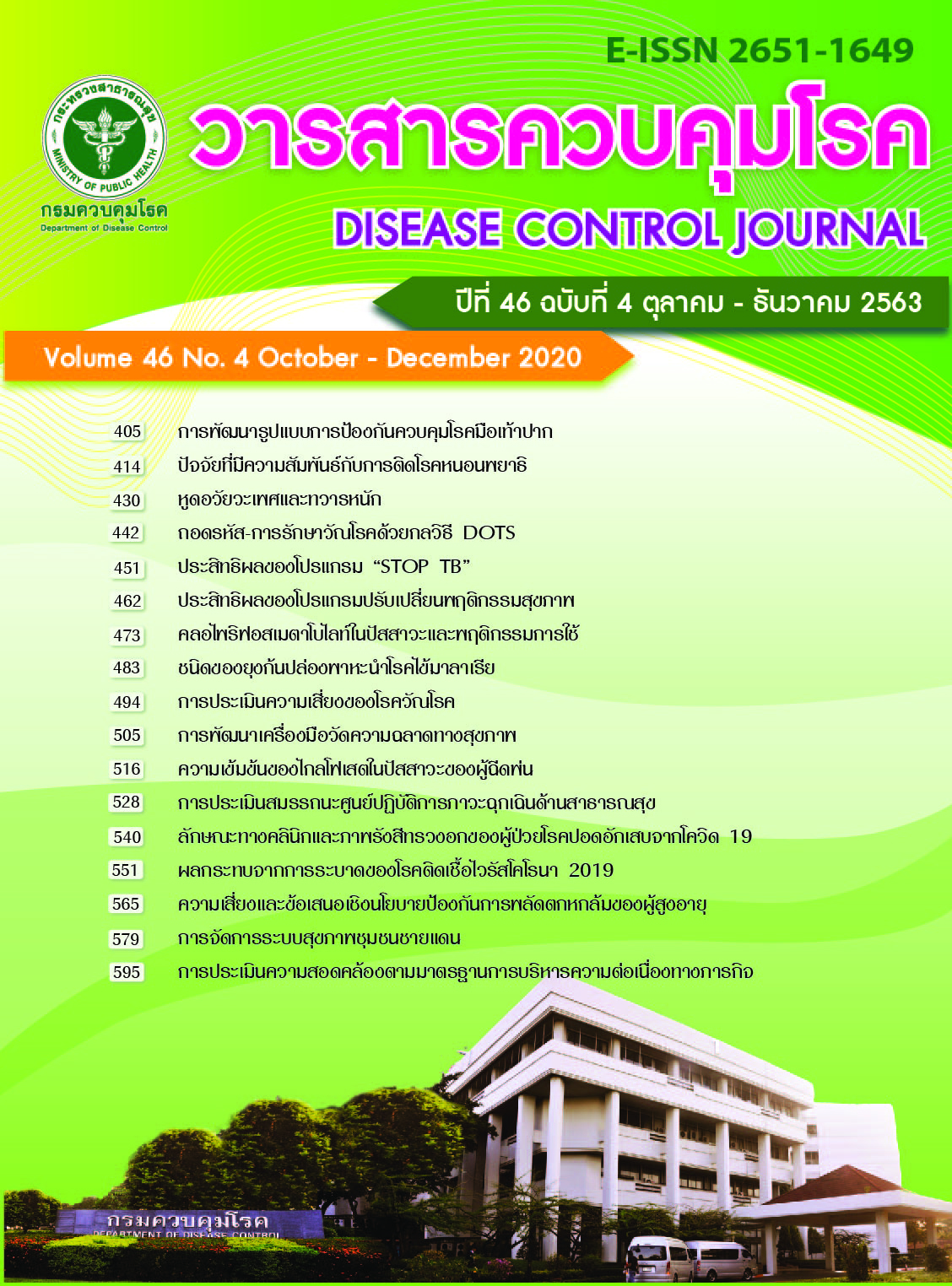
ความเข้มข้นของไกลโฟเสตในปัสสาวะของผู้ฉีดพ่น ในจังหวัดนครสวรรค์ ประเทศไทย
DOI:
https://doi.org/10.14456/dcj.2020.48คำสำคัญ:
ไกลโฟเสต, ปัสสาวะ, ผู้ฉีดพ่น, HPLC-FLDบทคัดย่อ
สารไกลโฟเสตเป็นสารที่ใช้อย่างกว้างขวางในการควบคุมหญ้าและวัชพืชใบกว้างในพื้นที่การเกษตร งานวิจัยนี้มีวัตถุประสงค์เพื่อวิเคราะห์ความเข้มข้นของสารไกลโฟเสตในปัสสาวะของกลุ่มผู้ฉีดพ่น จำนวน 49 คน วิธีการศึกษาโดยมีการสัมภาษณ์กลุ่มตัวอย่างและเก็บตัวอย่างปัสสาวะ 3 ช่วงเวลา ได้แก่ ปัสสาวะแรกตอนเช้าวันก่อนฉีดพ่น ปัสสาวะหลังฉีดพ่น และปัสสาวะแรกในเช้าวันถัดไปหลังจากวันฉีดพ่น วิเคราะห์หาสารไกลโฟเสตในปัสสาวะด้วยวิธีโครมาโทกราฟฟีของเหลวแบบสมรรถนะสูงด้วยดีเทคเตอร์ฟลูออเรสเซนต์ ผลการศึกษาพบว่า ค่าเฉลี่ยเรขาคณิตของสารไกลโฟเสตในปัสสาวะหลังฉีดพ่นเสร็จ และเช้าวันถัดไปหลังจากวันฉีดพ่น มีความแตกต่างจากระดับไกลโฟเสตตอนเช้าก่อนวันฉีดพ่น (Repeated measure ANOVA, p<0.001 และ p<0.001 ตามลำดับ) ระดับไกลโฟเสตในปัสสาวะมีค่าสูงสุดในตัวอย่างปัสสาวะในวันถัดไปหลังการฉีดพ่น มีค่าเฉลี่ยทางเรขาคณิต (ส่วนเบี่ยงเบนมาตรฐานทางเรขาคณิต) เท่ากับ 49.49 (2.63) µg/g creatinine การศึกษานี้บ่งชี้ข้อมูลระดับความเข้มข้นของสารไกลโฟเสตในกลุ่มผู้ฉีดพ่นมีค่าสูงกว่าการศึกษาอื่น ๆ จึงควรมีการควบคุมการใช้สารไกลโฟเสตโดยผู้ฉีดพ่นต้องผ่านการอบรมและขึ้นทะเบียนเป็นผู้ฉีดพ่นและสามารถซื้อสารไกลโฟเสตในปริมาณที่เหมาะสมกับพื้นที่การเกษตรที่ทำการฉีดพ่น ผู้ฉีดพ่นควรสวมใส่อุปกรณ์ป้องกันอันตรายส่วนบุคคลที่เหมาะสมได้แก่ หน้ากาก สวมใส่ถุงมือและรองเท้า ควรมีพฤติกรรมการทำงานที่เหมาะสม ได้แก่ ล้างมือก่อนรับประทานอาหารหรือเครื่องดื่ม เมื่อมีสารเคมีปนเปื้อนเสื้อผ้า ควรเปลี่ยนเสื้อผ้าและล้างตัวทันที เพื่อลดความเสี่ยงต่อสุขภาพของผู้ฉีดพ่น
Downloads
เอกสารอ้างอิง
Tarazona JV, Court-Marques D, Tiramani M, Reich H, Pfeil R, Istace F, et al. Glyphosate toxicity and carcinogenicity: a review of the scientific basis of the European Union assessment and its differences with IARC. Arch Toxicol. 2017;91(8):2723–43.
Benbrook CM. Trends in glyphosate herbicide use in the United States and globally. Environ Sci Eur. 2016;28(1):3.
World Health Organization. IARC Monographs volume 112: evaluation of five organophosphate insecticides and herbicides. Geneva: World Health Organization; 2015.
Bradberry SM, Proudfoot AT, Vale JA. Glyphosate poisoning. Toxicol Rev. 2004;23(3):159–67.
Thai-PAN (Thailand Pesticide Alert Network). Summary of hazardous pesticides in year 2017 [Internet]. 2018 [cited 2020 May 6]. 33 p. Available from: https://www.thaipan.org/wp-content/uploads/2018/10/pesticide_doc54.pdf
National Health Security Office. NHSO support the banning of the three pesticides. [Internet]. 2015 [cited 2020 May 6]. 1 p. Available from: https://www.nhso.go.th/FrontEnd/NewsInformationDetail.aspx?newsid=MjM5OQ==
Koller VJ, Furhacker M, Nersesyan A, Misik M, Eisenbauer M, Knasmueller S. Cytotoxic and DNA-damaging properties of glyphosate and Roundup in human-derived buccal epithelial cells. Arch Toxicol. 2012;86(5):805-13.
Acquavella JF, Alexander BH, Mandel JS, Gustin C, Baker B, Chapman P, et al. Glyphosate biomonitoring for farmers and their families: results from the Farm Family Exposure Study. Environ Health Perspect. 2004;112(3):321-6.
Kongtip P. Nangkongnab N, Mahaboonpeeti R, Bootsikeaw S, Batsungnoen K, Hanchenlaksh C, et al. Differences among Thai agricultural worker health, working conditions and pesticide use by farm type. Ann Work Expo Health. 2018;62(2):167-81.
Bernal J, Bernal JL, Martin MT, Nozal MJ, Anadon A, Martínez-Larrañaga MR, et al. Development and validation of a liquid chromatography–fluorescence–mass spectrometry method to measure glyphosate and aminomethylphosphonic acid in rat plasma. Journal of Chromatography B 2010;878(31):3290-6.
Polyiem W, Hongsibsong S, Chantara S, Kerdnoi T, Patarasiri V, Prapamonto T, et al. Determination and assessment of glyphosate exposure among farmers from northern part of Thailand. Journal of Pharmacology and Toxicology. 2017;12(2):97-102.
Connolly A, Jones K, Galea KS, Basinas I, Kenny L, McGowan P, et al. Exposure assessment using human biomonitoring for glyphosate and fluroxypyr users in amenity horticulture. Int J Hyg Environ Health. 2017;220(6):1064-73.
Connolly A, Basinas I, Jones K, Galea K, Kenny L, McGowan P, et al. Characterising glyphosate exposures among amenity horticulturists using multiple spot urine samples. Int J Hyg Environ Health. 2018;221(17):1012-22.
Connolly A, Jones K, Basinas I, Galea KS, Kenny L, McGowan P, et al. Exploring the half-life of glyphosate in human urine samples. Int J Hyg Environ Health. 2019;222(2):205-10.
Curwin BD, Hein MJ, Sanderson WT, Striley C, Heederik D, Kromhout H, et al. Urinary pesticide concentrations among children, mothers and fathers living in farm and non-farm households in Iowa. Ann Occup Hyg 2007;51(1):53-65.
ดาวน์โหลด
เผยแพร่แล้ว
รูปแบบการอ้างอิง
ฉบับ
ประเภทบทความ
สัญญาอนุญาต
บทความที่ลงพิมพ์ในวารสารควบคุมโรค ถือว่าเป็นผลงานทางวิชาการหรือการวิจัย และวิเคราะห์ตลอดจนเป็นความเห็นส่วนตัวของผู้เขียน ไม่ใช่ความเห็นของกรมควบคุมโรค ประเทศไทย หรือกองบรรณาธิการแต่ประการใด ผู้เขียนจำต้องรับผิดชอบต่อบทความของตน