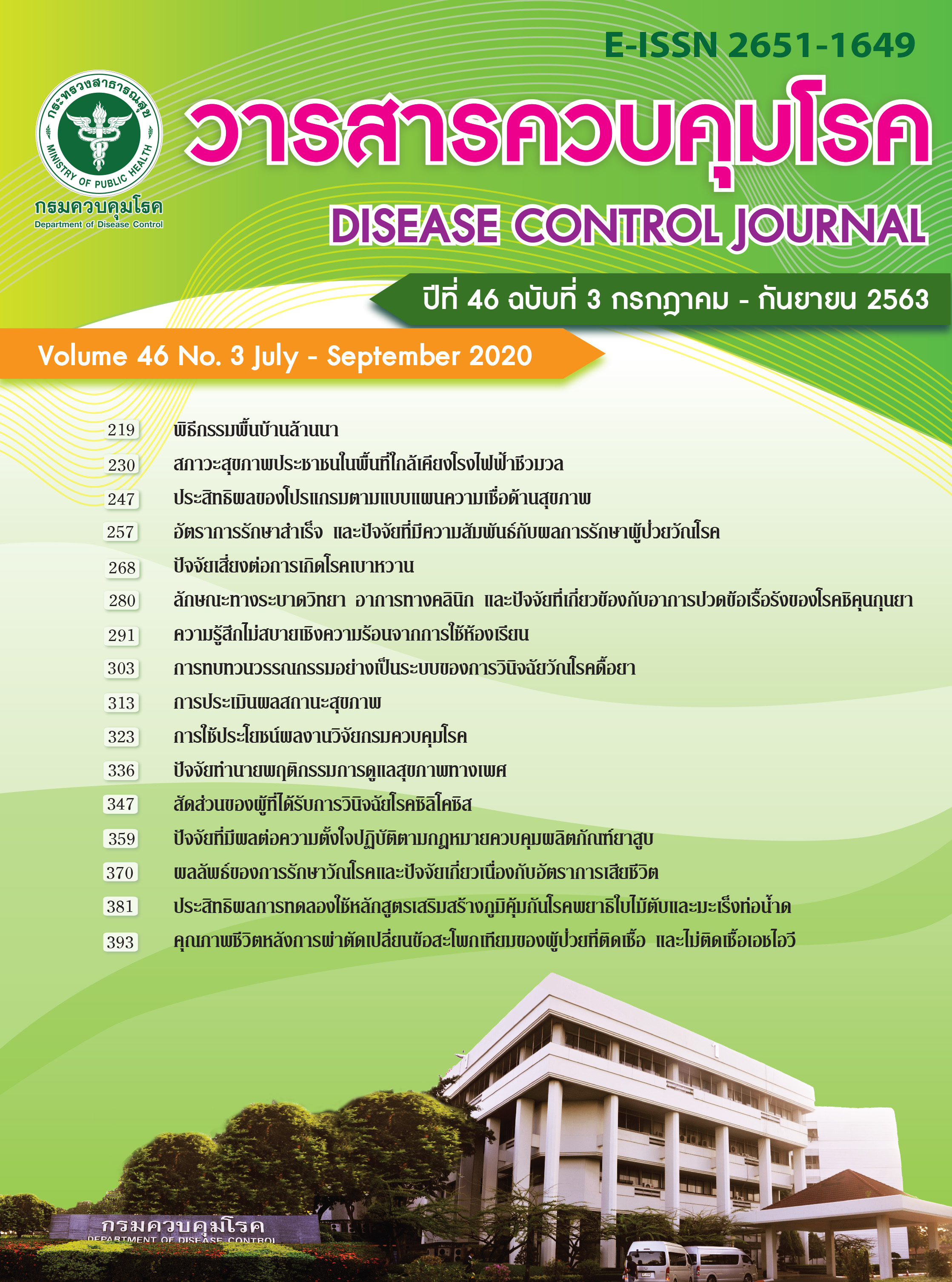
ปัจจัยที่มีผลต่อความตั้งใจปฏิบัติตามกฎหมายควบคุมผลิตภัณฑ์ยาสูบ ของผู้ประกอบการร้านค้าที่จำหน่ายบุหรี่รอบสถานศึกษาในพื้นที่เขตสุขภาพที่ 5
DOI:
https://doi.org/10.14456/dcj.2020.34คำสำคัญ:
ความตั้งใจปฏิบัติตามกฎหมายควบคุมผลิตภัณฑ์ยาสูบ, ผู้ประกอบการร้านค้าที่จำหน่ายบุหรี่, ทฤษฎีพฤติกรรมตามแผนบทคัดย่อ
การวิจัยเชิงสำรวจแบบภาคตัดขวางนี้ มีวัตถุประสงค์เพื่อศึกษาความตั้งใจ และปัจจัยที่มีผลต่อความตั้งใจปฏิบัติตามกฎหมายควบคุมผลิตภัณฑ์ยาสูบ พ.ศ. 2560 ของผู้ประกอบการร้านค้าที่จำหน่ายบุหรี่รอบสถานศึกษาที่เคยละเมิดกฎหมาย โดยประยุกต์ทฤษฎีพฤติกรรมตามแผนเป็นกรอบแนวคิดการวิจัย ตัวอย่างเป็นผู้ประกอบการร้านค้าที่จำหน่ายบุหรี่ประเภทร้านขายของชำ จำนวน 127 คน ซึ่งมีที่ตั้งร้านค้าอยู่ในรัศมี 1,000 เมตร รอบสถานศึกษาระดับมัธยมศึกษา ในพื้นที่เขตสุขภาพที่ 5 และเคยละเมิดกฎหมายควบคุมผลิตภัณฑ์ยาสูบอย่างน้อย 1 ประเด็นในรอบ 1 ปีที่ผ่านมา เก็บข้อมูลด้วยแบบสัมภาษณ์ และวิเคราะห์ข้อมูลด้วยสถิติเชิงพรรณนาและสถิติเชิงอนุมาน ผลการวิจัย พบว่าผู้ประกอบการร้านค้าที่จำหน่ายบุหรี่รอบสถานศึกษาที่เคยละเมิดกฎหมาย ส่วนใหญ่มีความตั้งใจปฏิบัติตามกฎหมายฯ ในระดับปานกลาง ร้อยละ 51.2 โดยมี 7 ปัจจัยที่มีความสัมพันธ์กับความตั้งใจปฏิบัติตามกฎหมายฯ อย่างมีนัยสำคัญทางสถิติ (p< 0.05) ซึ่ง 3 ใน 7 ปัจจัยแรก เป็นปัจจัยลบ ได้แก่ จำนวนชั่วโมงที่เปิดทำการต่อวัน จำนวนประเด็นการเคยละเมิดกฎหมาย และการคล้อยตามกลุ่มอ้างอิงที่เป็นหน่วยงานราชการ ส่วนอีก 4 ใน 7 ปัจจัยที่เหลือ เป็นปัจจัยบวก ได้แก่ การรับรู้กฎหมายฯ เจตคติต่อการปฏิบัติตามกฎหมายฯ การรับรู้ความสามารถในการควบคุมพฤติกรรม และการได้รับคำแนะนำหรือสิ่งสนับสนุนการจำหน่ายบุหรี่จากตัวแทนบริษัทบุหรี่ ซึ่งในจำนวนนี้มี 3 ปัจจัยที่ร่วมกันอธิบายความผันแปรของความตั้งใจปฏิบัติตามกฎหมายได้ ร้อยละ 73.6 (Nagelkerke R2 = 0.736) ได้แก่ การรับรู้กฎหมายฯ การรับรู้ความสามารถในการควบคุมพฤติกรรมฯ และเจตคติต่อการปฏิบัติตามกฎหมายฯ ดังนั้น จึงควรเสริมสร้างความเข้มแข็งในกิจกรรมที่เกี่ยวกับการยินยอมปฏิบัติตามกฎหมาย และให้แรงจูงใจด้วยวิธีต่างๆ เมื่อร้านค้าเหล่านี้ยินยอมปฏิบัติตามกฎหมายควบคุมผลิตภัณฑ์ยาสูบ
Downloads
เอกสารอ้างอิง
World Health Organization. WHO report on the global tobacco epidemic, 2019 Offer help to quit tobacco use. Luxembourg: World Health Organization; 2019.
Goodchild M, Nargis N, d’Espaignet ET. Global economic cost of smoking-attributable diseases. Tobac Contr 2018; 27: 58–64.
National Statistical Office. The Smoking and Drinking Behaviour Survey 2014. Bangkok: National Statistical Office; 2014. (in Thai)
National Statistical Office. The Smoking and Drinking Behaviour Survey 2017. Bangkok: National Statistical Office; 2018. (in Thai)
Usaha J, Luemchan D, Gunvihok T. Evaluation on the National Strategic Plan for Tobacco Control 2012 – 2014. Disease Control Journal 2012;42:151–61. (in Thai)
National Statistical Office. The Smoking and Drinking Behaviour Survey 2011. Bangkok: National Statistical Office; 2011. (in Thai)
Chotbenjamaporn P, Anuntawong N. Law Enforcement of Tobacco and Alcohol Control Acts in peri - Bangkok Metropolitan area in 2010 - 2011. Disease Control Journal 2012;33:167–176. (in Thai)
Law Division. Tobacco Product Control Act B.E.2560. Bangkok: Chulalongkorn University; 2017. (in Thai)
Bureau of Tobacco Control. Smoke Free School in 2018 [Internet]. Nonthaburi. Bureau of Tobacco Control; 2018 [cited 2017 July 22]. 20 p. Available from: http://btc.ddc.moph.
go.th/th/smokefree.php?type=1. (in Thai)
McCarthy WJ, Mistry R, Lu Y, Patel M, Zheng H, Dietsch B. Density of tobacco retailers near schools: effects on tobacco use among students. Am J Publ Health 2009;99:2006 –13.
Chan WC, Leatherdale ST. Tobacco retailer density surrounding schools and youth smoking behaviour: a multi-level analysis. Tobacco Induced Disease 2011;9:1–7
Leatherdale ST, Strath JM. Tobacco retailer density surrounding schools and cigarette access behaviors among underage smoking students. Ann Behav Med 2007;33:105–111.
Ajzen I. From intention to actions: A theory of planned behaviour. In: J. Kuhl & J. Beckmann, editors. Action - control: From cognition to behavior. Heildelgerg: Springer; 1985. p. 11–39.
Bloom BS, Hasting JT, Madaus GF. Handbook on Formative and Summative Evaluation of Student Learning. New York: McGraw-Hill Book Co; 1971.
Khumthong A. Factors Predicting Intention in Prevention and Control of Avian Influenza of Village Health Volunteers [dissertation]. Chiang Mai: Chiang Mai University; 2007. 125 p. (in Thai)
Apitantiti P. Relationships among Attitude, Subjective Norm, Perceived Behavioral Control, Intention and Service Behavior (CARE) of Employees in Non – Life Insurance Company [dissertation]. Pathum Thani: Thammasat University; 2008. 133 p. (in Thai)
Srisakul S. Factors Predicting Intention for Cervical Cancer Screening among Women Aged 30 to 60 Years in Ratchaburi Province [dissertation]. Pathum Thani: Thammasat University; 2011. 85 p. (in Thai)
Norman P, et al. The Theory of Planned Behaviour and exercise: Evidence for the moderating role of past behaviour. Br J Health Psycho 2000;5:249–261.
Boudreau F, Godin G. Using the Theory of Planned Behaviour to predict exercise intention in obese adults. CJNR 2007;39:112–124.
Sujitchawalakul A, Chomson S, Sinsuesatkul S. The Factors Influencing the Intention of Smoking Behaviors Amongst Female Junior High School Students. Christian University of Thailand Journal 2011;17:42–50. (in Thai)
Tiamtoy P. Implementation Effectiveness of Tobacco Advertisement and Sales Promotion at The Point of Sale in Retail Stores According to The Tobacco Product Control ACT 2535 B.E. in Bangkok [dissertation]. Bangkok: Mahidol University; 2013. 152 p. (in Thai)
Phetphum C, Noosorn N, Nimpitakpong P, Mekrungrongwong S. A Community of Practices (COPs) Approach for Rural Retailer Behavioral Change Concerning Tobacco Sale to Minor. Journal of Nursing and Health Sciences 2015;9:147–161. (in Thai)
Phetphum C, Noosorn N, Wangwonsin A, Pongpreecha B. Retailer Factors Related to Tobacco Sale to Minors in Health Region 2. Journal of Health Systems Research 2018;12:56–70. (in Thai)
Chiu YL, Chiu YC, Chang YW, Chu CM, Lin FG, Lai CH, et al. Using an extended theory of planned behaviour to predict smoking cessation counsellors’ intentions to offer smoking cessation support in the Taiwanese military: a cross-sectional study. BMJ Open 2019;9:1–7.
ดาวน์โหลด
เผยแพร่แล้ว
รูปแบบการอ้างอิง
ฉบับ
ประเภทบทความ
สัญญาอนุญาต
บทความที่ลงพิมพ์ในวารสารควบคุมโรค ถือว่าเป็นผลงานทางวิชาการหรือการวิจัย และวิเคราะห์ตลอดจนเป็นความเห็นส่วนตัวของผู้เขียน ไม่ใช่ความเห็นของกรมควบคุมโรค ประเทศไทย หรือกองบรรณาธิการแต่ประการใด ผู้เขียนจำต้องรับผิดชอบต่อบทความของตน