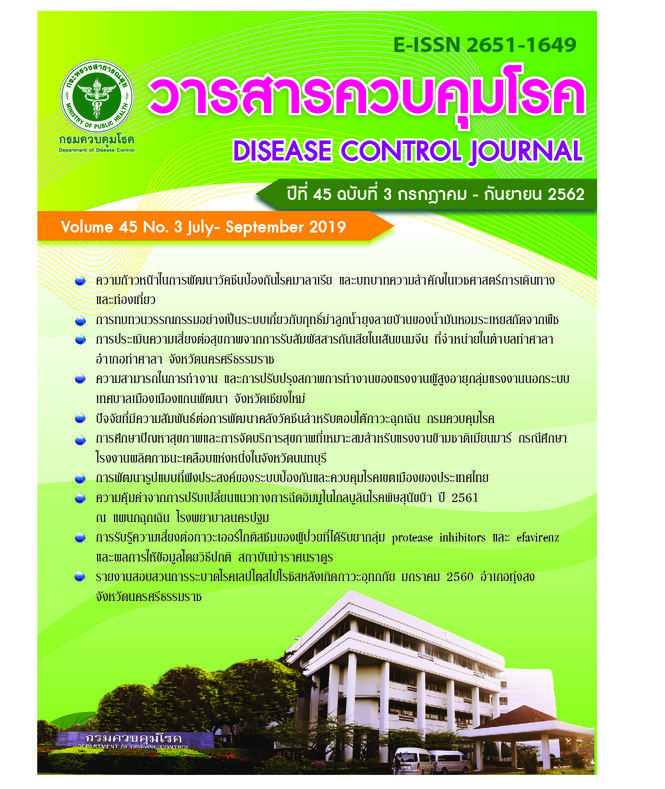
การประเมินความเสี่ยงต่อสุขภาพจากการรับสัมผัสสารกันเสียในเส้นขนมจีน ที่จำหน่ายในตำบลท่าศาลา อำเภอท่าศาลา จังหวัดนครศรีธรรมราช
DOI:
https://doi.org/10.14456/dcj.2019.23คำสำคัญ:
สารกันเสีย, กรดเบนโซอิก, กรดซอร์บิก, ขนมจีน, ความเสี่ยงต่อสุขภาพบทคัดย่อ
การศึกษานี้เป็นการวิจัยเชิงพรรณนาภาคตัดขวาง มีวัตถุประสงค์เพื่อวิเคราะห์ปริมาณสารกันเสียในเส้นขนมจีนที่จำหน่ายในพื้นที่ตำบลท่าศาลา อำเภอท่าศาลา จังหวัดนครศรีธรรมราช โดยใช้วิธี HPLC และประเมินความเสี่ยงต่อสุขภาพผู้บริโภคจากปริมาณการรับสัมผัสสารกันเสีย เทียบกับค่าระดับความปลอดภัยที่ร่างกายสามารถรับได้ต่อวัน (acceptable daily intake) ผลการวิเคราะห์สารกันเสียในเส้นขนมจีนจำนวน 26 ตัวอย่าง ไม่พบการเจือปนกรดซอร์บิกในทุกตัวอย่าง แต่ตรวจพบกรดเบนโซอิก 17 ตัวอย่าง (ร้อยละ 65) และเกินมาตรฐาน 1 ตัวอย่าง (ร้อยละ 4) โดยมีปริมาณระหว่าง 63-1,007 มิลลิกรัมต่อกิโลกรัม ผลการประเมินความเสี่ยงในกลุ่มประชากรทั้งหมด ทั้งกรณีระดับความเสี่ยงเฉลี่ย (ร้อยละ 1-4 ของค่า ADI) และระดับสูง (ร้อยละ 24-78) รวมทั้งในกลุ่มเฉพาะผู้ที่บริโภคขนมจีน กรณีความเสี่ยงเฉลี่ย (ร้อยละ 19-44) พบว่า อยู่ในเกณฑ์การปนเปื้อนที่ยอมรับให้มีการบริโภคต่อวัน ยกเว้นผลการประเมินความเสี่ยงกรณีระดับสูงในกลุ่มเฉพาะผู้บริโภค (ร้อยละ 148-446) ซึ่งกลุ่มที่มีความเสี่ยงสูงสุดคือ กลุ่มเด็กเล็กอายุไม่เกิน 2.90 ปี และอายุระหว่าง 3-5.90 ปี ตามลำดับ หน่วยงานรับผิดชอบในพื้นที่ควรมีการตรวจติดตามเพื่อควบคุมการใช้สารกันเสียในเส้นขนมจีนที่จำหน่ายให้เป็นไปตามเกณฑ์มาตรฐานที่กำหนด และแนะนำผู้บริโภคให้เลือกซื้อจากผู้ผลิตที่มีการผลิตที่ได้มาตรฐานและไว้ใจได้ รวมถึงควบคุมดูแลเด็กเล็กไม่ให้บริโภคขนมจีนในปริมาณสูงเกินไป
Downloads
เอกสารอ้างอิง
2. National Bureau of Agricultural Commodity and Food Standards. Food consumption data of Thailand [Internet]. 2016 [cited 2018 Mar 18]. Available from: https://www.acfs.go.th/files/files/attach-files/867_20190606145951_625162.pdf (in Thai)
3. Patanan L. Study of potential of some Thai-style noodle (Ka-Nom-Jeen) producers to comply with established Good Manufacturing Practices (GMP): a case study in food producers in northern of Thailand [dissertation]. Bangkok: Thammasat University; 2008. 111 p. (in Thai)
4. Ngokpilai W, Parinyasiri T, Jindaprasert A, Areekul V, Swetwiwathana A. A study of quality and safety of Kanom Jien (fermented and fresh rice noodle). SWU Sci J 2012;28:121-34. (in Thai)
5. Thongpho S, Jamsri W, Uetrongchit Y, Toviyanon C, Phromprasit P. Quality of noodles available in Bangkok and circumferences during 2012-2016 [Internet]. [cited 2018 Jun 27]. Available from: http://e-library.dmsc.moph.go.th/view.asp?id=496 (in Thai)
6. Bureau of Food Safety Extension and Support. High presevative levels found in rice noodle (Kanom Jien [Internet]. [cited 2018 Jun 27]. Available from: https://www.foodsafety.moph.go.th/document/News/จดหมายข่าว_ฉบับพิเศษ_5_ขนมจีน-สารกันบูด.pdf (in Thai)
7. Health Department, Bangkok Metropolitan Administration. Newsletter of Bangkok Food Safety City [Internet]. [cited 2018 Jun 27]. Available from: http://www.foodsanitation.bangkok.go.th/pdf/media_58/News_mail/30.pdf (in Thai)
8. Sonamit K, Kamlert W. Sodium benzoate and synthetic organic colors in food. Bulletin of the Department of Medical Science 2009;51:170-5. (in Thai)
9. Benjapong W, Solkittinapakul J, Nitithamyong A, Karnpanit W, Rojroongwasinkul N, Visetchart P, et al. Exposure assessment of benzoic acid from the consumption of processed meat and fish products, bakery wares and beverages at risk of commonly consumed by Thai people. Thai J Toxicology 2013;28:1-16. (in Thai)
10. Toorisut Y, Tassanaudom A, Wattanasiritham L, Tuitemwong K, Mahakarnchanakul W. Resistance of Aspergillus flavus against benzoic acid and sorbic acid in chilli paste (Num Prik Ta-Dang). KKU Sci J 2016;44:111-23. (in Thai)
11. Pichai P, Khanteekul N. Exposure assessment of benzoic acid in Nam Prig Noom sold in Chiang Mai since 2010-2013. Bulletin of the Department of Medical Science 2015;57:198-207. (in Thai)
12. Pholprasert P, Narakorn S, Swetwiwathana A. The surveillance of the ready-to-eat dried chili paste in Bangkok. FDA Journal 2016;23:21-7. (in Thai)
13. Tungsong Municipality. Kanom Jien Muang Tungsong [Internet]. [cited 2018 Jun 27]. Available from: http://www.tungsong.com/PR/rice_vermicelli/complete.pdf (in Thai)
14. Thongsrichan P. Cultural wisdom in the south: cuisine wisdom: Kanom Jien [Internet]. [cited 2018 Jun 27]. Available from: https://sites.google.com/site/looknampattalung/phumipayya-ni-dan-xahar-kar-kin/khnmcin (in Thai)
15. Chumane S. The development of analysis of preservatives (benzoic acid, sorbic acid, methylparapen and propylparaben) in foodstuffs and cosmetics by high performance liquid chromatography. Phetchabun: Phetchabun Rahabgat University; 2009. (in Thai)
16. World Health Organization. Dietary exposure assessment of chemicals in food. Report of a Joint FAO/WHO Consultation; 2005 May 2-6; Annapolis, Marryland, USA. Geneva: World Health Organization; 2008. p. 1-77.
17. Pattanakulanan P, Benjapong W, Sakolkittinapakul J, Amarasakulsab H, Phongitipokin P, Visetchart P, et al. Food preservatives and synthetic colors in sausages sold inside and outside schools in Nakhon Pathom Province, Thailand. Thai J Toxicology
2016;31:39-54. (in Thai)
18. Poolkua C, Srisorn P, Pattanakitjaruk O, Khontha M, Saengphuang R, Khompittaya N. Quality of street fruits vendors in Nakhonsawan Province. FDA Jounal 2014;21:42-9. (in Thai)
19. Singsoong K, Benjapong W, Moungsrichan N, Karnpanit W. Situation of preservatives used in coconut sap. Thai J Toxicology 2009;24:146-56. (in Thai)
20. Sripanaratanakul P, Benjapong W, Visetchart P, Phattanakulanan P, Karnpanit W. Risk assessment of exposure to benzoic acid and sorbic acid from the consumption of sausage and processed minced pork (Moo Yor) in Thai people. Thai J Toxicology 2009;24:27-36. (in Thai)
ดาวน์โหลด
เผยแพร่แล้ว
รูปแบบการอ้างอิง
ฉบับ
ประเภทบทความ
สัญญาอนุญาต
บทความที่ลงพิมพ์ในวารสารควบคุมโรค ถือว่าเป็นผลงานทางวิชาการหรือการวิจัย และวิเคราะห์ตลอดจนเป็นความเห็นส่วนตัวของผู้เขียน ไม่ใช่ความเห็นของกรมควบคุมโรค ประเทศไทย หรือกองบรรณาธิการแต่ประการใด ผู้เขียนจำต้องรับผิดชอบต่อบทความของตน