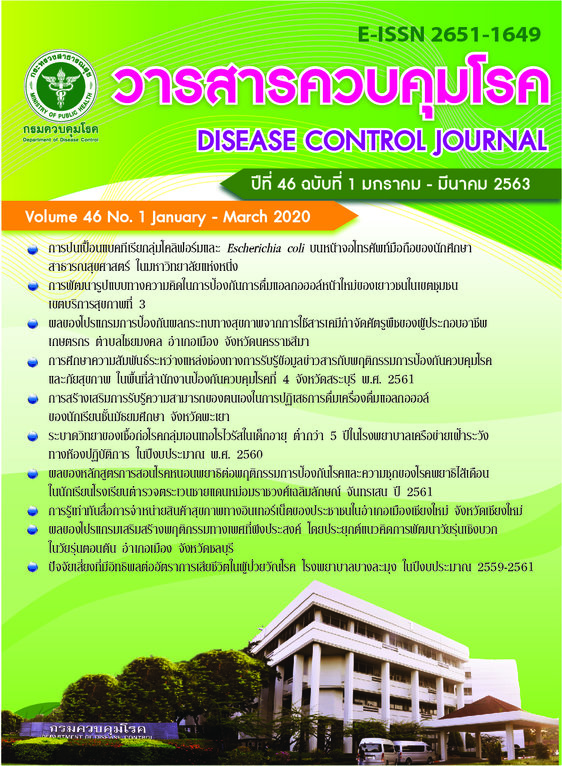
ผลของโปรแกรมเสริมสร้างพฤติกรรมทางเพศที่พึงประสงค์ โดยประยุกต์แนวคิดการพัฒนาวัยรุ่นเชิงบวก ในวัยรุ่นตอนต้น อ.เมือง จ.ชลบุรี
DOI:
https://doi.org/10.14456/dcj.2020.9คำสำคัญ:
แนวคิดการพัฒนาวัยรุ่นเชิงบวก, พฤติกรรมทางเพศที่พึงประสงค์, วัยรุ่นตอนต้นบทคัดย่อ
การศึกษานี้เป็นการวิจัยกึ่งทดลองแบบสองกลุ่ม วัดผลก่อนและหลัง โดยมีวัตถุประสงค์เพื่อศึกษาผลของโปรแกรมเสริมสร้างพฤติกรรมทางเพศที่พึงประสงค์ โดยประยุกต์แนวคิดการพัฒนาวัยรุ่นเชิงบวก ในวัยรุ่นตอนต้น กลุ่มตัวอย่างเป็นนักเรียนชั้นมัธยมศึกษาปีที่ 2 จำนวน 67 คน แบ่งเป็นกลุ่มทดลอง 31 คน และกลุ่มเปรียบเทียบ จำนวน 36 คน ดำเนินกิจกรรมในกลุ่มทดลอง จำนวน 8 สัปดาห์ เครื่องมือที่ใช้คือ โปรแกรมเสริมสร้างพฤติกรรมทางเพศ โดยประยุกต์ใช้แนวคิดการพัฒนาวัยรุ่นเชิงบวก ประกอบด้วย 8 กิจกรรม คือ (1) การกำหนดเป้าหมายชีวิต (2) การสร้างความเชื่อมั่นในตนเอง (3) การสร้างสัมพันธภาพ (4) การแสดงออกถึงคุณลักษณะทางเพศ (5) การแสดงความเอาใจใส่ (6) การเรียนรู้ทักษะการปฏิเสธ (7) การเรียนรู้ทักษะการสวมถุงยางอนามัย และ (8) การดูแลสุขอนามัยทางเพศ เก็บรวบรวมข้อมูลด้วยแบบสอบถาม 4 ส่วน ประกอบด้วย ข้อมูลทั่วไป พฤติกรรมทางเพศเชิงบวก พฤติกรรมการป้องกันทางเพศ และสุขอนามัยทางเพศ มีค่าความเชื่อมั่นระหว่าง .856 - .902 วิเคราะห์ข้อมูลโดยใช้สถิติพรรณนา และเปรียบเทียบค่าเฉลี่ยภายในกลุ่มทดลอง ด้วยสถิติ paired sample t-test และเปรียบเทียบค่าเฉลี่ยระหว่างกลุ่มด้วยสถิติ independent sample t-test ผลการวิจัยพบว่า หลังการได้รับโปรแกรม นักเรียนกลุ่มทดลองมีความตั้งใจกระทำพฤติกรรมทางเพศที่พึงประสงค์ด้านพฤติกรรมทางเพศเชิงบวก พฤติกรรมการป้องกันทางเพศ สุขอนามัยทางเพศ และผลโดยรวม เพิ่มขึ้นจากก่อนทดลอง อย่างมีนัยสำคัญทางสถิติ (p<0.001) และเพิ่มขึ้นมากกว่ากลุ่มเปรียบเทียบ อย่างมีนัยสำคัญทางสถิติ (p<0.05) การศึกษานี้แสดงให้เห็นว่า โปรแกรมเสริมสร้างพฤติกรรมทางเพศโดยประยุกต์แนวคิดการพัฒนาวัยรุ่นเชิงบวก สามารถเป็นแนวทางส่งเสริมพฤติกรรมทางเพศที่พึงประสงค์ให้กับนักเรียนได้
Downloads
เอกสารอ้างอิง
World Health Organization. Thailand 2015 global school-based student health survey. Bangkok: World Health Organization, Thailand Country Office; 2017.
Department of Disease Control, Ministry of Public Health. Guidelines for surveillance system analysis of 5-dimensional diseases, 2016. Nonthaburi: Bureau of Epidemiology; 2016. (in Thai)
Department of Disease Control, Ministry of Public Health. National disease surveillance (Report 506), 2008-2015. Nonthaburi: Bureau of Epidemiology; 2015. (in Thai)
Department of Disease Control, Ministry of Public Health. Surveillance behaviors associated with HIV infection among students in Thailand, 2014. Nonthaburi: Bureau of Epidemiology; 2015. (in Thai)
Department of Disease Control, Ministry of Public Health. Surveillance behaviors associated with HIV infection among students in Thailand, 2015. Nonthaburi: Bureau of Epidemiology; 2016. (in Thai)
Department of Disease Control, Ministry of Public Health. Result of promoting condom use project, 2012-2015. Nonthaburi: Bureau of AIDS, TB and STIs; 2015. (in Thai)
Becker MH. The health belief model and sick role behavior. Health Education Monograph 1974; 2:409-17.
Bandura A. The nature and structure of self-efficacy, source of self-efficacy: The exercise of control. New York: W.H. Freeman; 1997.
Cochran WG. Sampling techniques. 3rded. New York: John Wiley & Sons; 1997.
Bloom BS, Hastings JT, Madaus GF, Baldwin TS. Hand book on formative and summative evaluation of student learning. New York: Mc Graw-Hill; 1971.
Clark-Carter D. Percentiles. In: Everitt BS, Howell D, editors. Encyclopedia of Statistics in Behavioral Science. 3th ed. Hoboken, NJ: Wiley; 2005. p.1539-40.
Pawaree W. Preventive behavior on sexually transmitted diseases by condom of people in Watsisuk community, Chomthong District, Bangkok Metropolitan Administration. APHEIT Journal 2014;20:148-57. (in Thai)
LiXianhong, Lei Y, Wang H, He G, Williams AB. The health belief model: a qualitative study to understand high-risk sexual behavior in Chinese men who have sex with men. J Assoc Nurses AIDS Care 2016;27:66-76.
Chondaeng K, Rutchanagul P, Buaboon N. Factors influencing HIV preventive behaviors among male adolescents in a correctional institution. J Nurs Health Care 2018;36:43-51. (in Thai)
Rosenstock IM, Strecher VJ, Becker MH. Social learning theory and the health belief model. Health Educ Behav 1988;15:175-83.
Isaro N, Toonsiri CH, Srisuriyawet R. Factors predicting appropriated sexual behaviors among the lower secondary school students in Chanthaburi Province. The Journal of Faculty of Nursing Burapha University 2016;24:72-84. (in Thai)
Pented P, Chomson S. Factors affecting protection of sexual risk behaviors among high school students in Banklang Subdistrict, Wangthong District, Phitsanulok Province. BCNUT J Nurs 2019;11:62-79. (in Thai)
Watronachai N, Kredmongkol P, Powwattana A, Khan P. Safer sex practices among male vocational students in NakhonPathom province. J Health Sci Res 2007;1:38-46. (in Thai)
Chudjuajeen S, Singhasame P, Wuttisukpaisan S. Effects of perceived self-efficacy promoting for life skill enhancement on sexual health behavior of students. The Southern College Network Journal of Nursing and Public Health 2017;4:268-80. (in Thai)
Buarod T, Thongnopakun S. Sexual media literacy and preventive behaviors about sexually transmitted diseases among youth in university students Chon Buri Province, Thailand. Disease Control Journal. 2019;45:402-12. (in Thai)
Wongpanarak N, Siriwattanamethanon J. Perception of homosexuality in adolescent males. J Nurs Health Care 2012;30:42-9. (in Thai)
Thoma BC. Parental monitoring among young men who have sex with men: Associations with sexual activity and HIV-related sexual risk behaviors. J Adolesc Health 2017;61:348-54.
Promma N, Suparp J, Chamroonsawasdi K, Theachaboonsermsak P, Tansakul S. Factors predict intentions to havepremarital sexual amongst freshman college male students. Naresuan Phayao Journal 2013;6:157-67. (in Thai)
Yatha G, Sivabaedya S. Family relationship affecting adolescent’s tendency to have premarital sexual relation. Journal of Education (Graduate Studies Research), KhonKaen University 2013;7:11-22. (in Thai)
Farahani FK, Cleland J, Mehryar AH. Associations between family factors and premarital heterosexual relationships among female college students in Tehran. IntPerspect Sex Reprod Health 2011;37:30-9.
Dimbuene ZT, Defo BK.Family environment and premarital intercourse in Bandjoun (West Cameroon). Arch Sex Behav 2012;41:351-61.
Rogers AA, Ha T, Stormshak EA, Dishion TJ. Quality of parent–adolescent conversations about sex and adolescent sexual behavior: an observational study. J Adolesc Health 2015;57:174-8.
van de Bongardt D, de Graaf H, Reitz E, Deković M.Parents as moderators of longitudinal associations between sexual peer norms and Dutch adolescents' sexual initiation and intention. J Adolesc Health 2014;55:388-93.
ดาวน์โหลด
เผยแพร่แล้ว
รูปแบบการอ้างอิง
ฉบับ
ประเภทบทความ
สัญญาอนุญาต
บทความที่ลงพิมพ์ในวารสารควบคุมโรค ถือว่าเป็นผลงานทางวิชาการหรือการวิจัย และวิเคราะห์ตลอดจนเป็นความเห็นส่วนตัวของผู้เขียน ไม่ใช่ความเห็นของกรมควบคุมโรค ประเทศไทย หรือกองบรรณาธิการแต่ประการใด ผู้เขียนจำต้องรับผิดชอบต่อบทความของตน