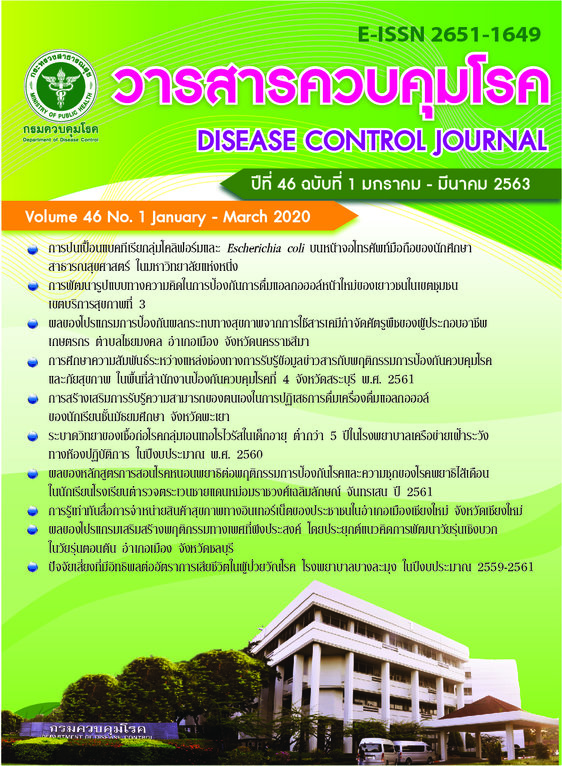
การปนเปื้อนแบคทีเรียกลุ่มโคลิฟอร์มและ Escherichia coli บนหน้าจอโทรศัพท์มือถือของนักศึกษาสาธารณสุขศาสตร์ในมหาวิทยาลัยแห่งหนึ่ง
DOI:
https://doi.org/10.14456/dcj.2020.1คำสำคัญ:
โทรศัพท์มือถือ, โคลิฟอร์ม, เอสเชอริเชีย โคไลบทคัดย่อ
โทรศัพท์มือถือนับเป็นปัจจัยสำคัญอย่างหนึ่งในชีวิตประจำวันยุคปัจจุบัน อย่างไรก็ตาม การใช้โทรศัพท์มือถือนั้นอาจเกิดความเสี่ยงต่อสุขภาพจากเชื้อโรคที่ปนเปื้อนอยู่บนหน้าจอ งานวิจัยครั้งนี้มีวัตถุประสงค์เพื่อตรวจวิเคราะห์การปนเปื้อนแบคทีเรียกลุ่มโคลิฟอร์มและเอสเชอริเชีย โคไล และวิเคราะห์ความสัมพันธ์ระหว่างพฤติกรรมและสุขลักษณะในการใช้โทรศัพท์มือถือ กับการปนเปื้อนแบคทีเรียกลุ่ม โคลิฟอร์มบนหน้าจอโทรศัพท์ ซึ่งได้ศึกษาในกลุ่มนักศึกษาสาธารณสุขศาสตร์ของมหาวิทยาลัยแห่งหนึ่งในจังหวัดนครศรีธรรมราช ตรวจวิเคราะห์การปนเปื้อนแบคทีเรียกลุ่มโคลิฟอร์มโดยใช้ชุดทดสอบโคลิฟอร์มแบคทีเรียขั้นต้น SI-2 และเอสเชอริเชีย โคไล ด้วยวิธีทดสอบปฏิกิริยาทางชีวเคมี ได้แก่ Indole production test, Methyl red test, Voges-Proskauer test และ Citrate utilization test วิเคราะห์ความสัมพันธ์ระหว่างพฤติกรรมและสุขลักษณะในการใช้โทรศัพท์มือถือ กับการปนเปื้อนแบคทีเรียกลุ่มโคลิฟอร์มบนหน้าจอโทรศัพท์มือถือ ด้วยสถิติไคสแควร์ ที่ระดับความเชื่อมั่นร้อยละ 95 ผลการวิจัยพบว่า ร้อยละ 17.0 (19/112) มีการปนเปื้อนแบคทีเรียกลุ่มโคลิฟอร์ม และตรวจพบเอสเชอริเชีย โคไล จำนวน 2 ตัวอย่าง และพบว่าพฤติกรรมการนำโทรศัพท์มือถือไปใช้ในห้องน้ำมีความสัมพันธ์กับการปนเปื้อนแบคทีเรียกลุ่มโคลิฟอร์มอย่างมีนัยสำคัญทางสถิติ (p<0.05) จากผลการวิจัยแสดงให้เห็นว่า ผู้ใช้โทรศัพท์มือถือควรหลีกเลี่ยงการนำโทรศัพท์มือถือไปใช้ในห้องน้ำ และควรมีสุขลักษณะที่ดีในการใช้โทรศัพท์มือถือเพื่อป้องกันความเสี่ยงต่อสุขภาพจากการสัมผัสเชื้อจุลินทรีย์บนหน้าจอโทรศัพท์มือถือ
Downloads
เอกสารอ้างอิง
National Statistical Office Thailand. Computer, internet and mobile phones usage [Internet]. [cited 2019 May 26]. Available from: https://service.nso.go.th/nso/web/ statseries/statseries22.html (in Thai)
Information Center for Science, Technology and Innovation. Mobile telephone subscriptions per 100 inhabitants by country of ASEAN+6, 2013-2017 [Internet]. [cited 2019 May 26]. Avaliable from: https://stiic.sti.or.th/stat/ind-it/it-t005/ (in Thai)
Wattanakoon P, Piwkhom W, Chansawang P. Behavior and factors of smartphones usage among adolescents [Internet]. [cited 2019 May 26]. Available from: https://sc2.kku.ac.th/stat/statweb/images/Eventpic/60/Seminar/01_6_.pdf (in Thai)
Brady RR, Wasson A, Stirling I, McAllister C, Damani NN. Is your phone bugged? The incidence of bacteria known to cause nosocomial infection on healthcare worker’s mobile phones. J Hosp Infect 2006;62:123-5.
Brady RR, Verran J, Damani NN, Gibb AP. Review of mobile communication devices as potential reservoirs of nosocomial pathogens. J Hosp Infect 2009;71:295-300.
Pal S, Juyal D, Adekhandi S, Sharma M, Prakash R, Sharma N, et al. Mobile phones: reservoirs for the transmission of nosocomial pathogens. Adv Biomed Res 2015;4:144-9.
Famurewa O, David OM. Cell phone: a medium of transmission of bacterial pathogens. World Rural Observ 2009;1:69-72.
Yilmaz ES, Çetin SK. Investigation of Staphylococcus spp. and Escherichia coli colonization and biofilm formation on university students’ mobile phones and hands. CBU J Sci 2017; 13:839-44.
Al-Ghurabi BH, Ghaib NH, Abbas AA, Al-Musawi BK, Hassain NS, Al-Ghurabi ZH. Evaluation of microbial contamination of mobile phone among dentists in college of dentistry in Baghdad University. Int J Med Res Health Sci 2017;6:98-101.
Martínez-Gonzále NE, Solorzano-Ibarra F, Cabrera-Díaz E, Gutiérrez-González P, Martínez-Chávez L, Pérez-Montaño JA, et al. Microbial contamination on cell phones used by undergraduate students. Can J Infect Control 2017;32:211-6.
Di Lodovico S, Del Vecchio A, Cataldi V, Di Campli E, Di Bartolomeo S, Cellini L, et al. Microbial contamination of smartphone touchscreens of Italian university students. Curr Microbiol 2018;75:336-42.
Egert M, Späth K, Weik K, Kunzelmann H, Horn C, Kohl M, et al. Bacteria on smartphone touchscreens in a German university setting and evaluation of two popular cleaning methods using commercially available cleaning products. Folia Microbiol 2015;60:159–64.
Research and Laboratory Development Center, Department of Health. Guide to the food detect coliform bacteria 13. To detect contaminated food containers. For food handlers and food [Internet]. [cited 2019 May 20]. Available from: https://rldc.anamai. moph.go.th/index.php?option=com_content&view=article&id=73&Itemid=353 (in Thai)
Barrow IG, Feltham AKR. Cowan and Steel’s Manual for the Identification of Medical bacteria. 3rd ed. UK: Cambridge University; 1993.
Forbes BA, Sahm DF, Weissfeld AS. Bailey and Scott’s diagnostic microbiology. 11th ed. St Louis: Mosby; 2002.
World Health Organization. Indicators of microbial water quality [Internet]. [cited 2019 May 27]. Available from: https://www.who.int/water_sanitation_health/dwq/iwachap13.pdf
Abubakar I, Bello AY, Mohammed D, Nata’ala K, Aliyu M. Occurrence of bacterial species from mobile phones of students from two departments in Niger State Polytechnic Zungeru, Nigeria. LAJANS 2017;2:72-7.
Chitpirom K. Evaluation and bacterial contamination of public toilets. KKU Sci J 2013;41:789-96. (in Thai)
Chitpirom K, Polyong C, Chitpirom P. Contamination of antibiotic resistant bacteria from toilets, Thon Buri District, Bangkok. Dis Control J 2018;44:38-49. (in Thai)
Ogba O, Obio O. Microbial spectrum on public toilet seats. Ann Microbiol Infect Dis 2018;1:58-62.
Kramer A, Schwebke I, Kampf G. How long do nosocomial pathogens persist on inanimate surfaces? A systematic review. BMC Infect Dis 2006;6:130.
Koscova J, Hurnikova Z, Pistl J. Degree of bacterial contamination of mobile phone and computer keyboard surfaces and efficacy of disinfection with Chlorhexidine Digluconate and Triclosan to its reduction. Int J Environ Res Public Health 2018;15:2238.
ดาวน์โหลด
เผยแพร่แล้ว
รูปแบบการอ้างอิง
ฉบับ
ประเภทบทความ
สัญญาอนุญาต
บทความที่ลงพิมพ์ในวารสารควบคุมโรค ถือว่าเป็นผลงานทางวิชาการหรือการวิจัย และวิเคราะห์ตลอดจนเป็นความเห็นส่วนตัวของผู้เขียน ไม่ใช่ความเห็นของกรมควบคุมโรค ประเทศไทย หรือกองบรรณาธิการแต่ประการใด ผู้เขียนจำต้องรับผิดชอบต่อบทความของตน