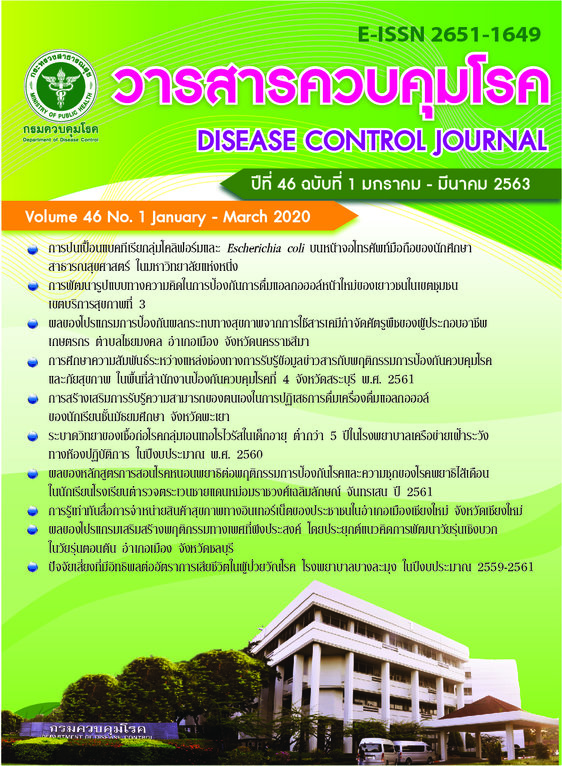
ผลของโปรแกรมการป้องกันผลกระทบทางสุขภาพ จากการใช้สารเคมีกำจัดศัตรูพืชของผู้ประกอบอาชีพเกษตรกร ตำบลไชยมงคล อำเภอเมือง จังหวัดนครราชสีมา
DOI:
https://doi.org/10.14456/dcj.2020.3คำสำคัญ:
เกษตรกร, การใช้สารเคมีกำจัดศัตรูพืช, พฤติกรรมการป้องกันผลกระทบจากการใช้สารเคมีกำจัดศัตรูพืชบทคัดย่อ
การศึกษาวิจัยแบบกึ่งทดลอง (quasi-experimental research) เพื่อศึกษาผลของโปรแกรมการป้องกันผลกระทบทางสุขภาพจากการใช้สารเคมีกำจัดศัตรูพืช ของผู้ประกอบอาชีพเกษตรกรบ้านบุตาล ตำบลไชยมงคล อำเภอเมือง จังหวัดนครราชสีมา กลุ่มตัวอย่างคือ ผู้ประกอบอาชีพเกษตรกร ที่มีการสัมผัสสารเคมีกำจัดศัตรูพืช อย่างน้อย 1 ปี จำนวน 48 คน โดยการเลือกแบบเจาะจง (purposive sampling) ตัวแปรที่ศึกษา ได้แก่ การรับรู้ประโยชน์ การรับรู้อุปสรรค การรับรู้ความความสามารถในการป้องกันผลกระทบจากการใช้สารเคมีกำจัดศัตรูพืช และพฤติกรรมการใช้สารเคมีกำจัดศัตรูพืชของผู้ประกอบอาชีพเกษตรกร เครื่องมือที่ใช้ในการวิจัย ได้แก่ โปรแกรมการพัฒนาความรู้เกี่ยวกับการป้องกันผลกระทบทางสุขภาพจากการใช้สารเคมีกำจัดศัตรูพืช และแบบสอบถามมีค่าความเชื่อมั่นเท่ากับ 0.84, 0.69, 0.92 และ 0.98 สถิติที่ใช้ในการวิเคราะห์ ได้แก่ ค่าร้อยละ ค่าเฉลี่ย ค่าส่วนเบี่ยงเบนมาตรฐาน และ paired samples t-test ผลการวิจัย พบว่า หลังการทดลองผู้ประกอบอาชีพเกษตรกรมีการรับรู้ประโยชน์ การรับรู้อุปสรรค การรับรู้ความความสามารถในการป้องกันผลกระทบทางสุขภาพจากการใช้สารเคมีกำจัดศัตรูพืช และพฤติกรรมการใช้สารเคมีกำจัดศัตรูพืชของผู้ประกอบอาชีพเกษตรกร มีค่าเฉลี่ยดีกว่าก่อนการทดลองอย่างมีนัยสำคัญทางสถิติ (0.05) ผลการศึกษาครั้งนี้แสดงให้เห็นว่า โปรแกรมการพัฒนาความรู้เกี่ยวกับการป้องกันผลกระทบทางสุขภาพจากการใช้สารเคมีกำจัดศัตรูพืช ทำให้ผู้ประกอบอาชีพเกษตรกรมีการรับรู้ประโยชน์ การรับรู้อุปสรรค การรับรู้ความความสามารถในการป้องกันผลกระทบจากการใช้สารเคมีกำจัดศัตรูพืช และพฤติกรรมการใช้สารเคมีกำจัดศัตรูพืชของผู้ประกอบอาชีพเกษตรกรเพิ่มขึ้น
Downloads
เอกสารอ้างอิง
Office of Natural Resources and Environmental Policy and planning. Indicators on the importation volumes of hazardous substances for use in agricultural sector [Internet]. [cited 2018 Nov 10]. Available from : https://www.onep.go.th/env_data/2016/01_60 (in Thai)
Karnchanajira C. Thai population health and food security. Bangkok: Amarin Printing & Publishing; 2012. (in Thai)
Pradabwong A. Pollution from hazardous chemicals in Thailand. Environmental Health Journal 2010;12:3-13. (in Thai)
Chaiklieng S, Praengkrathok S. Risk assessment on pesticide exposure by biological monitoring among farmers: a case study in Tambon Kangsanamnang, Nakhon Ratchasima Province. Srinagarind Med J 2013;28:382-9. (in Thai)
Water Quality Management Bureau. Folk wisdom and the reduction in the use of pesticides [Internet]. Bangkok: Water Quality Management Bureau; 2013 [cited 2018 Dec 10]. 83 p. Available from www.pcd.go.th/public/Publications/template/peticide_wisdom56.pdf (in Thai)
Bangkokbiznews. Medical advice on the prevention of occupational diseases. Data on healthcare utilization under the national health security program [Internet]. 2015 Mar 28 [cited 2018 May 12]. Available from: https://www.bangkokbiznews.com/news/detail/640950 (in Thai)
Buranatrevedh S, Sweatsriskul P. Model development for health promotion and control of agricultural occupational health hazards and accidents in Pathumthani, Thailand. Ind Health 2005;43:669-76.
National Health Security Office. Healthcare utilization rates under National Health Security System [Internet]. 2018 Sep 9 [cited 2019 Dec 12]. Available from: https://prachatai.com/journal/2018/09/78623 (in Thai)
Mingchai P. The effect of health belief program on self-prevention behaviors from the use of chemical pesticides by farmers in the area of responsibility of Lu Sub-district Health Promoting Hospital, Pathum Ratchawongsa District, Amnat Charoen Province. Journal of ODPC 10th Ubon Ratchathani 2017;15:54-65. (in Thai)
Chantaramanee N. Behaviors of chemical pesticide uses and effectiveness of an occupational health education program of safety knowledge among farmers in upriver area, Phayao Province. Journal of Safety and Health 2017;10:35-45. (in Thai)
Danyuthasilpe C. Pender’s health promotion model and its applications in nursing practice. Songklanagarind Journal of Nursing. 2018;38:132-41. (in Thai).
Nakhon Ratchasima Provincial Agricultural Extension Office. Agriculturist registration database [Internet]. [cited 2019 May 25]. Available from: https://www.khorat.doae.go.th/web/index.php/2014-11-27-04-36-03 (in Thai)
Chaimongkol Subdistrict Municipality. Conditions and demographic data of the population [Internet]. [cited 2018 May 22]. Available from: https://www.chaimongkon.go.th/base.php?content_id=7 (in Thai)
Chaimongkol Tambon Health Promoting Hospital. Screening results for residual chemicals among farmers by means of finger stick. Nakhon Ratchasima: Chaimongkol Tambon Health Promoting Hospital; 2017. (in Thai)
Phosri R. Statistics for research. Bangkok: Chulalongkorn University Press; 2006.
Yodchan S, Suntayakorn C, Noosorn N, Prachanban P. Effects of health belief program on pesticide prevention behavior among the farmers. Journal of Nursing and Health Sciences 2011;5:45-54. (in Thai)
Rodniam J, Saetiaw S, Jantaweemuang W. Perceived benefits, perceived barriers, perceived self-efficacy and health promoting behaviors, and health status of nursing students. Nursing Journal of the Ministry of Public Health 2014;23:88-97. (in Thai)
Rachcha M, Samranchit S, Saen Thao J, Suktakue S, Atsuwansuwan A. Protection behavior of chemical pesticides among farmers of Ban Thung Nang Khruan, Chalaesud District, Thong PhaPhum District, Kanchanaburi Province. Journal of Nursing Public Health and Education 2017;18:84-94. (in Thai)
Hanklang S, Kaewboonchoo O, Suwan-Ampai P, Morioka I. Effectiveness of an intervention to reduce pesticide exposure among rice farmers in Nakhon Ratchasima Province: applying social learning theory. Journal of Public Health Nursing 2017;31:183-200. (in Thai)
ดาวน์โหลด
เผยแพร่แล้ว
รูปแบบการอ้างอิง
ฉบับ
ประเภทบทความ
สัญญาอนุญาต
บทความที่ลงพิมพ์ในวารสารควบคุมโรค ถือว่าเป็นผลงานทางวิชาการหรือการวิจัย และวิเคราะห์ตลอดจนเป็นความเห็นส่วนตัวของผู้เขียน ไม่ใช่ความเห็นของกรมควบคุมโรค ประเทศไทย หรือกองบรรณาธิการแต่ประการใด ผู้เขียนจำต้องรับผิดชอบต่อบทความของตน