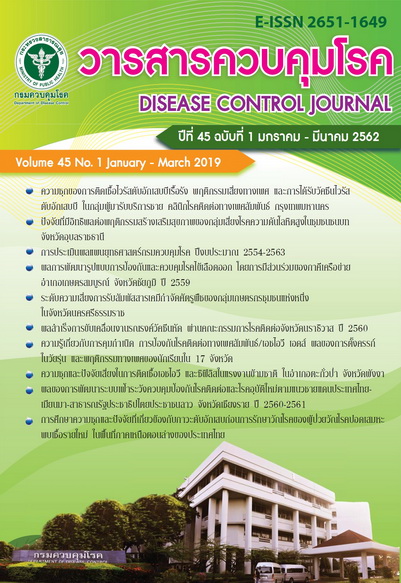
ปัจจัยที่มีอิทธิพลต่อพฤติกรรมสร้างเสริมสุขภาพของกลุ่มเสี่ยงโรคความดันโลหิตสูง ในชุมชนชนบท จังหวัดอุบลราชธานี
DOI:
https://doi.org/10.14456/dcj.2019.12คำสำคัญ:
พฤติกรรมสร้างเสริมสุขภาพ, กลุ่มเสี่ยงโรคความดันโลหิตสูง, การรับรู้ประโยชน์ในการสร้างเสริมสุขภาพบทคัดย่อ
การวิจัยเชิงสำรวจแบบภาคตัดขวางนี้มีวัตถุประสงค์เพื่อศึกษาพฤติกรรมการสร้างเสริมสุขภาพ และปัจจัยที่มีอิทธิพลและคาดทำนายพฤติกรรมการสร้างเสริมสุขภาพของกลุ่มเสี่ยงโรคความดันโลหิตสูง กลุ่มตัวอย่างคือ กลุ่มเสี่ยงโรคความดันโลหิตสูง อายุ 35 ปีขึ้นไป จำนวน 302 คน ซึ่งได้จากการสุ่มตัวอย่างแบบแบ่งชั้นภูมิ เก็บข้อมูลโดยใช้แบบสอบถามชนิดตอบด้วยตนเอง วิเคราะห์ข้อมูลโดยใช้สถิติไคสแควร์ และการวิเคราะห์ถดถอยพหุคูณแบบมีขั้นตอน ผลการศึกษาพบว่า พฤติกรรมการสร้างเสริมสุขภาพโดยภาพรวมอยู่ในระดับปานกลาง 64.90 ส่วนปัจจัยที่มีอิทธิพล และสามารถคาดทำนายพฤติกรรมการสร้างเสริมสุขภาพของกลุ่มเสี่ยงโรคความดันโลหิตสูง อย่างมีนัยสำคัญทางสถิติ (p<0.01) ได้แก่ การรับรู้ประโยชน์สร้างเสริมสุขภาพ (Beta = .402) อายุ (Beta = -.084) แรงสนับสนุนทางสังคม (Beta = .162) และการรับรู้สมรรถนะของตนเองในการสร้างเสริมสุขภาพ (Beta = -.088) โดยสามารถร่วมทำนายพฤติกรรมการสร้างเสริมสุขภาพของกลุ่มเสี่ยงโรคความดันโลหิตสูงได้ร้อยละ 32.0 (Adjusted R2 = 0.320) ผลการศึกษานี้มีข้อเสนอแนะให้พยาบาลอนามัยชุมชน และหน่วยงานที่เกี่ยวข้องกับการป้องกันและส่งเสริมการดูแลกลุ่มเสี่ยงโรคความดันโลหิต โดยเน้นการรับรู้ประโยชน์สร้างเสริมสุขภาพ การส่งเสริมความสามารถในการดูแลตนเอง เพื่อส่งเสริมให้กลุ่มเสี่ยงโรคความดันโลหิตสูงในชุมชนมีพฤติกรรมสร้างเสริมสุขภาพเพิ่มมากขึ้นต่อไป
Downloads
เอกสารอ้างอิง
2. World Health Organization. Hypertension fact sheet. Geneva: World Health Organization; 2011.
3. Srivanichakorn S. Morbidity and mortality situation of non-communicable diseases (diabetes type 2 and cardiovascular diseases) in Thailand during 2010-2014. Disease Control Journal 2017;43:379-90. (in Thai)
4. World Health Organization. A global brief on hypertension. Geneva: World Health Organization; 2013.
5. Kannel WB, Wilson PW F. Cardiovascular risk factors and hypertension. In: Joseph L Izzo, Henry R Black, editors. Hypertension primer the essential of high blood pressure. Philadelphia: Lippincott Williams & Wilkins; 2003. p. 293-8.
6. Karnjanapiboonwong A, Sanchaisuriya P, Srivanichakorn S. Data system for surveillance of cardiovascular disease, diabetes and related risk factors in Thailand during 2010-2015. Disease Control Journal 2017;43:220-32. (in Thai)
7. Nitikul K. Risk factors of cardiovascular disease prevention among diabetic patients receiving healthcare services in Kuannieng Hospital, Songkhla Province. Disease Control Journal 2017;43:196-206. (in Thai)
8. World Health Organization. Global status report on non-communicable diseases. Geneva: World Health Organization; 2014.
9. International Health Policy Program, Ministry of Public Health. Disability-Adjusted Life Years (DALYs) in 2014. Nonthaburi: International Health Policy Program; 2015. (in Thai)
10. Health Data Center, Ministry of Public Health. Population classified by gender, age group in 2018 [Internet]. 2018 [cited 2018 Jun 6]. Available from:
https://hdcservice.moph.go.th/hdc/main/index_pk.php (in Thai)
11. Ubonratchathani Provincial Public Health Office, Human Resource and Service Quality Development Section. Manual of family health. Ubonratchathani: Ubonratchathani Provincial Public Health Office; 2017.
12. Green LW, Kreuter MW. Health program planning: an educational and ecological approach. 4th ed. New York: McGraw-Hill, 2005.
13. Polit DF, Beck CT. Essentials of nursing research: methods, appraisal and utilization. 6th ed. London: Lippincott Williams & Wilkins; 2006.
14. Boonvarasatit S, Homsin P, Srisuriyawet R. Factors Influencing health-promoting behaviors among prison officers in Department of Corrections, Nakhon Ratchasima Province [dissertation]. Chonburi: Burapha University; 2015. 91 p. (in Thai)
15. Bunlong N. Factors related to health promoting behaviors of health personnel in general hospital, Phangnga Province [dissertation]. Chonburi: Burapha University; 2009. 116 p. (in Thai)
16. Seeherunwong A, Suwonnaroop N. An analysis of validity and reliability of the health-promoting lifestyle profile. Thai Journal of Nursing Council 2004;19:44-63. (in Thai)17. Becker MH, Drachman RH, Kirscht JP. A new approach to explaining sick-role behavior in low-income populations. Am J Public health 1974;64:205-16.
18. Khuneepong A. The effectiveness of health promotion program on preventive behaviors affecting complications of hypertensive patients, Pathum Thani Province. VRU Research and Development Journal Science and Technology 2017;12:55-65.
19. Sanghuaiprai K. Factors affecting health promotion behaviors of officers working at Royal Thai Navy Hospitals [dissertation]. Bangkok: Ramkhamhaeng University; 2008. 170 p.
20. Pender NJ, Murdaugh CL, Parsons MA. Health promotion in nursing practice. 5th ed. New Jersey: Prentice Hall; 2006.
21. Green W, Kreuter W. Health program planning an educational and ecological
approach. New York: Quebecor World Fairfield; 2005.
22. House S. Work stress and social support. New Jersey: Prentice Hall; 1981.
23. Sootsukon S. Factors relating hypertension protective health behaviors of out-
patients seeking care at Bhumibol Adulyadej Hospital [dissertation]. Bangkok:
Kasetsart University; 2011. 123 p.
24. Kohtbantau S, Witayapichetsakul S, Salout A, Suksawang P. A causal relationship model of practice toreduce hypertension risk of people in Bansuan Municipality, Muang District, Chonburi Province. The Public Health Journal of Burapha University 2014;9:85-96.
25. Kanganapangka P, Suntayakorn C, Wannapornsiri C, Siripornpibul T. Effects of self efficacy promotion program on health behaviors and levels of blood pressure of the patients with hypertension. Naresuan University Journal 2009;17:63-73. (in Thai)
26. Srisiri S. Application of self-efficacy program for changing health behaviors among elderly people with hypertension, Health Center 19 Wong Sawang, Bangkok Metropolitan. Journal of Faculty of Physical Education 2012;15(special): 308-15. (in Thai)
ดาวน์โหลด
เผยแพร่แล้ว
รูปแบบการอ้างอิง
ฉบับ
ประเภทบทความ
สัญญาอนุญาต
บทความที่ลงพิมพ์ในวารสารควบคุมโรค ถือว่าเป็นผลงานทางวิชาการหรือการวิจัย และวิเคราะห์ตลอดจนเป็นความเห็นส่วนตัวของผู้เขียน ไม่ใช่ความเห็นของกรมควบคุมโรค ประเทศไทย หรือกองบรรณาธิการแต่ประการใด ผู้เขียนจำต้องรับผิดชอบต่อบทความของตน