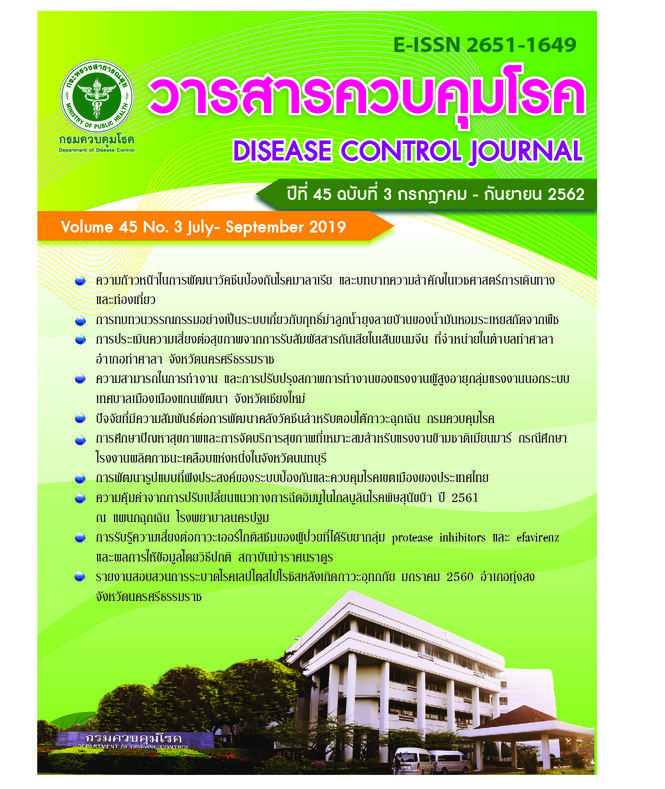
ความคุ้มค่าจากการปรับเปลี่ยนแนวทางการฉีดอิมมูโนโกลบูลินโรคพิษสุนัขบ้า ปี 2561 ณ แผนกฉุกเฉิน โรงพยาบาลนครปฐม
DOI:
https://doi.org/10.14456/dcj.2019.28คำสำคัญ:
โรคพิษสุนัขบ้า, ความคุ้มค่า, แนวทาง, อิมมูโนโกลบูลินบทคัดย่อ
ปี 2561 มีการประกาศปรับเปลี่ยนแนวทางเวชปฏิบัติโรคพิษสุนัขบ้าจากองค์การอนามัยโลก และกระทรวงสาธารณสุขไทย โรงพยาบาลนครปฐมจึงได้มีการปรับเปลี่ยนแนวทางการฉีดอิมมูโนโกลบูลินโรคพิษสุนัขบ้า ในเดือนสิงหาคม 2561 โดยปรับเปลี่ยนการฉีดอิมมูโนโกลบูลินเฉพาะบาดแผลและรอบบาดแผล ยาที่เหลือไม่ต้องฉีดเข้ากล้ามเนื้อ และยกเลิกการทดสอบการแพ้ยาอิมมูโนโกลบูลินที่ผิวหนัง วัตถุประสงค์ ศึกษาผลความคุ้มค่าจากการปรับเปลี่ยนแนวทางการฉีดอิมมูโนโกลบูลินโรคพิษสุนัขบ้า ปี 2561 โดยพิจารณาถึงการประหยัดจำนวนยา ค่ายาและเวลา วิธีการศึกษา ศึกษาข้อมูลย้อนหลังผู้ป่วยสัมผัสโรคพิษสุนัขบ้า และได้รับการฉีดอิมมูโนโกลบูลิน ณ แผนกฉุกเฉิน โรงพยาบาลนครปฐม ตั้งแต่เดือนมกราคม-ธันวาคม 2561 โดยเปรียบเทียบข้อมูลก่อนและหลังการปรับเปลี่ยนเวชปฏิบัติในเดือนสิงหาคม 2561 ผลการศึกษา ปี 2561 มีผู้ป่วยสัมผัสโรคพิษสุนัขบ้ารับการรักษาทั้งสิ้น 4,805 ราย ได้รับการฉีดอิมมูโนโกลบูลินโรคพิษสุนัขบ้า 2,967 ราย คิดเป็นจำนวนเฉลี่ย 247 ราย/เดือน ก่อนการปรับเปลี่ยนแนวทางเวชปฏิบัติ มีการใช้อิมมูโนโกลบูลินโรคพิษสุนัขบ้าเฉลี่ย 2.6 vials/ราย ค่ายาเฉลี่ย 2,121 บาท/ราย ใช้เวลารักษาเฉลี่ย 79.0 นาที/ราย ภายหลังการปรับเปลี่ยนแนวทางเวชปฏิบัติ มีการใช้อิมมูโนโกลบูลินโรคพิษสุนัขบ้าเฉลี่ยลดลงเป็น 1.1 vials/ราย ค่ายาเฉลี่ย 866 บาท/ราย และใช้เวลารักษาเฉลี่ย 50.7 นาที/ราย ในช่วงระยะเวลา 5 เดือน สามารถลดการใช้ อิมมูโนโกลบูลินโรคพิษสุนัขบ้าประมาณ 1,600 vials ประหยัดค่ายาประมาณ 1,300,000 บาท ประหยัดเวลาในการรักษาเฉลี่ย 28.3 นาที/ราย โดยไม่พบภาวะแพ้ยาอย่างรุนแรงแบบ anaphylaxis และไม่พบรายงานการติดเชื้อโรคพิษสุนัขบ้าในคนในจังหวัดนครปฐม สรุป การปรับเปลี่ยนแนวทางการฉีดอิมมูโนโกลบูลิน โรคพิษสุนัขบ้า ปี 2561 ก่อให้เกิดความคุ้มค่า สามารถลดการใช้ยาอิมมูโนโกลบูลินและประหยัดค่ายาได้ประมาณร้อยละ 60.0 และประหยัดเวลาในการรักษาได้อย่างมีนัยสำคัญทางสถิติ
Downloads
เอกสารอ้างอิง
2. Bureau of Epidemiology, Department of Disease Control, Thailand. Number of cases and deaths by month and province [Internet]. [cited 2019 Feb 14]. Available from: https://www.boe.moph.go.th/boedb/surdata/disease.php?dcontent=old&ds=42 (in Thai)
3. World Health Organization. Rabies vaccines: WHO position paper. Wkly Epidemiol Rec [Internet]. 2010 [cited 2019 Feb 14];85:309-20. Available from: https://www.who.int/wer/2010/wer8532/en/
4. World Health Organization. Rabies vaccines and immunoglobulins: WHO position: summary of 2017 updates [Internet]. 2018 [cited 2019 Feb 14]. Available from: http://www.who.int/iris/handle/10665/259855
5. World Health Organization. Rabies vaccines: WHO position paper-April 2018. Wkly Epidemiol Rec [Internet]. 2018 [cited 2019 Feb 14];93:201-20. Available from: https://www.who.int/rabies/resources/who_wer9316/en/
6. Bureau of General Communicable Diseases, Department of Disease Control, Thailand. Revised rabies clinical practice guidelines for rabies vaccination [Internet]. [cited 2019 Feb 14]. Available from: http://r36.ddc.moph.go.th/r36/content/view/6/129/ (in Thai)
7. Rabies Immunization Clinic, Queen Saovabha Memorial Institute, Thai Red Cross Society. Rabies clinical practice guidelines 2018, Queen Saovabha Memorial Institute, Thai Red Cross Society, and frequently asked questions. Bangkok: Queen Saovabha Memorial Institute of the Thai Red Cross Society; 2018. (in Thai)
8. Health Data Center, Ministry of Public Health, Thailand. Population registration by age and sex [Internet]. [cited 2019 Feb 14]. Available from: https://hdcservice.moph.go.th/hdc/ reports/report.php?source=formated/pop_sex_age.php&cat_id=ac4eed1bddb23d6130746d62d2538fd0&id=710884bc8d16f755073cf194970b064a (in Thai)
9. Dean DJ, Bear GM, Thompson WR. Studies on the local treatment of rabies infected wounds. Bull World Health Organ 1963;28:477-86.
10. Saesow N, Chaiwatanarat T, Mitmoonpitak C, Wilde H. Diffusion and fate of intramuscularly injected human rabies immune globulin. Acta Trop 2000;76:289-92.
11. Bharti OK, Madhusudana SN, Gaunta PL, Belludi AY. Local infiltration of rabies immunoglobulins without systemic intramuscular administration: An alternative cost effective approach for passive immunization against rabies. Hum Vaccin Immunother 2016;12:837-42.
12. Bharti OK, Madhusudana SN, Wilde H. Injecting rabies immunoglobulin (RIG) into wounds only: A significant saving of lives and costly RIG. Hum Vaccin Immunother 2017;13:762-65.
13. Department of Livestock Development, Thailand. Rabies situation report as of 28 Jan 2019, Department of Livestock Development (DLD) [Internet]. [cited 2019 Feb 14]. Available from: http://www.dld.go.th/th/images/stories/warning/2562/256201/ 25620128_1rabies.pdf (in Thai)
ดาวน์โหลด
เผยแพร่แล้ว
รูปแบบการอ้างอิง
ฉบับ
ประเภทบทความ
สัญญาอนุญาต
บทความที่ลงพิมพ์ในวารสารควบคุมโรค ถือว่าเป็นผลงานทางวิชาการหรือการวิจัย และวิเคราะห์ตลอดจนเป็นความเห็นส่วนตัวของผู้เขียน ไม่ใช่ความเห็นของกรมควบคุมโรค ประเทศไทย หรือกองบรรณาธิการแต่ประการใด ผู้เขียนจำต้องรับผิดชอบต่อบทความของตน