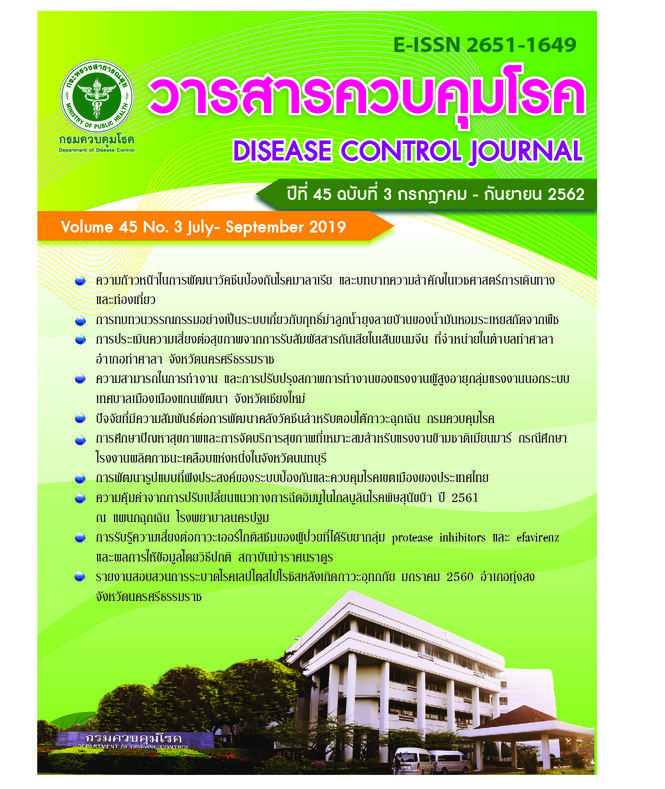
การรับรู้ความเสี่ยงต่อภาวะเออร์โกติสซึมของผู้ป่วยที่ได้รับยากลุ่ม protease inhibitors และ efavirenz และผลการให้ข้อมูลโดยวิธีปกติ สถาบันบำราศนราดูร
DOI:
https://doi.org/10.14456/dcj.2019.29คำสำคัญ:
เออร์โกติสซึม, เออร์โกตามีนบทคัดย่อ
การได้รับยากลุ่มเออร์กอทเพื่อรักษาอาการปวดศีรษะไมเกรนในผู้ป่วยที่ได้รับยาต้านเชื้อไวรัสเอชไอวี กลุ่ม protease inhibitors หรือ efavirenz ทำให้อุบัติการณ์ของภาวะเออร์โกติสซึมสูงขึ้น ผู้วิจัยจึงต้องการประเมินการรับรู้ความเสี่ยงต่อภาวะเออร์โกติสซึม และผลการให้ข้อมูลโดยวิธีปกติของผู้ที่รับยาต้านไวรัสกลุ่มนี้ โดยคัดเลือกผู้ป่วยนอกที่มารับยาต้านไวรัสเอชไอวีจากสถาบันบำราศนราดูร ด้วยวิธี non-random sampling ในช่วงเดือนตุลาคมถึงพฤศจิกายน 2561 จำนวน 373 คน เก็บข้อมูลโดยการสัมภาษณ์ ผลการศึกษาพบว่ากลุ่มตัวอย่างร้อยละ 53.6 เคยปวดศีรษะและรับประทานยากลุ่มเออร์กอท ร้อยละ 2.2 ผู้ป่วย 2 ราย เคยได้รับการวินิจฉัยเออร์โกติสซึม (อุบัติการณ์ 10/1,000) กลุ่มตัวอย่างร้อยละ 30.6 รายงานว่า เคยได้รับข้อมูลอันตรกิริยาระหว่างยาสองกลุ่มนี้จากสถาบัน ในภาพรวมกลุ่มตัวอย่างมีระดับคะแนนด้านความรู้เฉลี่ย ร้อยละ 20.3 ด้านพฤติกรรมและทัศนคติเฉลี่ย ร้อยละ 70.3 และ 78.8 ตามลำดับ จากการวิเคราะห์การถดถอยพหุคูณแบบลอจิสติกสะท้อนว่า การได้รับข้อมูลทุกครั้งที่มารับบริการ มีผลทำให้ระดับคะแนนด้านความรู้ และคะแนนด้านพฤติกรรมสูงกว่าการไม่เคยได้รับข้อมูล 76.6 เท่า (95% CI = 32.1, 182.3) และ 2.2 เท่า (95% CI = 1.0, 4.7) ตามลำดับ จากผลการวิจัยเชื่อว่า การบูรณาการและการพัฒนายกระดับระบบการให้ข้อมูลด้านยาแก่ผู้รับยาต้านไวรัสเอชไอวี จะช่วยลดอุบัติการณ์ของภาวะเออร์โกติสซึม และอันตรกิริยาระหว่างยาได้อย่างมีประสิทธิภาพ
Downloads
เอกสารอ้างอิง
2. Ongwandee S, Kiatburunakul S, Avihingsanon A, Sookkul E, Lolekha R, Editor. Thailand national guidelines on HIV/AIDS treatment and prevention 2017. Nonthaburi: Bureau of AIDS, Tuberculosis and Sexually Transmitted Infections, Department of Disease Control; 2017. (in Thai)
3. Bureau of Epidemiology, Department of Disease Control, Ministry of Public Health. Summary of the situation of AIDS and HIV infection in Thailand, 2015 [Internet]. [cited 2017 May 31]. Available from: http://www.boe.moph.go.th/files/report/20151126_87903337.pdf (in Thai)
4. Pornjirasil S. Migraine: Drug abuse is more dangerous than thought [Internet]. [cited 2017 May 31]. Available from: http://www.pharmacy.mahidol.ac.th/th/knowledge/article/310 (in Thai)
5. Avihingsanon A, Ramautarsing RA, Suwanpimolkul G, Chetchotisakd P, Bowonwatanuwong C, Jirajariyavej S, et al. Ergotism in Thailand caused by increased access to antiretroviral drugs: a global warning. Top Antivir Med 2014;21:165-8.
6. Adverse Drug Reaction Information Center, Bamrasnaradura Institute, Department of Disease Control, Ministry of Public Health. Report of adverse drug reactions in 2009. Nonthaburi: Bamrasnaradura Institute; 2009. (in Thai)
7. Adverse Drug Reaction Information Center, Bamrasnaradura Institute, Department of Disease Control, Ministry of Public Health. Report of adverse drug reactions in 2011. Nonthaburi: Bamrasnaradura Institute; 2011. (in Thai)
8. Friis RH, Sellers TA. Epidemiology for public health practice. 2nd ed. Gaithersburg, MD: Aspen; 1999.
9. Yamane T. Statistics, an introductory analysis. 2nd ed. New York: Harper and Row; 1967.
10. Suwan P. Measuring health: rating scales and questionnaires. Bangkok: Parbpim; 1994. (in Thai)
11. StataCorp. Stata statistical software: release 15. College Station, TX: StataCorp LLC; 2017.
12. Rosner B. Fundamentals of Biostatistics. 5th ed. Pacific Grove, CA: Duxbury Thomson Learning; 2000.
13. Suthiwet D. Interaction of anti-HIV drugs. Thai Journal of Pharmacy Practice 2017;9:448-462. (in Thai)
14. Szklo M, Nieto FJ. Epidemiology beyond the basics. Gaithersburg, MD: Aspen; 2000.
15. Gordis L. Epidemiology. 2nd ed. Philadelphia: W.B. Suanders; 2000.
16. Youngdam N, Nirakorn J. Results of educating patients taking PIs or Efavirenz to prevent ergotism in Phra Phutthabat Hospital. Journal of Clinical Pharmacy 2015;2-3:75-84. (in Thai)
17. Intarapim B, Rueanghongsa R. The effectiveness of education on drug interaction between Kaletra and Ergotamine in patients receiving antiretroviral therapy Kaletra, who received services at a Friend's Clinic in Si Sa Ket Hospital during April-August 2012. Si Sa Ket: Sisaket Hospital; 2012. (in Thai)
18. Munee-nam K. Factors related to knowledge, attitude, and practices in drug use among outpatients, Khuan Niang Hospital, Songkhla province. Journal of Clinical Pharmacy 2014;1:66-80. (in Thai)
19. Kongsaden T. Personal factors and understanding from counseling about drug use that affects drug adherence in HIV-infected patients. Journal of Clinical Pharmacy 2014;1:96-106. (in Thai)
ดาวน์โหลด
เผยแพร่แล้ว
รูปแบบการอ้างอิง
ฉบับ
ประเภทบทความ
สัญญาอนุญาต
บทความที่ลงพิมพ์ในวารสารควบคุมโรค ถือว่าเป็นผลงานทางวิชาการหรือการวิจัย และวิเคราะห์ตลอดจนเป็นความเห็นส่วนตัวของผู้เขียน ไม่ใช่ความเห็นของกรมควบคุมโรค ประเทศไทย หรือกองบรรณาธิการแต่ประการใด ผู้เขียนจำต้องรับผิดชอบต่อบทความของตน