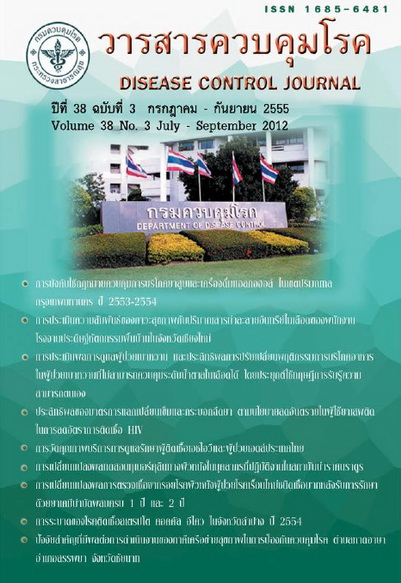
ประสิทธิผลของมาตรการแลกเปลี่ยนเข็มและกระบอกฉีดยาตามนโยบายลดอันตราย ในผู้ใช้ยาเสพติดในการลดอัตราการติดเชื้อ HIV
คำสำคัญ:
มาตรการแลกเปลี่ยนเข็มและกระบอกฉีดยา, ประสิทธิผล, การติดเชื้อเอชไอวีบทคัดย่อ
การศึกษานี้มีวัตถุประสงค์ เพื่อศึกษาถึงประสิทธิผลของมาตรการแลกเปลี่ยนเข็มและกระบอกฉีดยาในการลดอัตราการติดเชื้อ HIV ลดอัตราการใช้เข็มฉีดยาร่วมกัน อัตราการใช้เข็มและกระบอกฉีดยาซ้ำรวมถึงปัจจัยที่มีผลต่อความสำเร็จและปัญหาและอุปสรรคในการดำเนินการ ความครอบคลุมและการเข้าถึงการบริการตามมาตรการแลกเปลี่ยนเข็มและกระบอกฉีดยา ศึกษาโดยการทบทวนงานวิจัยเชิงลึก (in depth review)สืบค้นงานวิจัยจากฐานข้อมูลทางด้านวิทยาศาสตร์การแพทย์และด้านสังคมศาสตร์ ผลการศึกษาพบว่า มาตรการแลกเปลี่ยนเข็มและกระบอกฉีดยามีประสิทธิผลในการลดหรือชะลออัตราการติดเชื้อ HIV ในผู้ใช้ยาเสพติดชนิดฉีดลดอัตราการใช้เข็มฉีดยาร่วมกัน ลดอัตราการใช้เข็มและกระบอกฉีดยาซ้ำ ทำให้อัตราการเลิกใช้ยาเสพติดเพิ่มขึ้นไม่ทำให้มีการเพิ่มขึ้นของการเริ่มเข้ามาเสพยาของผู้เสพติดหน้าใหม่ ไม่มีผลทำให้อัตราการก่ออาชญากรรมที่เกี่ยวข้องกับยาเสพติดเพิ่มขึ้น มีความคุ้มทุนและลดค่าใช้จ่ายในการดูแลผู้เสพยาเสพติด ลดอัตราการใช้บริการด้านการแพทย์ฉุกเฉินเนื่องจากการเสพยา ปัจจัยที่มีผลต่อการดำเนินการตามมาตรการแลกเปลี่ยนเข็มและกระบอกฉีดยา ทั้งทางด้านสนับสนุนและต่อต้านคือปัจจัยทางด้านสังคม การเมือง ศาสนา การเคลื่อนไหวทางสังคมของนักเคลื่อนไหวกลุ่มต่างๆโดยเฉพาะกลุ่มคนรักเพศเดียวกัน ความร่วมมือกันของคนในชุมชนการสนับสนุนด้านทรัพยากรในการดำเนินการทั้งด้านงบประมาณ บุคลากร วัสดุ อุปกรณ์ และความยั่งยืนของการสนับสนุนนั้นๆ ในงานวิจัยที่ตีพิมพ์ก่อนปี 2000 บางฉบับผลการศึกษาพบว่ามาตรการแลกเปลี่ยนเข็มและกระบอกฉีดยาไม่มีผลในการลดอัตราการติดเชื้อ HIV แต่ได้มีการศึกษาหลังจากนั้นที่พบว่าสาเหตุที่ผลการศึกษาออกมาเช่นนั้น เป็นเพราะว่ายังขาดความครอบคลุมของหน่วยบริการและความสามารถในการเข้าถึงหน่วยบริการยังเป็นไปอย่างจำกัด ซึ่งปัจจัยที่มีผลต่อความครอบคลุมและการเข้าถึงหน่วยบริการก็เป็นปัจจัยทางด้านสังคม ระยะทางจากหน่วยบริการกับชุมชนที่ผู้ใช้ยาเสพติดอาศัยอยู่ เวลาเปิดปิดของหน่วยบริการไม่เอื้อต่อการเข้าใช้บริการ รวมถึงผู้เสพยาเสพติดประสงค์ให้หน่วยบริการให้บริการในด้านอื่นๆด้วยเช่น การวางแผนครอบครัว การบริการที่เป็นมิตร การขยายเวลาเปิดปิดนอกเวลาราชการ รวมทั้งให้บริการส่วนประกอบอื่นๆในการผสมยาเสพติดร่วมด้วย สรุปผลการศึกษา มาตรการแลกเปลี่ยนเข็มและกระบอกฉีดยามีประสิทธิผลในการลดหรือชะลออัตราการติดเชื้อ HIV ในกลุ่มผู้ใช้ยาเสพติดชนิดฉีดในทุกๆ ประเทศที่มีการดำเนินการตามมาตรการนี้ล้วนประสบกับปัญหาการต่อต้านของบุคคลและหน่วยงานต่างๆในสังคมโดยเฉพาะหน่วยงานทางด้านศาสนา การเมืองและกฎหมาย แต่ก็สามารถดำเนินงานมาได้อย่างต่อเนื่อง แม้จะพบกับอุปสรรค
Downloads
เอกสารอ้างอิง
2. Ball A, Weiler G A. Evidence for Action: Acritical tool for guideline policies and program for HIV prevention, treatment and care among injected drug users.IJDP. 2005: 16s: s1-s6
3. WHO. Biregional Strategy for Harm Reduction WHO publication. 2009.
4. Steffanie A S, Vlahov D. The effectiveness of needle exchange programs: A review of the science and policy AIDScience. 2001; 1: 1-31
5. Ellen J V A, A. Coutinho. Large decline in injecting drug use in Amsterdam, 1986-1998: explanatory mechanisms and determinants of injecting transitions. J Epidemiol Community Health. 2001: 55: 356-63
6. Stark K, Herrmann U, Ehrhardt S, Bienzle U. A syringe exchange programme in prison as prevention strategy against HIV infection and hepatitis B and C in Berlin, Germany. Epidemiology and Infection. 2005: 134: 8-14
7. Hurley SF, Jolley DJ, Kaldor JM. Effectiveness of needle-exchange programmes for prevention of HIV infection. Lancet. 1997:3 49: 1797- 1800
8. Azim T, Hussein N, Kelly R. Effectiveness of harm reduction programmes for injecting drug users in Dhaka city. Harm Reduct J. 2005: 25: 2:22
9. Pollock H A, Khoshnood K, Blankenship K M, Altice F L. The impact of needle exchange-based health services on emergency department use. J Gen Intern Med. 2002; 17(5): 341-8
10. Julie Bruneau FL, Eduardo F, Nathalie L, Marie D, Julio S, and, Vincelette J. High Rates of HIV Infection among Injection Drug Users Participating in Needle Exchange Programs in Montreal: Results of a Cohort Study. American Journal of Epidemiology. 1997: 146(12): 994 1002
11. Strathdee A, Sue LD, Peter C GA, Corne LM, Julio S, Montane O'Shaughnessy. Needle exchange is not enough lessons from the urban area. AIDS Care. 1997: 11: 59-65
12. Bluthenthal R N, Heinzerling K G, Anderson R, Flynn N M, Kral A H. Approval of Syringe Exchange Programs in California: Results From a Local Approach to HIV Prevention. American Journal of Public Health. 2008: 98: 278-83
13. Andrea K, Wren K , Patricia AL. Lessons learned from a peri-urban needle exchange. Harm Reduction Journal. 2010; 7(1): 8
14. Heimer R, Kaveh K, Dan B, Joseph G, Junge B. Syringe use and reuse: Effect of syringe exchange programs in four cities. Journal of Acquired immune deficiency sydrome. 1998;18(S1): s37-s44
15. Guydish J BJ, Young M, Woods W, Grinstead O, Clark W. Evaluating needle exchange: are there negative effects? AIDS 1997. 1993:7 (6): 871-876
16. Robert H. Community coverage and HIV prevention: Assessing metrics for estimating HIV incidence through syringe exchange. Int J Drug Policy. 2008: 19(1): 65-73
17. Vazirian M, Nassirimanesh B, Zamani S, Ono- Kihara M, Kihara M, Ravari S M, et al. Needle and syringe sharing practices of injecting drug users participating in an outreach HIV prevention program in Tehran, Iran: a cross-sectional study. Harm Reduct J. 2005: 7: 2-19
18. Kral A, Anderson H, Flynn R N, Bluthenthal R N. Injection risk behaviors among clients of syringe exchange programs with different syringe dispensation policies. Jaids-J Acq Imm Def. 2004:37(2): 1307-12
19. Jonh K, Watters MJE, George LC, Jennifer L. syringe and needle exchange as HIV/AIDS preventionfor injection drug users. Journal of American Medical Association. 1994:271(2): 115-20
20. Van den B C, Smit C, Van B G, Coutinho R,Prins M. Full participation in harm reduction programmes is associated with decreased risk for human immunodeficiency virus and hepatitis C virus: evidence from the Amsterdam Cohort Studies among drug users. Addiction. 2007: 102(9): 1454-62
21. Ellen J. A, Anne E, Hein S, Else S, Aalen OO. Legal access to needles and syringes/ needle exchange programmes versus HIV counselling and testing to prevent transmission of HIV among intravenous drug users. European journal Of Public health. 2003: 13: 252-8
22. de la Fuente L., Bravo M J, Toro C, Brugal M T, Barrio G, Soriano V, et al. Injecting and HIV prevalence among young heroin users in three Spanish cities and their association with the delayed implementation of harm reduction programmes. J Epidemiol Commun H. 2006: 60(6): 537-42
23. Strike, Carol B, Daniel ZC, Russell CW, Cass A, Susan L, et al. Giving away used injection equipment: missed prevention message? Harm Reduction Journal. 2010: 7(1): 2
24. Ricky N, Bluthenthal GR, Terry S, Rachel A, Neil M. F, Alex HK. Examination of the association between syringe exchange program dispensation policy and SEP client-level syringe coverage among injection drug user. Addiction. 2007: 102(4): 638-46
25. Vorobjov SU, Abel OA, Talu VA, Ruutel KD, Jarlais DC. Comparison of injecting drug users who obtain syringes from pharmacies and syringe exchange programs in Tallinn, Estonia. Harm Reduction Journal. 2009; 2: 6
26. Christopher A P, Peter Hs, Gary R, Campbell A. Selling syringe to injecting drug users: a study of five pharmacies in Hanoi, Vietnam. Journal of infect developing countries. 2007: 2: 51-8
27. Stoltz J A, Wood E, Small W, Li K, Tyndall M,Montaner J, et al. Changes in injecting practices associated with the use of a medically supervised safer injection facility. Journal of Public Health. 2007: 29(1): 35-9
28. Wood E. Changes in public order after the openingof a medically supervised safer injecting facilityfor illicit injection drug users. CanadianMedical Association Journal. 2004: 171(7):731-4
29. Kerr T, Tyndall M W, Zhang R, Lai C, MontanerJ S G, Wood E. Circumstances of First Injection Among Illicit Drug Users Accessing a Medi213cally Supervised Safer Injection Facility. AmericanJournal of Public Health. 2007: 97(7):1228-30
30. Thomas Kerr Jonh AS, Mark T, Kathy L, RuthZ, Julio M, Evan. Impact of a medical supervisedsafer injection facility on community drug
use pattern: a before and after study. BMJ. 2006:332: 220
31. Bayoumi A M, Zaric G S. The cost-effectivenessof Vancouver's supervised injection facility.CMAJ. 2008: 179(11): 1143-51
32. Franklin N L. Cost-effective of syringe exchange as an HIV prevention srategy. journal of Acquired immune deficiency sydrome. 2001: 28(3): 273-8
33. Juan MC, Eduardo S. Costs and effectiveness of a syringe distribution and needle exchange program for HIV prevention in a regional setting. The European Journal of Health Economics. 2003; 4: 203-8
34. David RH, Steven DP, Stephen TJ, Peter L, DavidV. Cost and Cost-Effectiveness of IncreasingAccess to Sterile Syringes and Needles as an HIV Prevention Intervention in the United States. J Acquir Immune Defic Syndr. 1998: 18(s1):s113-s38
35. Burrows D. Advocacy and coverage of needle exchange programs: results of a comparative study of harm reduction programs in Brazil, Bangladesh, Belarus, Ukraine, Russian Federation, and China. Cad Sa?de P?blica, Rio de Janeiro. 2006: 22(4): 871-9
36. Tempalski B, Flom P L, Friedman S R, DesJarlais D C, Friedman J J, McKnight C, et al.Social and Political Factors Predicting the Presence of Syringe Exchange Programs in 96 US Metropolitan Areas. American Journal of Public Health. 2007: 97(3): 437-47
37. Stopka T, Garfein J, Richard S R, Alessandra T, Steven R. Increasing Syringe Access and HIV Prevention in California: Findings from a Survey of Local Health Jurisdiction Key Personnel. Journal of Urban Health. 2006; 84(1): 116-25
38. Moher D, Thomas HR, Karen V, Nina M, Marilyn H, McKnight C et al. What's Community Got To Do With It? Implementation Models Of Syringe Exchange Programs. AIDS Educ Prev. 2005: 17(1): 68-78
39. Philbin MM, Lozada AR, Case P, Pollini RA, Alvelais J, Latkin CA, et al. Exploring stakeholder perceptions of acceptability and feasibility of needle exchange programmes, syringe vending machines and safer injection facilities in Tijuana, Mexico. Int J Drug Policy. 2009 20(4): 329-35
40. Fonseca E M, Ribeiro J M, Bertoni N, Bastos F I. Syringe exchange programs in Brazil: preliminary assessment of 45 programs. Cad Saude Publica. 2006: 22(4): 761-70
41. Razak M, Jittiwutikarn H, Suriyanon J, Vongchak V, Srirak T, Beyrer N, et al. HIV prevalence and risks among injection and noninjection drug users in northern Thailand: Need for comprehensive HIV prevention programs. Jaids-J Acq Imm Def. 2003: 33(2): 259-6
42. Li, Jianhua H, Toan HZ, Cunmin LH. The Chinese government's response to drug use and HIV/AIDS: A review of policies and programs. Harm Reduction Journal. 2010; 7(1): 4.
43. Melissa AM, Byron C, Ronald SBr, Benjamin J, Carl L, Vlahov D, et al. Trends in Crime and the Introduction of a Needle Exchange Program. American Journal of Public Health. 2000: 90(12): 1933-6
44. Rhodes T, Platt L, Sarang A, Vlasov A, Mikhailova L, Monaghan G. Street policing, injecting drug use and harm reduction in a Russian city: A qualitative study of police perspectives. J Urban Health. 2006: 83(5): 911-25
45. EVan JCA. large decline in injecting drug use inAmsterdam, 1986-1998: explnatory mechanismsand determinants of injecting transitions. Journal of epidemiology community health.2001; 55: 356-63
46. Davis C S, Burris S, Kraut-Becher J, Lynch KG, Metzger D. Effects of an intensive streetlevelpolice intervention on syringe exchange programuse in Philadelphia. American Journal of Public Health. 2005:95(3): 375
47. Wood E, Tyndall M W, Spittal P M, Li K, Hogg R S, Montaner J S G, et al. Factors associatedwith persistent high-risk syringe sharing in the presence of an established needle exchange programme. Aids. 2002: 16(6): 941-3
48. Matheson C, Anthony G B, Bond C, Rossi M K. Assessing and prioritizing the preferences of injecting drug users in needle and syringe exchange service development. Journal of Public Health. 2008: 30(2): 133-8
49. Tempalski B. Placing the dynamics of syringe exchange programs in the United States. HealthPlace. 2007: 13(2):417-31
50. Evan Wood, Patricia MS, Kathy L, Robert SH,O'Shaughnessy MV, Martin TS. needle exchangeand difficullty with needle access during an ongoing HIV epidemic. the international journal of drug policy. 2002: 13(2): 95-102
51. Tempalski B, Cooper H, Friedman S, Desjarlais D, Brady JKG. Correlates of syringe coverage for heroin injection in 35 large metropolitan areas in the US in which heroin is the dominant injected drug. International Journal of Drug Policy. 2008: 19: 47
ดาวน์โหลด
เผยแพร่แล้ว
รูปแบบการอ้างอิง
ฉบับ
ประเภทบทความ
สัญญาอนุญาต
บทความที่ลงพิมพ์ในวารสารควบคุมโรค ถือว่าเป็นผลงานทางวิชาการหรือการวิจัย และวิเคราะห์ตลอดจนเป็นความเห็นส่วนตัวของผู้เขียน ไม่ใช่ความเห็นของกรมควบคุมโรค ประเทศไทย หรือกองบรรณาธิการแต่ประการใด ผู้เขียนจำต้องรับผิดชอบต่อบทความของตน