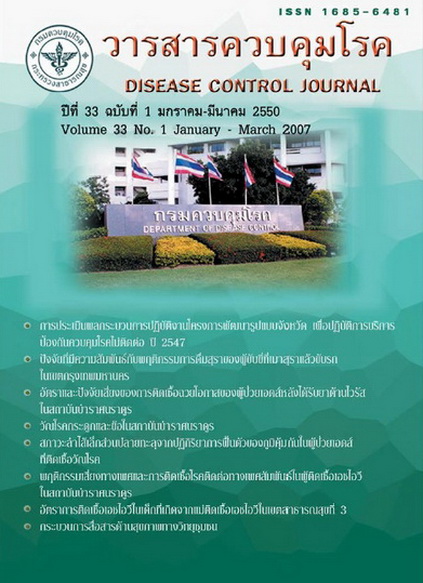
พฤติกรรมเสี่ยงทางเพศและการติดเชื้อโรคติดต่อทางเพศสัมพันธ์ ในผู้ติดเชื้อเอชไอวีในสถาบันบำราศนราดูร
คำสำคัญ:
ผู้ป่วยโรคเอดส์, โรคติดต่อทางเพศสัมพันธ์, สถาบันบำราศนราดูรบทคัดย่อ
การศึกษานี้มีวัตถุประสงค์เพื่อประเมินประวัติความความเสี่ยงของการมีเพศสัมพันธ์ที่ไม่ปลอดภัย ร่วมกับปัจจัยอื่นที่เกี่ยวข้องและเพื่อคัดกรองโรคติดต่อทางเพศสัมพันธ์ในผู้ติดเชื้อเอชไอวีที่มารับบริการ ที่คลินิกเอชไอวีที่สถาบันบำราศนราดูร โดยผู้ที่สมัครใจเข้าร่วมโครงการทุกรายจะได้รับการสอบถามถึงพฤติกรรมเสี่ยงทางเพศ การใช้ถุงยางอนามัย อาการที่เกี่ยวข้องกับโรคติดต่อทางเพศสัมพันธ์ การตรวจดูแผลที่อวัยวะเพศ ตรวจหาเชื้อหนองในและหนองในเทียมโดยวิธี Polymerase Chain Reaction ตรวจการติดเชื้อซิฟิลิสโดยดู VDRL และ TPHA เป็นบวก และทำการตรวจ wet smearเพื่อหาเชื้อพยาธิทริโคโมแนส (เฉพาะผู้หญิง) ผู้ที่พบผลผิดปกติ จากการ ซักประวัติและตรวจร่างกายจะได้รับการดูแลตามมาตรฐานของโรงพยาบาล ผลที่ได้จะถูกนำมาคำนวณโดย ใช้สถิติ chi-square test และ multivariate model หาปัจจัยที่มีความสัมพันธ์กับพฤติกรรมทางเพศที่ไม่ปลอดภัย ผลการศึกษาพบว่า ตั้งแต่เดือน กรกฎาคม พ.ศ. 2548-กุมภาพันธ์ พ.ศ. 2549 มีผู้ป่วยเข้าร่วมโครงการทั้งหมด 894 คน เป็นเพศชาย 395 คน (ร้อยละ 44) เพศหญิง 499 คน(ร้อยละ 56 ) ค่ามัธยฐานอายุ 36 ปี ผู้ป่วยร้อยละ 61 มีเพศสัมพันธ์ในช่วง 3 เดือนที่ผ่านมา ในจำนวนผู้ป่วย 546 คนที่มีเพศสัมพันธ์ในช่วง 3 เดือนที่ผ่านมาพบว่า ผู้ชาย 90/138 คน (ร้อยละ 65) และผู้หญิง 166/203 คน (ร้อยละ 82) รายงานใช้ถุงยางอนามัยเมื่อมีเพศสัมพันธ์ ครั้งสุดท้ายกับคู่นอนประจำ (p-value <0.01) ผู้ชาย 90/225 (ร้อยละ 40)และผู้หญิง 37/259 คน (ร้อยละ 14) มีเพศสัมพันธ์กับคู่นอนชั่วคราว (p-value <0.01) โดย 51/98 คน (ร้อยละ 52) ใช้ถุงยางอนามัยครั้งสุดท้าย ที่มีเพศสัมพันธ์กับคู่นอนชั่วคราว ผู้ชาย 44/178 ราย (ร้อยละ 25) รายงานว่ามีเพศสัมพันธ์กับผู้ชายด้วยกัน และ 20/33 (ร้อยละ 61) รายงานการมีเพศสัมพันธ์ทางทวารหนักโดยไม่ได้ป้องกัน ผู้ชาย 43/223 (ร้อยละ 19)มีการซื้อบริการทางเพศในช่วง 3 เดือนที่ผ่านมาและใช้ถุงยางอนามัยกับผู้ขายบริการเมื่อมีเพศสัมพันธ์ครั้งสุดท้ายเพียง 7/26 (ร้อยละ 27) ผู้หญิง 266/331 (ร้อยละ 80)และผู้ชาย 89/143 (ร้อยละ 62) เปิดเผยผลเลือดกับคู่นอนประจำ(p-value<0.01) ในจำนวนคู่นอนประจำ 401 คน ร้อยละ 44 ไม่ทราบผลเลือด ร้อยละ 34 มีผลเลือดเป็นบวก และร้อยละ 22 มีผลเลือดเป็นลบ โดยปัจจัยที่มีความสัมพันธ์กับการมีเพศสัมพันธ์ที่ ไม่ปลอดภัยกับคู่นอนประจำคือ การไม่เปิดเผยผลเลือดกับคู่นอน (OR =2.5 (95%CI 1.2-5.2)) ปัจจัยที่มีความ สัมพันธ์กับการมีเพศสัมพันธ์ที่ไม่ปลอดภัยกับคู่นอนที่ไม่ทราบผลเลือดหรือมีผลเอชไอวีเป็นลบคือผู้ป่วยที่ไม่ได้รับ การรักษาด้วยยาต้านไวรัส (OR = 2.2 (95%CI1.2-4.2)) ปัจจัยที่มีความสัมพันธ์กับการเปิดเผยผลเลือด กับคู่นอนคือเพศหญิง (OR 2.6 (95%CI1.4-4.6) และการรักษาด้วยยาต้านไวรัส (OR 2.2 (95%CI 1.2- 4.2) อัตราความชุกของโรคติดต่อทางเพศสัมพันธ์โดยรวมทั้งหนองใน หนองในเทียม ซิฟิลิส ทริโคโมแนสที่พบใน ผู้ชายคิดเป็นร้อยละ 10 และผู้หญิงพบร้อยละ 6 (p-value = 0.06) อย่างไรก็ตามผู้ชายมีการตรวจพบผล VDRL เป็นบวกมากกว่าผู้หญิง คิดเป็นร้อยละ 8 และ 2 ตามลำดับ (p-value = <0.01) ปัจจัยที่สัมพันธ์กับการ ตรวจพบโรคติดต่อทางเพศสัมพันธ์ใดๆคือผู้ชายที่มีอาการ (OR31.2 (95%CI7.0-139.7)) และผู้หญิงที่ตรวจ พบความผิดปกติที่เข้าได้กับโรคติดต่อทางเพศสัมพันธ์จากการตรวจร่างกายและการตรวจภายใน (OR 4.0, 95%CI 1.2-12.9)) โดยสรุป พฤติกรรมเสี่ยงทางเพศของผู้มารับบริการที่คลินิคเอชไอวีค่อนข้างสูง แม้ว่าความชุกของโรคติดต่อทางเพศสัมพันธ์ไม่มากนัก ผู้ที่ไม่ได้รับยาต้านไวรัสและไม่ได้เปิดเผยผลเลือดกับคู่นอนเป็นกลุ่มที่มีความเสี่ยงในการมีเพศสัมพันธ์ที่ไม่ปลอดภัยโดยเฉพาะอย่างยิ่งกับคู่นอนที่ไม่ทราบผลเลือดหรือมีผลเลือดเป็นลบ ผู้ชายที่มีอาการของโรคติดต่อทางเพศสัมพันธ์และผู้หญิงที่ตรวจพบความผิดปกติจากการตรวจร่างกายมีความชุกของโรคติดต่อทางเพศสัมพันธ์สูงกว่ากลุ่มอื่น
Downloads
เอกสารอ้างอิง
2) กราฟแสดงจำ นวนผู้ป่วยที่ได้รับยา ARV ในโครงการ NAPHA ณ เดือนกันยายน 2549 ในยาต้านไวรัสเอดส์: การดำเนินงานโครงการ NAPHA. Available at http://www.aidsthai.org/arrv03.html (Access Jan 17, 07)
3) Joint United Nations Program on HIV/AIDS (UNAIDS) and World Health Organization (WHO). AIDS epidemic update: Dec. 2006,Geneva, UNAIDS, WHO, Dec. 2006
4) Castilla J, Del Romero J, Hernando V, Marincovich B, Garcia S, Rodriguez C. Effectiveness of highly active antiretroviral therapy in reducing heterosexual transmistion of HIV. J Acquir Immune Defic Syndr. 2005; 40: 96-101.
5) Gremy I, Beltzer N. HIV risk and condom use in the adult heterosexual population in France between 1992 and 2001: return to the starting point AIDS. 2004; 18(5): 805-9. starting point. AIDS 2004; 18(5): 805-9.
6) Diamond C, Richardson JL, Milan J, et al. Use of and Adherence to antiretroviral therapy is associated with decreased sexual risk behavior in HIV clinic patients. J Acquir Immune Defic Syndr. 2004; 39: 211-218.
7) Boily MC, Godin G, Hogben M, Sherr L, Bastos FI.The impact of the transmission dynamics of the HIV/AIDS epidemic on sexual behaviour: a new hypothesis to explain recent increases in risk taking-behaviour among men who have sex with men. Med Hypotheses. 2005; 65(2): 215-26.
8) Tun W, Gange SJ, Vlahov D, Strathdee SA, Celentano DD.Increase in sexual risk behavior associated with immunologic response to highly active antiretroviral therapy among HIV-infected injection drug users. Clin Infect Dis 2004; 38(8): 1167-74. Epub 2004. Apr 5.
9) Cohen MS. Sexually transmitted diseases enhance HIV transmission: no longer a hypothesis. Lancet 1998; 351(suppl III): 5-7
10) Rothenberg RB, Wasserheit JN, St Louis ME, Douglas JM. The effect of treating sexually transmitted diseases on the transmission of HIV in dually infected persons: a clinic-based estimate. Ad Hoc STD/HIV Transmission Group. Sex Transm Dis. 2000; 27(7): 411-6.
11) บำราศ OPD cases
12) Brannstrom J, Akerlund B, Arneborn M, Blaxhult A, Giesecke J. Patients unaware of their HIV infection until AIDS diagnosis in Sweden 1996-2002--a remaining problem in the highly active antiretroviral therapy era. Int J STD AIDS 2005; 16: 702-6.
13) Nakayiwa S, Abang B, Packel L, et al. Desire for children and pregnancy risk behavior among HIV-infected men and women in Uganda. AIDS Behav 2006; 10(4 Suppl): S95-104.
14) Sirivongrangson P, Bollen LJ, Chaovavanich A, et al. Sexually transmitted infection services as a component of HIV care: findings of a demonstration project among HIV-infected women in Thailand. J Acquir Immune Defic Syndr 2006; 41(5): 671-4.
15) Dave SS, Stephenson J, Mercey DE, Panahmand N, Jungmann E.Sexual behaviour, condom use, and disclosure of HIV status in HIV infected heterosexual individuals attending an inner
London HIV clinic. Sex Transm Infect 2006; 82(2): 117-20.
16) Bova C, Durante A. Sexual functioning among HIV-infected women. AIDS Patient Care STDS. 2003; 17: 75-83.
17) Aidala AA, Lee G, Garbers S, Chiasson MA. Sexual behaviors and sexual risk in a prospective cohort of HIV-positive men and women in New York City, 1994-2002: implications for prevention. AIDS Educ Prev. 2006; 18: 12-32.
18) Bennetts A, Shaffer N, Phophong P, et al. Differences in sexual behaviour between HIV-infected pregnant women and their husbands in Bangkok, Thailand. AIDS Care 1999; 11(6): 649-61.
19) Sturdevant MS, Belzer M, Weissman G, Friedman LB, Sarr M, Muenz LR; Adolescent Medicine HIV/AIDS Research Network. The relationship of unsafe sexual behaviour and the characteristics of sexual partners of HIV infected and HIV uninfected adolescent females. J Adolesc Health. 2001; 29 (3suppl): 64-71.
20) Kitsiripornchai S, Markowitz LE, Ungchusak K, et al. Sexual behavior of young men in Thailand: regional differences and evidence of behavior change. J Acquir Immune Defic Syndr Hum Retrovirol. 1998; 18(3): 282-8.
21) Griensven FV, Supawitkul S, Kilmarx P, et al. Rapid Assessment of Sexual Behavior, Drug Use, Human Immunodeficiency Virus, and Sexually Transmitted Diseases in Northern Thai
Interviewing and Noninvasive Specimen Collection Pediatrics. 2001; 108: 13
22) Mansergh G, Naorat S, Jommaroeng R, et al. Inconsistent condom use with steady and casual partners and associated factors among sexually-active men who have sex with men
in Bangkok, Thailand. AIDS Behav 2006; 10(6): 743-51.
23) Vittinghoff E, Douglas J, Judson F, McKirnan D, MacQueen K, Buchbinder SP. Per-contact risk of human immunodeficiency virus transmission between male sexual partners. Am J Epidemiol. 1999; 150(3): 306-11.
24) Weinhardt LS, Kelly JA, Brondino MJ, et al. HIV transmission risk behavior among men and women living with HIV in 4 cities in the United States. J Acquir Immune Defic Syndr. 2004;
36: 1057-66.
25) Brewer DD, Gloden MR, Handsfield HH. Unsafe sexual behavior and correlates of risk in a probablility sample of men who have sex with men in the era of highly active antiretroviral
therapy. Sex Transm Dis. 2006; 33: 250-5.
26) Semple SJ, Zians J, Grant I, Patterson TL. Sexual risk behavior of HIV-positive methamphetamine-using men who have sex with men: the role of partner serostatus and partner
type. Arch Sex Behav. 2006; 35: 461-71.
27) CDC. High risk sexual behavior by HIV-positive men who have sex with men-16 sites, United States, 2000-2002. MMWR . 2004; 53: 891-4.
28) Truong HH, Kellogg T, Klausner JD, et al. Increases in sexually transmitted infections and sexual risk behaviour without a concurrent increase in HIV incidence among men who have sex with men in San Francisco: a suggestion of HIV serosorting. Sex Transm Infect. 2006; 82: 461-6.
29) Xia Q, Molitor F, Osmond DH, et al. Knowledge of sexual partner's HIV serostatus and serosorting practices in a California population- based sample of men who have sex with men. AIDS. 2006; 20: 2081-9
30) de Boer MA, Celentano DD, Tovanabutra S, Rugpao S, Nelson KE, Suriyanon V. Reliability of self-reported sexual behavior in human immunodeficiency virus (HIV) concordant and discordant heterosexual couples in northern Thailand. Am J Epidemiol. 1998; 147(12): 1153-61.
31) Hong DS, Glodstein RB, Rotheram-Borus MJ, et al. Perceived partner serostatus, attribution of responsibility for prevention of HIV transmission, and sexual risk behavior with " MAIN" partner among adults living with HIV. AIDS Educ Prev. 2006; 18: 150-62.
32) Bunnell R, Ekwaru JP, Solberg P, et al. Changes in sexual behavior and risk of HIV transmission after antiretroviral therapy and prevention interventions in rural Uganda. AIDS. 2006; 20: 85-92.
33) Crepaz N, Hart TA, Marks G. Highly active antiretroviral therapy and sexual risk behavior: a meta-analytic review. JAMA. 2004; 292(2): 224-36.
34) Gunn RA, Eldred SL, Mathews C. Sexually transmitted disease clinical preventive services for HIV-infected patients. Sex Transm Dis. 2001; 28: 455-456.
35) Peterman TA, Tian LH, Metcalf CA, et al. High incidence of new sexually transmitted infections in the year following a sexually transmitted infection: a case for rescreening. Ann Intern Med. 2006; 145(8): 564-72.
36) Kharsany AB, Mashego M, Mdlotshwa M, Frohlich J, Karim QA. Direct questioning of genital symptoms: increasing opportunities for identifying and treatment of sexually transmitted infections in primary health-care settings. Afr J Reprod Health. 2006; 10: 105-12.
37) Mayaud P, McCormick D. Interventions against sexually transmitted infections (STI) to prevent HIV infection. Br Med Bull. 2001; 58: 129-53.
38) Chalermchockcharoenkit A, Sirimai K, Chaisilwattana P. High prevalence of cervical squamous cell abnormalities among HIV-infected women with immunological AIDS-defining illnesses. J Obstet Gynaecol Res. 2006; 32(3): 324-9.
39) Keiser O, Martinez de Tejada B, Wunder D, et al. Frequency of gynecologic follow-up and cervical cancer screening in the Swiss HIV cohort study. J Acquir Immune Defic Syndr 2006. 15; 43(5): 550-5.
40) สัญชัย ชาสมบัติ ชีวนันท์ เลิศพิริยสุวัฒน์ พรทิพย์ ยุกตานนท์ กระทรวงสาธารณสุข ในแนวทางการ ดูแลรักษาผู้ติดเชื้อเอชไอวีและผู้ป่วยโรคเอดส์ เด็กและผู้ใหญ่ในประเทศไทย ปี พ. ศ.2547 (ฉบับปรับปรุงครั้งที่ 8) : โรงพิมพ์ชุมนุมสหกรณ์การเกษตรแห่งประเทศไทย หน้า 138-140
41) Folch C, Marks G, Esteve A, Zaragoza K, Munoz R, Casabona J. Factors associated with unprotected sexual intercourse with steady male, casual male and female partners among men
who have sex with men in Barcelona, Spain. AIDS Educ Prev. 2006; 18: 222-42
42) Raj A, Cheng DM, Levison R, Meli S, Samet JH. Sex trade, sexual risk, and nondisclosure of HIV serostatus: findings from HIV-infected persons with a history of alcohol problems. AIDS behave. 2006; 10: 149-57.
43) Stein M, Herman DS, Trisvan E, Pirraglia P, Engler P, Anderson BJ. Alcohol use and sexual risk behavior among human immunodeficiency virus-positive persons. Alcohol Clin Exp Res.
2005; 29: 837- 43
ดาวน์โหลด
เผยแพร่แล้ว
รูปแบบการอ้างอิง
ฉบับ
ประเภทบทความ
สัญญาอนุญาต
บทความที่ลงพิมพ์ในวารสารควบคุมโรค ถือว่าเป็นผลงานทางวิชาการหรือการวิจัย และวิเคราะห์ตลอดจนเป็นความเห็นส่วนตัวของผู้เขียน ไม่ใช่ความเห็นของกรมควบคุมโรค ประเทศไทย หรือกองบรรณาธิการแต่ประการใด ผู้เขียนจำต้องรับผิดชอบต่อบทความของตน