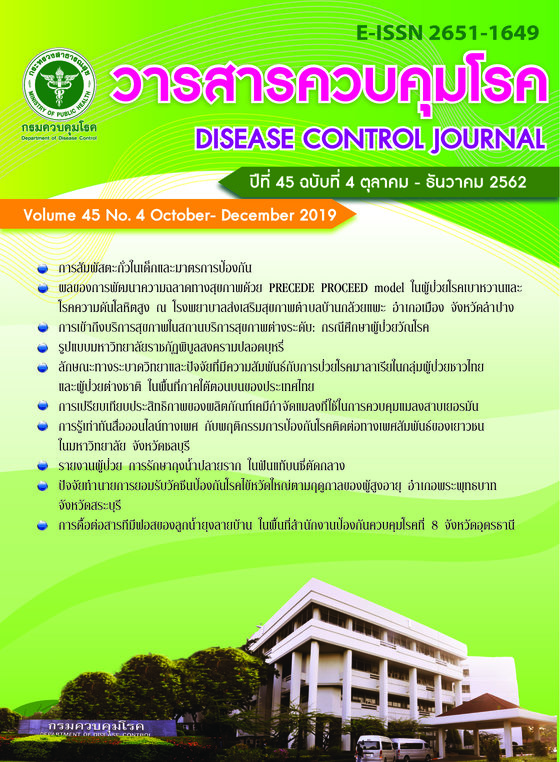
ลักษณะทางระบาดวิทยาและปัจจัยที่มีความสัมพันธ์กับการป่วยโรคมาลาเรียในกลุ่มผู้ป่วยชาวไทยและผู้ป่วยต่างชาติ ในพื้นที่ภาคใต้ตอนบนของประเทศไทย
DOI:
https://doi.org/10.14456/dcj.2019.35คำสำคัญ:
มาลาเรีย, ผู้ป่วยคนไทย, ผู้ป่วยต่างชาติบทคัดย่อ
โรคมาลาเรีย เป็นปัญหาสาธารณสุขของประเทศไทย การศึกษานี้มีวัตถุประสงค์เพื่อศึกษารูปแบบการแพร่เชื้อมาลาเรีย รวมถึงปัจจัยที่มีความสัมพันธ์กับการป่วยในกลุ่มผู้ป่วยชาวไทยและผู้ป่วยต่างชาติ ในพื้นที่ภาคใต้ตอนบน โดยใช้ข้อมูลทุติยภูมิผู้ป่วยโรคมาลาเรียรายใหม่จากฐานข้อมูลมาลาเรียออนไลน์ ตั้งแต่ปี 2556-2559 จำนวน 5,541 ราย วิเคราะห์ข้อมูลหาปัจจัยที่มีความสัมพันธ์กับการป่วยโรคมาลาเรีย โดยใช้โปรแกรม R ผลการศึกษาพบว่า ลักษณะทางระบาดวิทยาโรคมาลาเรียในผู้ป่วยชาวไทยและผู้ป่วยต่างชาติคล้ายกัน โดยพบการป่วยในเพศชายมากกว่าเพศหญิง กลุ่มอายุส่วนใหญ่อยู่ในวัยทำงาน อาชีพทำสวนยาง ผู้ป่วยต่างชาติพบมากในจังหวัดระนอง (ร้อยละ 64.4) ส่วนผู้ป่วยชาวไทยพบมากในจังหวัดสุราษฎร์ธานี (ร้อยละ 40.2) พบการแพร่โรคสูงในช่วงพฤษภาคมถึงมิถุนายนของทุกปี ผู้ป่วยส่วนใหญ่ติดเชื้อในหมู่บ้านที่มีการแพร่เชื้อบางฤดูกาล (A2) โดยผู้ป่วยชาวไทยส่วนใหญ่ติดเชื้อชนิด Plasmodium falciparum: PF (ร้อยละ 60.1) ส่วนผู้ป่วยต่างชาติติดเชื้อชนิด Plasmodium vivax: PV (ร้อยละ 56.7) จังหวัดที่มีการติดเชื้อชนิด PF สูง ได้แก่ สุราษฎร์ธานี พังงา นครศรีธรรมราชและกระบี่ จังหวัดที่มีการติดเชื้อชนิด PV สูง ได้แก่ ภูเก็ต ระนองและชุมพร ผู้ป่วยต่างชาติมีประวัติการไปพักแรมในต่างพื้นที่สูงกว่าผู้ป่วยชาวไทย 3 เท่า ส่วนผู้ป่วยชาวไทยมีพฤติกรรมการนอนในมุ้ง และการใช้ยาทากันยุงมากกว่าผู้ป่วยต่างชาติ การพ่นสารเคมี บ้านผู้ป่วย และการเจาะโลหิตค้นหาผู้ป่วยรายใหม่ พบในกลุ่มผู้ป่วยชาวไทยสูงกว่าผู้ป่วยต่างชาติ สำหรับปัจจัยที่มีความสัมพันธ์กับการป่วยโรคมาลาเรียในผู้ป่วยชาวไทยและผู้ป่วยต่างชาติพบว่า เพศ อายุ อาชีพ ประวัติการไปพักแรมก่อนเป็นไข้ การนอนในมุ้ง แหล่งคนไข้ติดเชื้อ ภูมิประเทศของแหล่งที่คนไข้ติดเชื้อ การพ่นสารเคมีในแหล่งติดเชื้อ การพ่นเคมีบ้านผู้ป่วยอาศัย การเจาะโลหิตค้นหาผู้ป่วยรายใหม่เพิ่มเติม มีความสัมพันธ์กับการป่วยด้วยโรคมาลาเรียอย่างมีนัยสำคัญทางสถิติ ผลการศึกษาสามารถนำไปใช้ประโยชน์ในการวางแผนเฝ้าระวัง ป้องกัน ควบคุมโรค และสื่อสารความเสี่ยง เพื่อปรับเปลี่ยนพฤติกรรมการป้องกันตนเองจากการถูกยุงกัดขณะกรีดยางและที่บ้านพัก เพื่อให้บรรลุตามเป้าหมายของประเทศ
Downloads
เอกสารอ้างอิง
2. World Health Organization. World malaria report 2017 [Internet]. Geneva: World Health Organization; 2017 [cited 2019 Jan 29]. 196 p. Available from: https://www.who.int/docs/default-source/documents/world-malaria-report-2017.pdf?sfvrsn=8b7b573a_0
3. Bureau of Vector-Borne Diseases. Annual Report 2011-2015. Nonthaburi: Bureau of Vector-Borne Diseases; 2015. (in Thai)
4. World Health Organization. World malaria report 2016 [Internet]. Geneva: World Health Organization; 2016 [cited 2019 Jan 29]. 186 p. Available from: https://apps.who.int/iris/bitstream/handle/10665/252038/9789241511711-eng.pdf
5. Bureau of Vector-Borne Diseases. Online malaria database [Internet]. [cited 2018 Mar 20]. Available from: https://malaria.ddc.moph.go.th/malariaR10/ (in Thai)
6. World Health Organization. Global technical strategy for malaria 2016-2030 [Internet]. Geneva: World Health Organization; 2016 [cited 2018 Mar 24]. 32 p. Available from:
https://www.who.int/malaria/publications/atoz/9789241564991/en/
7. Bureau of Vector-Borne Diseases. National malaria elimination strategy, Thailand 2017-2026. Nonthaburi: Bureau of Vector-Borne Diseases; 2015. (in Thai)
8. Bureau of Vector-Borne Diseases. Guidelines on malaria control for public health workers, 2009. 2nd ed. Nonthaburi: Bureau of Vector-Borne Diseases; 2009. (in Thai)
9. Health Systems Research Institute. Foreign migrant workers and notifiable diseases. [Internet]. [cited 2018 Mar 20]. Available from: www.hsri.or.th/people/media/care/detail/5529 (in Thai)
10. Department of Employment. Situations of migrant workers in Thailand [Internet]. [cited 2018 Mar 20]. Available from: https://www.doe.go.th/prd/alien/statistic/param/site/152/cat/82/sub/0/pull/category/view/list-label (in Thai)
11. Chujun S, Konglai K. Appropriate approach to the malaria prevention and control among migrant workers in the high incidence area of Ranong Province. Journal of vector borne disease 2012;2:45-55. (in Thai)
12. Saisin S. Protective behaviors for the people seeking malaria diagnosis at malaria clinic, Vector Borne Disease Control Unit 6, Ta Phraya District, Sa Kaeo Province [dissertation]. Bangkok: Mahidol University; 1999. 80 p. (in Thai)
13. Muenrat S. The pattern of health seeking and behavior prevention on malaria patients of the foreign labor in border area, Upper South, Thailand [Internet]. [cited 2018 Mar 20]. Available from: https://irem2.ddc.moph.go.th/research/3924 (in Thai)
14. Chuebangkaew P. Epidemiology and personal protection against malaria in hill tribe people, Wat Chan Sub-district, Mae Chaem District, Chiang Mai Province [dissertation]. Bangkok: Mahidol University; 1998. 157 p. (in Thai)
15. Sudathip P. Risk factors associated with malaria P. falciparum re-infection among malaria patients seeking treatment at malaria clinic, Vector Borne Disease Control Center 53, Kanchanaburi Province [dissertation]. Bangkok: Mahidol University; 1998. 91 p. (in Thai)
16. Sriwichai P, Karl S, Samung Y, Kiattibutr K, Sirichaisinthop J, Mueller L, et al. Imported Plasmodium falciparum and locally transmitted Plasmodium vivax: cross-border malaria transmission scenario in northwestern Thailand. Malar J 2017;16:258-67.
17. Hanandita W, Tammpubo G. Geography and social distribution of malaria in Indonesian Papua: a cross-sectional study. Int J Health Geogr 2016;15:13-28.
18. National Institute of Health of Thailand. Ecological biology and mosquito control in Thailand. 4th ed. Nonthaburi: National Institute of Health of Thailand; 2001. (in Thai)
19. Bureau of Vector-Borne Diseases. Entomology database [Internet]. [cited 2018 Mar 20]. Available from: www.thaivbd.org/entomological (in Thai)
20. Lonsunthorn P. Epidemiology. 3rd ed. Bangkok: Chulalongkorn University; 1997. (in Thai)
21. Wikipedia. Surat Thani [Internet]. [cited 2018 Mar 20]. Available from: https://en.wikipedia.org/wiki/Surat_Thani
22. Department of Employment. Statistics journal of the current number of foreign migrant patients who are allowed to work throughout the Kingdom in 2015 [Internet]. [cited 2018 Mar 20]. Available from:
https://www.doe.go.th/prd/assets/upload/files/alien_th/9543df52b3c6627a674841501f323738.pdf (in Thai)
23. Suthirawut T. Public health operation in migrant workers [Internet]. [cited 2018 Mar 20]. Available from: https://www.boe.moph.go.th/files/meeting/slide_IHR_2DEC_pdf/3.pdf in Thai)
24. Muenrat Y. Epidemiology and behavior of malaria prevention of foreign workers in high risk areas of Ranong Province [Internet]. [cited 2018 Mar 20]. Available from: https://kb.hsri.or.th/dspace/handle/11228/1203?locale-attribute=th (in Thai)
25. Fungladda W, Sornmani S, Klongkamnuankarn K, Hungsapruek T. Sociodemographic and behavioral factor associated with hospital malaria patient in Kanchanaburi, Thanland. J Trop Med Hyg 1987;90:233-7.
ดาวน์โหลด
เผยแพร่แล้ว
รูปแบบการอ้างอิง
ฉบับ
ประเภทบทความ
สัญญาอนุญาต
บทความที่ลงพิมพ์ในวารสารควบคุมโรค ถือว่าเป็นผลงานทางวิชาการหรือการวิจัย และวิเคราะห์ตลอดจนเป็นความเห็นส่วนตัวของผู้เขียน ไม่ใช่ความเห็นของกรมควบคุมโรค ประเทศไทย หรือกองบรรณาธิการแต่ประการใด ผู้เขียนจำต้องรับผิดชอบต่อบทความของตน