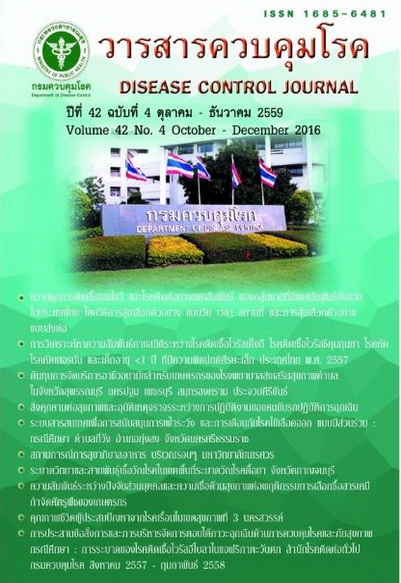
ระบาดวิทยาและสายพันธุ์เชื้อวัณโรคในเขตพื้นที่ระบาดวัณโรคดื้อยา จังหวัดกาญจนบุรี
DOI:
https://doi.org/10.14456/dcj.2016.7คำสำคัญ:
วัณโรคดื้อยาบทคัดย่อ
วัณโรคเป็นปัญหาสำคัญทางสาธารณสุข การแยกสายพันธุ์ของเชื้อวัณโรคมีประโยชน์ในการสอบสวนด้านระบาดวิทยาและติดตามการแพร่ติดต่อของโรค การศึกษานี้ทำการแยกสายพันธุ์และศึกษาการแพร่ติดต่อของเชื้อวัณโรค ในเขตอำเภอท่ามะกา จังหวัดกาญจนบุรี ซึ่งมีการระบาดของเชื้อวัณโรคดื้อยา โดยใช้เทคนิคการวิเคราะห์ลายพิมพ์ DNA (DNA fingerprint) ของเชื้อวัณโรคที่เพาะเลี้ยงจากเสมหะผู้ป่วยที่ได้รับการขึ้นทะเบียนรักษาวัณโรคระหว่างปี พ.ศ. 2556-2557 จำนวน 68 ตัวอย่าง ในจำนวนนี้เป็นเชื้อดื้อยาหลายขนาน (การดื้อต่อยา isoniazid และ rifampicin) จำนวน 20 ตัวอย่าง และเป็นเชื้อดื้อยาหลัก isoniazid หรือ rifampicin ชนิดเดียว จำนวน 5 ตัวอย่าง ใช้วิธีการที่เป็นสากลในการแยกสายพันธุ์ ได้แก่ spoligotyping และการวิเคราะห์ Mycobacterial interspersed repetitive unit-variable number of tandem repeat (MIRU-VNTR) ผลการแยกสายพันธุ์ พบเชื้อวัณโรคสายพันธุ์ Beijing มีจำนวนมาก คิดเป็นร้อยละ 50.00 (34/68) สายพันธุ์อื่น 12 สายพันธุ์และสายพันธุ์ใหม่ 7 สายพันธุ์ ผลการแยกย่อยสายพันธุ์ (subtype) ในกลุ่ม Beijing พบเชื้อ 14 ตัวอย่าง เป็นสายพันธุ์เดียวกันและเป็นเชื้อดื้อยาหลายขนาน ผลการจำแนกสายพันธุ์ในครั้งนี้ เชื่อมโยงการระบาดเชื้อ วัณโรคดื้อยาในเขตอำเภอท่ามะกา จังหวัดกาญจนบุรี ตั้งแต่ พ.ศ. 2545 จนถึงปัจจุบัน ได้บ่งชี้สายพันธุ์ที่สำคัญซึ่งเป็นสาเหตุการแพร่ระบาดของเชื้อวัณโรคดื้อยาที่ยากต่อการควบคุมกำจัดการแพร่ติดต่อได้ ควรมีการติดตามการระบาดโดยตรวจแยกสายพันธุ์อย่างต่อเนื่อง และกำหนดมาตรการในการควบคุมการแพร่ติดต่อ การป้องกัน และรักษาอย่างมีประสิทธิภาพต่อไป
Downloads
เอกสารอ้างอิง
2. สำนักข่าวแห่งชาติ กรมประชาสัมพันธ์. สาธารณสุขจังหวัดกาญจนบุรี พัฒนาระบบการจัดบริการดูแลรักษา ลดอัตราการเสียชีวิตและการแพร่ระบาดของวัณโรคดื้อยาหลายขนานในจังหวัดกาญจนบุรี [อินเทอร์เน็ต]. [สืบค้นเมื่อ 18 มิ.ย. 2559]. แหล่งข้อมูล: http://thainews.prd.go.th/website_th/news/news_detail/ TNSOC5805140010105
3. สำนักวัณโรค กรมควบคุมโรค กระทรวงสาธารณสุข. แนวทางการดำเนินงานควบคุมวัณโรคแห่งชาติ พ.ศ. 2556 [อินเทอร์เน็ต]. [สืบคืนเมื่อ 19 ม.ค. 2559]. แหล่งข้อมูล: http://e-lib.ddc.moph.go.th/pdf /eb333/eb333.pdf
4. ชุลีพร จิระพงษา, ธนพล หวังธีระประเสริฐ, ณรงค์ เห็นประเสริฐแท้, จันทิรา สุขะสิฐษ์วณิชกุล, นาฎพธู สงวนวงศ์, ลัดดาวัลย์ ปัญญา, และคณะ. การระบาดของ วัณโรคดื้อยาในชุมชน อ.ท่ามะกา จ.กาญจนบุรี 2545 - มิถุนายน 2553. วารสารสมาคมเวชศาสตร์ป้องกันแห่งประเทศไทย 2554;3:262-71.
5. Wells CD, Cegielski JP, Nelson LJ, Laserson KF, Holtz TH, Finlay A, et al., HIV infection and multidrug-resistant tuberculosis: the perfect storm. J Infect Dis 2007;196 Suppl 1:S86- 107.
6. Regmi SM, Chaiprasert A, Kulawonganunchai S, Tongsima S, Coker OO, Prammananan T, et al. Whole genome sequence analysis of multi¬drug resistant Mycobacterium tuberculosis Bei¬jing isolates from an outbreak in Thailand. Mol Genet Genomics 2015; doi 10.1007/s00438 -015-1048-0.
7. Disratthakit A, Meada S, Prammananan T, Thaipisuttikul I, Doi N, Chaiprasert A. Genotypic diversity of multidrug-, quinolone- and exten¬sively drug-resistant Mycobacterium tuberculosis isolates in Thailand. Infect Genet Evol 2015; 32:432-9.
8. van Embden JD, Cave MD, Crawford JT, Dale JW, Eisenach KD, GicqueI B, et al. Strain iden¬tification of Mycobacterium tuberculosis by DNA fingerprinting: recommendations for a standard¬ized methodology. J Clin Microbiol 1993;31 :406-9.
9. Sukkasem S, Yanai H, Mahasirimongkol S, Yamada N, Rienthong D, Palittapongarnpim P, et al. Drug resistance and IS6110-RFLP patterns of Mycobacterium tuberculosis in patients with recurrent tuberculosis in northern Thailand. Microbiol Immunol 2013;57:21-9.
10. Brudey K, Driscoll JR, Rigouts L, Prodinger WM, Gori A, Al-Hajoj SA, et al. Mycobacterium tuberculosis complex genetic diversity: mining the fourth international spoligotyping database (SpolDB4) for classification, population genetics and epidemiology. BMC Microbiol 2006;6:1- 17.
11. Filliol I, Driscoll JR, Soolingen DV, Kreiswirth BN, Kremer K, Valtudie G, et al. Global distri¬bution of Mycobacterium tuberculosis spoligo¬types. Emerging Infectious Diseases 2002;8: 1347-9.
12. Allix-Béguec C, Harmsen D, Weniger T, Supply P, Niemann S. Evaluation and strategy for use of MIRU-VNTRplus, multifunctional database for online analysis of genotyping data and phyloge¬netic identification of Mycobacterium tuberculosis complex isolates. J Clin Microbiol 2008;46: 2692-9.
13. Homolka S, Post E, Oberhauser B, George AG, Westman L, Dafae F, et al. High genetic diver¬sity among Mycobacterium tuberculosis complex strain from Sierra Leone. BMC microbiol 2008;8:103.
14. Faksri K, Drobniewski F, Nikolayevskyy V, Brown T, Prammananan T, Palittapongarnpim P, et al. Genetic diversity of the Mycobacterium tuberculosis Beijing family based on IS6110, SNP, LSP and VNTR profiles from Thailand. Infect Genet Evol 2011;11:1142-9.
15. Demay C, Liens B, BurguiereT, Hill V, Couvin D, Millet J, et al. SITVITWEB- a publicly available international multimarker database for studying Mycobacterium tuberculosis genetic diversity and molecular epidemiology. Infect Genet Evol 2012;12:755-66.
16. Supply P, Allix C, Lesjean S, Cardoso-Oele¬mann M, Rusch-Gerdes S, Willery E, et al. Pro¬posal for standardization of optimized mycobac¬terial interspersed repetitive unit-variable-number tandem repeat typing of Mycobacterium tubercu¬losis. J Clin Microbiol 2006;44: 4498-510.
17. van Soolingen D, Qian L, de Haas PE, Douglas JT, Traore H, Portaels F, et al. Predominance of a single genotype of Mycobacterium tuberculosis in countries of east Asia. J Clin Microbiol 1995;33:3234-8.
18. European concerted action on new generation genetic markers and techniques for the epidemi¬ology and control of tuberculosis. Beijing/W genotype Mycobacterium tuberculosis and drug resistance. Emerg Infect Dis 2006;12:736-43.
19. Bifani PJ, Mthema B, Kurepina NE, Kreiswirth BN. Global dissemination of the Mycobacterium tuberculosis W. Beijing family strain. Trends Microbiol 2002;10:45-52.
20. Wang J, Liu Y, Zhang CL, Ji BY, Zhang LZ, Shao YZ, et al. Genotypes and characteristics of clustering and drug susceptibility of Mycobacte¬rium tuberculosis isolates collected in Heilong-jiang Province, China. J Clin Microbiol 2011; 49:1354-62.
21. Nakajima C, Tamaru A, Rahim Z, Poudel A, Maharjan B, Aye KS, et al. Simple multiplex PCR Assay for Identification of Beijing Family Mycobacterium tuberculosis Isolates with a lineage-specific mutation in Rv0679c. J Clin Microbiol 2014;51:2025-32.
22. Klopper M, Warren RM, Hayes C, Pittius NCGV, Streicher EM, Müller B, et al. Emer¬gence and spread of extensively and totally drug-resistant tuberculosis, South Africa. Emerg Infect Dis 2013;19:449-55.
23. Lopez B, Aguilar D, Orozco H, Buger M, Espitia C, Ritacco V, et al. A marked difference in pathogenesis and immune response induce by different Mycobacterium tuberculosis genotypes. Clin Exp Immunol 2003;133:30-37.
24. Mokrousov I, Ly HM, Otten T, Lan NN, Vyshnevskyi B, Hoffner S, et al. Origin and primary dispersal the Mycobacterium tuberculo¬sis Beijing genotype: clues for human phyloge¬ography. Genome Res 2005;15:1357-64.
ดาวน์โหลด
เผยแพร่แล้ว
รูปแบบการอ้างอิง
ฉบับ
ประเภทบทความ
สัญญาอนุญาต
บทความที่ลงพิมพ์ในวารสารควบคุมโรค ถือว่าเป็นผลงานทางวิชาการหรือการวิจัย และวิเคราะห์ตลอดจนเป็นความเห็นส่วนตัวของผู้เขียน ไม่ใช่ความเห็นของกรมควบคุมโรค ประเทศไทย หรือกองบรรณาธิการแต่ประการใด ผู้เขียนจำต้องรับผิดชอบต่อบทความของตน