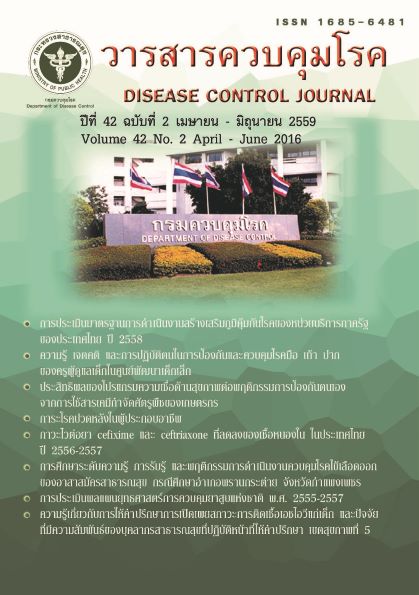
ภาวะไวต่อยา cefixime และ ceftriaxone ที่ลดลงของเชื้อหนองใน ในประเทศไทย ปี 2556-2557
DOI:
https://doi.org/10.14456/dcj.2016.23คำสำคัญ:
หนองใน, ดื้อยาบทคัดย่อ
บทนำ : ปัจจุบันได้มีรายงานการพบภาวะเชื้อหนองในดื้อยามากขึ้นในหลายประเทศ การศึกษานี้เป็นการรายงานความไวต่อยา cephalosporin ของเชื้อหนองใน ในผู้ป่วยที่มารักษาที่โรงพยาบาลบางรัก กรุงเทพมหานคร วัตถุประสงค์ : เพื่อเฝ้าระวังการดื้อยาของเชื้อหนองใน ในผู้ป่วยซึ่งมารับการรักษาโรคหนองใน ณ โรงพยาบาลบางรัก กรุงเทพมหานคร วิธีการดำเนินงาน : ทดสอบการหาความเข้มข้นต่ำสุดที่สามารถยับยั้งการเจริญของเชื้อ Neisseria gonorrhoeae ของยา cefixime และ ceftriaxone โดยวิธี E-test บนอาหารเลี้ยงเชื้อ selective media ผลการศึกษา : ผู้ป่วยรายแรกเป็นผู้ป่วยเพศชาย มาโรงพยาบาลด้วยปัญหาปัสสาวะแสบและมีหนองไหลออกจากท่อปัสสาวะ ผู้ป่วยรายที่สองเป็นเพศหญิง ซึ่งเป็นคู่เพศสัมพันธ์ของผู้ป่วยรายแรก ไม่มีอาการผิดปกติ ผู้ป่วยรายที่สามเป็นชายรักชาย มาโรงพยาบาลด้วยผื่น ไม่มีอาการผิดปกติของระบบทางเดินปัสสาวะ ผลเพาะเชื้อจากผู้ป่วยทั้งสามราย พบเชื้อ N. gonorrhoeae β-lactamase negative ค่า MICs ของ cefixime อยู่ในช่วงระหว่าง 0.064-0.125 μg/ml ค่า MICs ของ ceftriaxone ได้แก่ 0.064 μg/ml ผู้ป่วยทั้งสามรายหลังได้รับการรักษาหายเป็นปกติ และตรวจไม่พบเชื้อ วิจารณ์ : จากรายงานผู้ป่วยทั้งสามราย พบว่า เชื้อ N. gonorrhoeae ยังมีความไวต่อยา cefixime และ ceftriaxone แต่พบการเพิ่มขึ้นของระดับค่า MICs ของยาทั้งสองชนิด ดังนั้นหากพบผู้ป่วยที่ไม่ตอบสนองต่อการรักษาตามแนวทางการรักษาโรคหนองใน แพทย์ควรพิจารณาส่งสารคัดหลั่งจากผู้ป่วยเพื่อตรวจค่า MICs ต่อยากลุ่ม cephalosporin
Downloads
เอกสารอ้างอิง
2. Satterwhite CL, Satterwhite CL, Torrone E, Meites E, Dunne EF, Mahajan R, et al. Sexually transmitted infections among U.S. women and men: Prevalence and incidence estimates, 2008. Sex Transm Dis 2013;40:187-93.
3. Unemo M, Shafer WM. Antibiotic resistance in Neisseria gonorrhoeae: origin, evolution, and lessons learned for the future. Ann N Y Acad Sci 2011;1230:E19-28.
4. Centers for Disease Control and Prevention. Sexually transmitted diseases treatment guidelines, 2015. MMWR Recomm Rep 2015;64 (RR-03):60-8.
5. Unemo M, Golparian D, Hestner A. Ceftriaxone treatment failure of pharyngeal gonorrhoea verified by international recommendations, Sweden, July 2010. Euro Surveill [Internet]. 2011 [cited 2015 Aug 17]16:pii=19792. Available from: http://www.eurosurveillance.org/ViewArticle. aspx?ArticleId=19792
6. Unemo M. Treatment failure of pharyngeal gonorrhoea with internationally recommended first-line ceftriaxone verified in Slovenia, 2011. Euro surveill;17(25): pii=20200.
7. Ohnishi M, Saika T, Hoshina S, Iwasaku K, Nakayama S, Watanabe H, et al. Ceftriaxone-resistant Neisseria gonorrhoeae, Japan. Emerging infectious diseases 2011;17:148-9.
8. Unemo M, Golparian D, Nicholas R, Ohnishi M, Gallay A, Sednaoui P. High-level cefixime and ceftriaxone-resistant Neisseria gonorrhoeae in France: novel penA mosaic allele in a successful international clone causes treatment failure. Antimicrobial agents and chemotherapy 2012;56: 1273-80.
9. Manzano S, Lacroix LE. Catheterization of the urethra in girls. The New England journal of medicine 2014;371:1849-50.
10. Ison CA, Hussey J, Sankar KN, Evans J, Alexander S. Gonorrhoea treatment failures to cefixime and azithromycin in England, 2010. Euro Surveill 2011;16(14): pii=19833.
11. Tapsall J, Read P, Carmody C, Bourne C, Ray S, Limnios A, et al. Two cases of failed ceftriaxone treatment in pharyngeal gonorrhoea verified by molecular microbiological methods. J Med Microbiol 2009;58:683-687.
12. Bala M, Kakran M, Singh V, Sood S, Ramesh V, Dorji D, et al. Monitoring antimicrobial resistance in Neisseria gonorrhoeae in selected countries of the WHO South-East Asia Region between 2009 and 2012: a retrospective analysis. Sexually Transmitted Infections 2013;89 (Suppl 4):iv28-iv35.
13. Cockerill F. Performance standards for antimicrobial susceptibility testing. Wayne, PA: Clini¬cal and Laboratory Standards Institute; 2012.
14. Center for Disease Control and Prevention. Antibiotic Resistance Threats in the United States, 2013 [Internet]. [cited 2015 Aug 17]. Available from: http://www.cdc.gov/drugresistance/threat-report-2013/
15. bioMérieux. E-test antimicrobial susceptibility testing for in-vitro diagnostic use. Marcy-l’ Etoile: bioMérieux; 2010.
16. Ghanem KG. Gonorrhea. In: Bope ET, Kellerman R, Rakel RE, editors. Conn’s Current Ther¬apy 2011. Philadelphia, Pa: Saunders/Elsevier; 2010. p. 931-8.
17. Hook EW III, Handsfield HH. Gonococcal infections in the adult. In: Holmes KK, Sparling PF, Stamm WE, Piot P, Wasserheit JN, Corey L, et al. editors. Sexually Transmitted Diseases. 4th ed. New York, NY: McGraw-Hill; 2008.
18. Unemo M, Sjöstrand A, Akhras M, Gharizadeh B, Lindbäck E, Pourmand N, et al. Molecular characterization of Neisseria gonorrhoea identifies transmission and resistance of one ciproflox¬acin-resistant strain. APMIS 2007;115:23141.
19. Ohnishi M, Watanabe Y, Ono E, Takahashi C, Oya H, Kuroki T, et al. Spreading of a chromosomal cefixime-resistant penA gene among different Neisseria gonorrhoeae lineages. Antimicrob Agents Chemother 2010;54:1060-7.
20. Cole MJ, Spiteri G, Chisholm SA, Hoffmann S, Ison CA, Unemo M, et al. Emerging cephalosporin and multidrug-resistant gonorrhoea in Europe. Euro Surveill [Internet]. 2014 [cited 2015 Aug 17];19:pii=20955. Available from: http://www.eurosurveillance.org/ViewArticle.aspx?ArticleId=20955
ดาวน์โหลด
เผยแพร่แล้ว
รูปแบบการอ้างอิง
ฉบับ
ประเภทบทความ
สัญญาอนุญาต
บทความที่ลงพิมพ์ในวารสารควบคุมโรค ถือว่าเป็นผลงานทางวิชาการหรือการวิจัย และวิเคราะห์ตลอดจนเป็นความเห็นส่วนตัวของผู้เขียน ไม่ใช่ความเห็นของกรมควบคุมโรค ประเทศไทย หรือกองบรรณาธิการแต่ประการใด ผู้เขียนจำต้องรับผิดชอบต่อบทความของตน