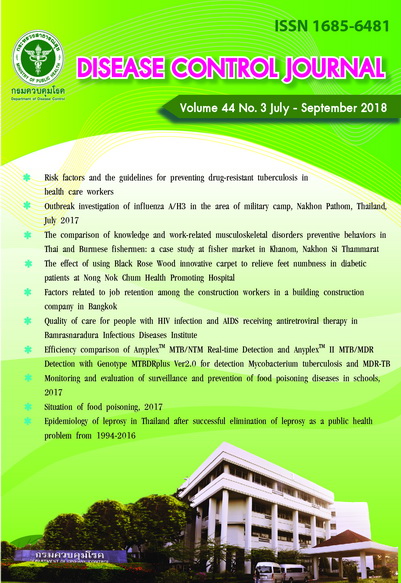
เปรียบเทียบประสิทธิภาพชุดตรวจ AnyplexTM MTB/NTM Real-time Detection และ AnyplexTM II MTB/MDR Detection กับ Genotype MTBDRplus Ver2.0 สำหรับตรวจวิเคราะห์หาเชื้อวัณโรคและวัณโรคดื้อยาหลายขนาน
DOI:
https://doi.org/10.14456/dcj.2018.27บทคัดย่อ
การตรวจทางห้องปฏิบัติการวัณโรคและวัณโรคดื้อยาหลายขนานที่มีประสิทธิภาพ ถือเป็นหัวใจสำคัญ ที่ทำให้การรักษาวัณโรคและวัณโรคดื้อยาประสบความสำเร็จ ปัจจุบันหลักการทางอณูชีววิทยาได้เข้ามามีบทบาทสำคัญในการตรวจวินิจฉัย โดยเป็นหลักการที่มีความไวและความจำเพาะสูง ง่าย สะดวก รวดเร็ว สามารถใช้เป็นวิธีการตรวจเบื้องต้นได้ โดยหลักการอณูชีววิทยาที่องค์การอนามัยโลกรับรองให้ใช้ในการตรวจวินิจฉัยวัณโรคคือ หลักการ Line Probe Assay (LPA) ซึ่งเป็นการใช้วิธี reverse hybridization แต่ในประเทศไทยมีการนำชุดตรวจหลักการ Real-time PCR มาใช้อย่างแพร่หลาย การศึกษานี้จึงมีวัตถุประสงค์เพื่อเปรียบเทียบประสิทธิภาพชุดตรวจ AnyplexTM MTB/NTM Real-time Detection และ AnyplexTM II MTB/MDR Detection ซึ่งเป็นหลักการ Real-time PCR ในการตรวจวิเคราะห์หาเชื้อวัณโรค (MTB) วัณโรคที่ดื้อต่อยา rifampicin (RIF-resistance TB) วัณโรคที่ดื้อต่อยา isoniazid (INH-resistance TB) และวัณโรคดื้อยาหลายขนาน (MDR-TB) กับชุดตรวจ Genotype MTBDRplus Ver2.0 ซึ่งใช้หลักการ LPA โดยใช้ตัวอย่างเสมหะของผู้ป่วยที่ส่งมาตรวจที่ห้องปฏิบัติการของสำนักงานป้องกันควบคุมโรคที่ 5 จังหวัดราชบุรี จำนวน 147 ตัวอย่าง ผลการศึกษาพบว่า ชุดตรวจหลักการ Real-time PCR นี้ให้ผลสอดคล้องกับหลักการ LPA โดยการตรวจหาเชื้อ MTB, RIF-resistance TB, INH-resistance TB และ MDR-TB มีค่าความไวร้อยละ 100, 88.89, 100 และ 100 มีค่าความจำเพาะ ร้อยละ 100, 99.06, 100 และ 100 มีค่าทำนายผลบวกร้อยละ 100, 88.89, 100 และ 100 และมีค่าทำนายผลลบร้อยละ 100, 99.06, 100 และ 100 แสดงให้เห็นว่า การตรวจวิเคราะห์หาเชื้อวัณโรคและวัณโรคดื้อยาด้วยหลักการ Real-time PCR นี้มีประสิทธิภาพที่ดีเทียบเท่ากับหลักการ LPA จึงเป็นอีกทางเลือกหนึ่งที่สามารถนำมาใช้ในการตรวจวินิจฉัยเชื้อวัณโรคได้ และยังเป็นวิธีที่สะดวก รวดเร็ว ใช้งานง่าย ช่วยให้รักษาผู้ป่วยได้ทันเวลา เป็นการป้องกันควบคุมวัณโรคไม่ให้เกิดการแพร่ระบาดสู่ชุมชน
Downloads
เอกสารอ้างอิง
2. Kim MJ, Nam YS, Cho SY, Park TS, Lee HJ. Comparison of the Xpert MTB/RIF Assay and Real-time PCR for the detection of Mycobacterium tuberculosis. Ann Clin Lab Sci 2015;45:327-32.
3. Zhang ZX, Sng LH, Yong Y, Lin LM, Cheng TW, Seong NH, et al. Delays in diagnosis and treatment of pulmonary tuberculosis in AFB smear-negative patients with pneumonia. Int J Tuberc Lung Dis 2017;21:544-9.
4. Suthum K, Tipkrua N. Comparison of Mycobacterium tuberculosis drug resistance testing between Real-time PCR using a Dual Priming Oligonucleotide Method and drug susceptibility testing by The BACTECTM MGITTM 960 System. J Med Tech Assoc Thailand 2013;41:4654-66.
5. Lawn SD, Mwaba P, Bates M, Piatek A, Alexander H, Marais BJ, et al. Advances in tuberculosis diagnostics: the Xpert MTB/RIF assay and future prospects for a point of care test. Lancet Infect Dis 2013;13:349-61.
6. Brossier F, Veziris N, Truffot-Pernot C, Jarlier V, Sougakoff W. Performance of the genotype MTBDR Line Probe Assay for detection of resistance to rifampin and isoniazid in strains of Mycobacterium tuberculosis with low- and high-level resistance. J Clin Microbiol 2006;44:3659-64.
7. Rufai SB, Kumar P, Singh A, Prajapati S, Balooni V, Singh S. Comparison of Xpert MTB/RIF with Line Probe Assay for Detection of Rifampin-Monoresistant Mycobacterium tuberculosis. J Clin Microbiol 2014;52:1846-52.
8. Lv Z, Zhang M, Zhang H, Lu X. Utility of Real-Time Quantitative Polymerase Chain Reaction in Detecting Mycobacterium tuberculosis. Biomed Res Int 2017;2017:1-5.
9. Hance AJ, Grandchamp B, Lévy-Frébault V, Lecossier D, Rauzier J, Bocart D, et al. Detection and identification of mycobacteria by amplification of mycobacterial DNA. Mol Microbiol 1989;3:843-9.
10. Patel RJ, Fries JWU, Piessens WF, Wirth DF. Sequence analysis and amplification by polymerase chain reaction of a cloned DNA fragment for identification of Mycobacterium tuberculosis. J Clin Microbiol 1990;28:513-8.
11. Marin M, Viedma DG, Ruiz-Serrano MJ, Bouza E. Rapid direct detection of multiple rifampin and isoniazid resistance mutations in Mycobacterium tuberculosis in respiratory samples by real-time PCR. Antimicrob Agents and Chemother 2004;48:4293–300.
12. Perry MD, White PL, Ruddy M. Potential for use of the Seegene Anyplex MTB/NTM real-time detection assay in a regional reference laboratory. J Clin Microbiol 2014;52:1708-10.
13. Molina-Moya B, Lacoma A, Prat C, Pimkina E, Diaz J, García-Sierra N, et al. Diagnostic accuracy study of multiplex PCR for detecting tuberculosis drug resistance. J Infect 2015;71:220-30.
14. Deggim-Messmer V, Bloemberg GV, Ritter C, Voit A, Hömke R, Keller PM, et al. Diagnostic molecular mycobacteriology in regions with low tuberculosis endemicity: combining Real-time PCR Assays for detection of multiple mycobacterial pathogens with Line Probe Assays for identification of resistance mutations. EBioMedicine 2016;9:228-37.
15. Bakker E. Is the DNA sequence the gold standard in genetic testing? Quality of molecular genetic tests assessed. Clin Chem 2006;52:557-8.
ดาวน์โหลด
เผยแพร่แล้ว
รูปแบบการอ้างอิง
ฉบับ
ประเภทบทความ
สัญญาอนุญาต
บทความที่ลงพิมพ์ในวารสารควบคุมโรค ถือว่าเป็นผลงานทางวิชาการหรือการวิจัย และวิเคราะห์ตลอดจนเป็นความเห็นส่วนตัวของผู้เขียน ไม่ใช่ความเห็นของกรมควบคุมโรค ประเทศไทย หรือกองบรรณาธิการแต่ประการใด ผู้เขียนจำต้องรับผิดชอบต่อบทความของตน