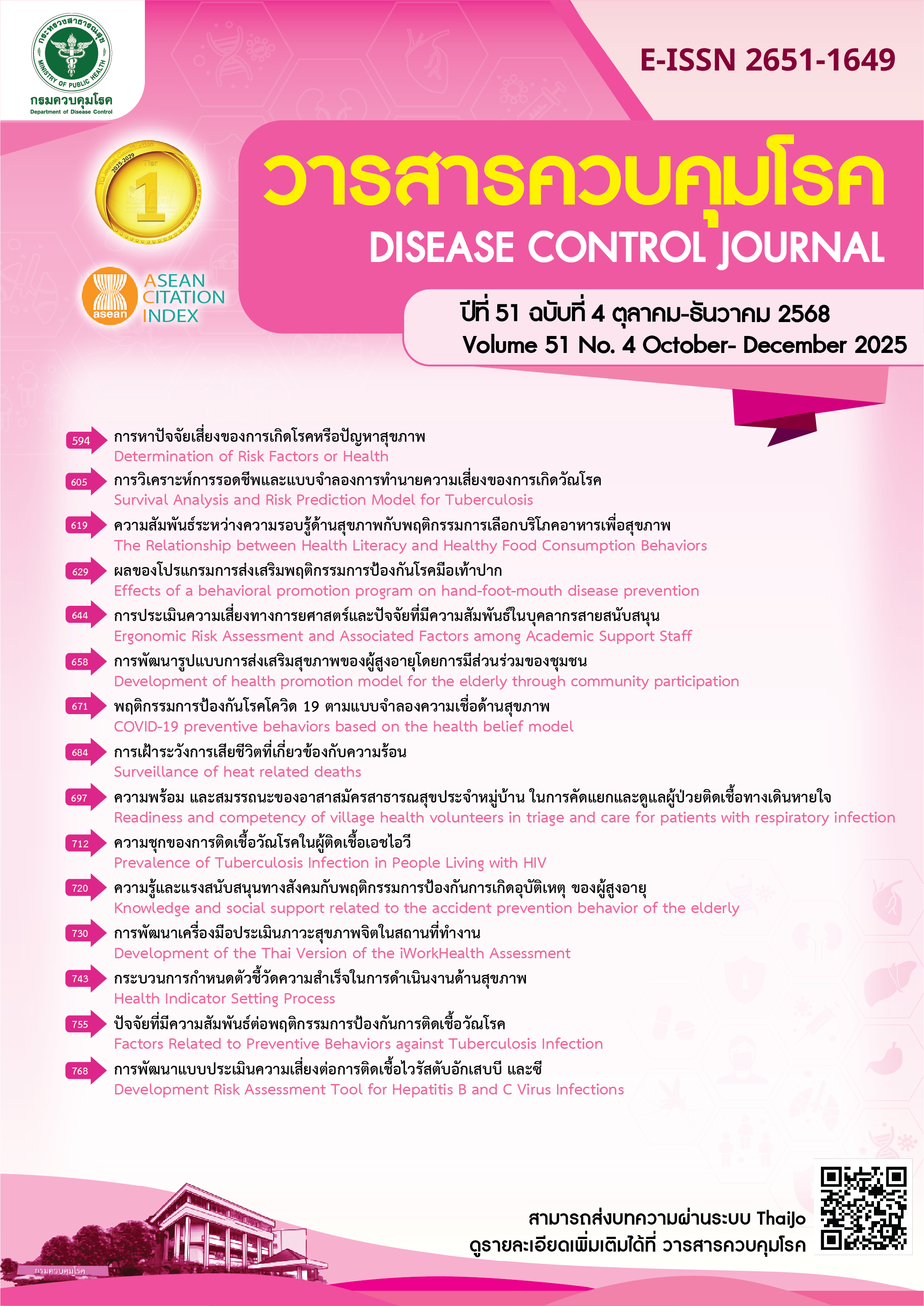
COVID-19 preventive behaviors based on the health belief model among people in Khueang Nai District, Ubon Ratchathani Province
DOI:
https://doi.org/10.14456/dcj.2025.53Keywords:
health belief, preventive behavior, COVID-19Abstract
This survey research was conducted to examine covid-19 preventive behaviors and community management approaches in caring for COVID-19 patients. The sample was residents from Ko Ae Subdistrict, Khueang Nai District, Ubon Ratchathani Province. Data were collected from January 1 to September 30, 2022. Quantitative data were collected from 456 participants using a questionnaire measuring 25 items on COVID-19 perception and 12 items on preventive behaviors related to COVID-19. The reliability of the questionnaire was validated with 30 similar participants, yielding Cronbach’s alpha coefficients of 0.83 and 0.90, respectively. Data were analyzed using descriptive statistics and multiple regression analysis. For the qualitative study, purposive sampling was used to recruit 30 key informants, including public health personnel, community leaders, and community representatives. The focus group discussions were conducted using semi-structured interviews. Qualitative data were analyzed using content analysis. The result showed that the majority of the sample had good COVID-19 preventive behaviors (71.93%). History of COVID-19 infection and perceived benefits of preventive practices could predict preventive behaviors for COVID-19 by 14.84%, with a statistical significance level of 0.05. Regarding community management of COVID-19 patients, it was found that participatory processes were implemented in collaboration with related organizations. Disease prevention and control measures should emphasize the benefits of preventive behaviors and promote community participation, which would enhance the sustainability and efficiency of implementation.
Downloads
References
Department of Disease Control. Situation of Covid infected people 2022. [Internet]. Nonthaburi: Department of Disease Control; 2022 [cited 2022 Jan 20]. Available from https://ddc.moph.go.th/covid19-dashboard/ (in Thai)
COVID-19 Central Information Center. COVID-19 situation in Ubon Ratchathani Province [Internet]. Ubon Ratchathani: Ubon Ratchathani Provincial Health Office; 2022 [cited 2022 Jan 20]. Available from: https://www.facebook.com/ubonratchathanicentercovid19. (in Thai)
COVID-19 Treatment Guidelines Panel. Coronavirus Disease 2019 (COVID-19) Treatment Guidelines. [Internet]. National Institutes of Health (last update 2 March 2022) [cited 2022 Nov 21]. Available from https://www.covid19treatmentguidelines.nih.gov/
Rosenstock IM. The Health Belief Model and Preventive Health Behavior. Health Education Monographs. 1974;2(4):354-86.
Yod mai K, Pechrapa K, Kittipichai W, Charupoonpol P, Suksatan W. Factors associated with good COVID-19 preventive behaviors among older adults in urban communities in Thailand. Journal of Primary Care & Community Health. 2021;12:1-9.
Zhong BL, Luo W, Li HM, Zhang QQ, Liu XG, Li WT, Li Y. Knowledge, attitudes, and practices towards COVID-19 among Chinese residents during the rapid rise period of the COVID-19 outbreak: a quick online cross-sectional survey. International Journal of Biological Sciences. 2020;16(10):1745-52.
Zewdie A, Mose A, Sahle T, et al. The health belief model’s ability to predict COVID-19 preventive behavior: A systematic review. SAGE Open Medicine. 2022;10:20503121221113668.
Lakkhet T. The Development Model for the Prevention and Control of Coronavirus Disease 2019 (COVID-19) among the People, Ubon Ratchathani Province. Thai Journal of Public Health and Health Education. 2023;3(2):62-79. (in Thai)
Yamane T. Statistics: an introductory analysis. 3rd ed. New York: Harper and Row; 1973.
Polit DF, Beck CT. Nursing Research: Principles and Methods. 7th Edition. Philadelphia: Lippincott Williams & Wilkins; 2004.
Kaewsuksai R, Kongkun P, Tongkoop B, Samaair L, Boonnarakorn S. Relationships between knowledge, perception, and the “New Normal Behaviors” for preventing Coronavirus Disease (COVID-19) infection among people in Narathiwat Province. The Southern College Network. Journal of Nursing and Public Health. 2021;8(2):67-79. (in Thai)
Inthacharoen A, Kanchanapoom K, Tansakul K. Factors Influencing Preventive Behavior towards Coronavirus Disease 2019 among People in Khohong Town Municipality Songkhla Province. Journal of Council of Community Public Health. 2021;3(2):14-25. (in Thai)
Bloom BS. Taxonomy of educational objectives, handbook : The cognitive domain. New York: David McKay; 1956.
Nawsuwan K, Singweratham N, Waichompu N, Chayakul K. The Successful Implementation of Novel Coronavirus (COVID-19) in the Community of Village Health Volunteers (VHVs) in Thailand. Princess of Naradhiwas University Journal. 2020;12(3):195-212. (in Thai)
Sukkhachat N, Manwong M, Sukumal P. Factors associated with preventive behaviors for coronavirus disease 2019 among patients with chronic disease Patients Samrong District, Ubon Ratchathani Province. Journal of Medical and Public Health Region 4. 2023;13(2):80-92. (in Thai)
Kanchaiyaphum K. Developing a Management Model for The Novel Coronavirus Disease 2019 (COVID-19) with a Mechanism for Improving Quality of Life at the District Level Khon Sawan District Chaiyaphum. Journal of Health and Environmental Education. 2022;7(3):66-75. (in Thai)
Ounseam S, Dech-Arun V. Prevention and Control of COVID-19 in Hat Yai District of Songkhla Province. Journal of Health Sciences and Pedagogy. 2023;3(1):1-6. (in Thai)
Sirimongkhol S, Buadang S. Development of a process model for driving health constitutions in specific areas on the issue of prevention and control of coronavirus disease 2019 in the area of Ban Si Udom Health Promoting Hospital, Trakaj Sub-district, Kantharalak district, Sisaket Province. Sisaket Journal of Research and Health Development. 2023;2(1):39-51. (in Thai)
Downloads
Published
How to Cite
Issue
Section
License
Copyright (c) 2025 Disease Control Journal

This work is licensed under a Creative Commons Attribution-NonCommercial-NoDerivatives 4.0 International License.
Articles published in the Disease Control Journal are considered as academic work, research or analysis of the personal opinion of the authors, not the opinion of the Thailand Department of Disease Control or editorial team. The authors must be responsible for their articles.