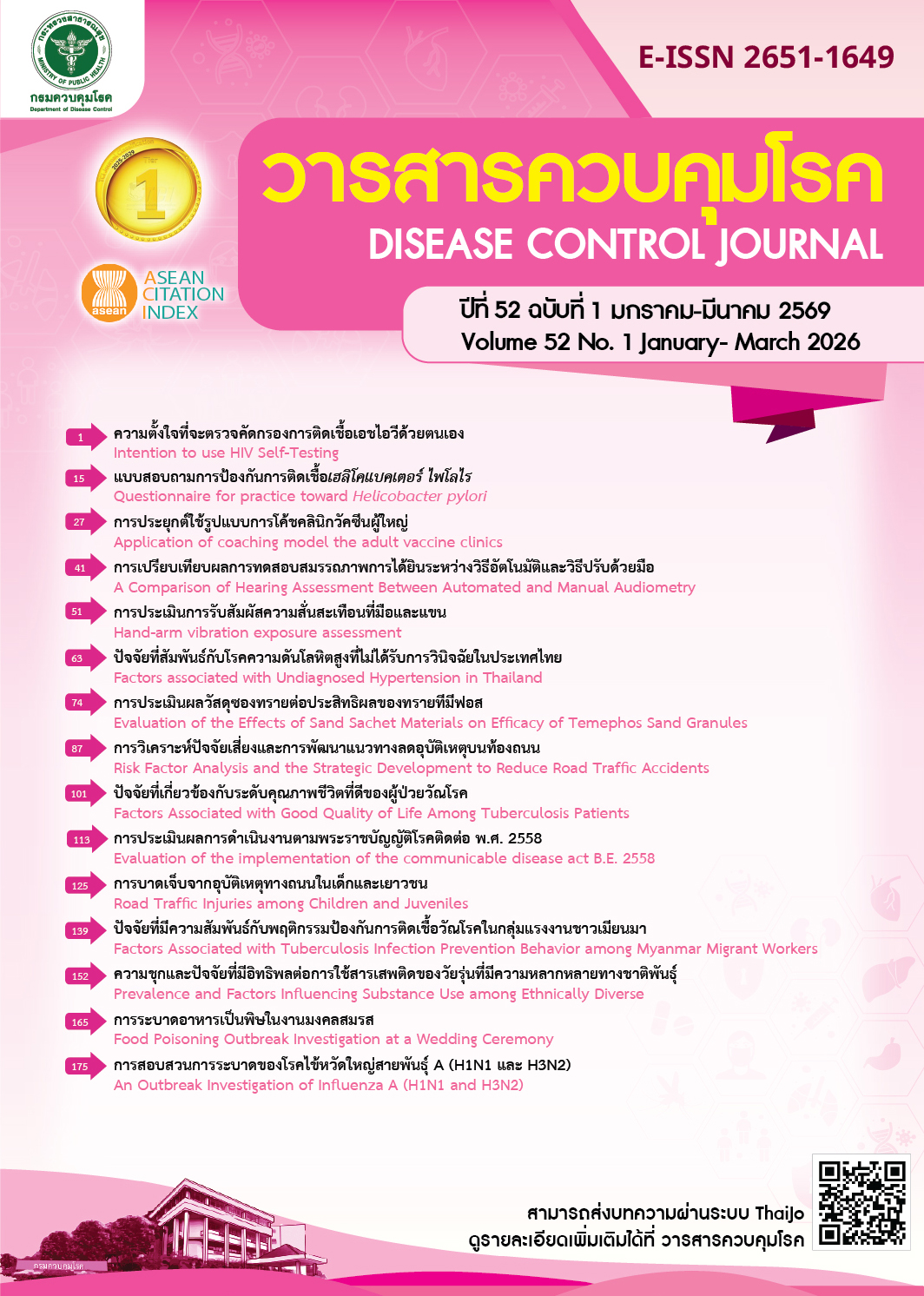
Evaluation of the implementation of the communicable disease act B.E. 2558 (2015): key lessons and directions for the development of Thailand’s disease control system
DOI:
https://doi.org/10.14456/dcj.2026.10Keywords:
communicable disease act B.E. 2558 (2015), national action plan for communicable disease surveillance, prevention, and control B.E. 2566-2570 (2023-2027), outcome evaluation, disease control system, public health policyAbstract
This mixed-methods study aimed to evaluate the implementation of the Communicable Disease Act B.E. 2558 (2015) and the National Action Plan for Communicable Disease Surveillance, Prevention, and Control B.E. 2566-2570 (2023-2027) at the mid-term stage, in order to derive lessons learned and
develop policy recommendations for strengthening Thailand’s disease control system. Quantitative data were collected from key performance indicators, while qualitative data were obtained through document review and in-depth interviews with 66 stakeholders across six provinces: Chiang Rai, Kanchanaburi, Chonburi, Bangkok, Songkhla, and Ubon Ratchathani. Quantitative findings demonstrated progress in several indicators, including the development of subordinate legislation, strengthening of surveillance systems, and enhanced performance of Emergency Operations Centers (EOCs). Qualitative findings revealed that Thailand has established strong disease control mechanisms—such as Provincial Communicable Disease Committees, Communicable Disease Control Units, and Surveillance and Rapid Response Teams (SRRTs)—as well as active community networks that contributed to timely epidemic response. However, key challenges remain, including structural complexity, limited confidence among Communicable Disease Control Officers in exercising legal authority, and constraints related to human resources, budgets, and information systems. Based on the findings, three strategic directions are proposed to strengthen Thailand’s disease control system: (1) Decentralize, by empowering local authorities and modernizing legal mechanisms; (2) Digitalize, by advancing integrated information systems and digital technologies to enhance surveillance and emergency response; and (3) Collaborate, by fostering multisectoral partnerships and promoting multilingual public communication. These strategies are expected to enhance the flexibility, efficiency, and long-term sustainability of Thailand’s disease control system.
Downloads
References
Royal Thai Government Gazette. Communicable Disease Act B.E. 2558 [Internet]. Bangkok. Office of the Prime Minister; 2015 [cited 2025 May 25]. Available from: https://ddc.moph.go.th/law.php?law=1 (in Thai)
Department of Disease Control, Ministry of Public Health. Action Plan for Surveillance, Prevention, and Control of Communicable Diseases B.E. 2566-2570. Nonthaburi: Secretariat Office of the National Communicable Disease Committee, Department of Disease Control, Ministry of Public Health; 2023 (in Thai)
Banpoun V, Phisarnrattanakhun P, Sapoapon C. The Factor on Determinant of Health and Health Behaviors Affected Families and Communities. Journal of Roi Kaensarn Academi [Internet]. 2024 [cited 2025 May 25];9(4):632-48. Available from: https://so02.tci-thaijo.org/index.php/JRKSA/article/view/268867/180009 (in Thai)
Institute for Population and Social Research, Mahidol University. Thai Health 2024: Stress, the Silent Threat of Thai Society. Bangkok: Thai Health Promotion Foundation; 2024 (in Thai)
Mongkolsomlit S, Homkom N, Ivanovitch K. A Survey of Epidemiology of Health and Needs Assessment among Aging People Living in Town Municipality. Journal of Health Science [Internet]. 2022 [cited 2025 May 25];31(2):199-210. Available from: https://thaidj.org/index.php/JHS/article/view/12001/10200 (in Thai)
World Health Organization. Strengthening health security preparedness: The International Health Regulations (2005) [Internet]. Geneva. WHO; 2022 [cited 2025 May 25]. Available from: https://www.ipu.org/resources/publications/handbooks/2022-03/strengthening-health-security-preparedness-international-health-regulations-2005
DAC Network on Development Evaluation. Evaluation Criteria: Adapted Definitions and Principles for Use [Internet]. 2019 [cited 2025 May 25]. Available from: https://one.oecd.org/document/DCD/DAC(2019)58/FINAL/en/pdf
Stufflebeam DL. The CIPP Model for Evaluation. In: Kellaghan T, Stufflebeam DL, editors. International Handbook of Educational Evaluation. Dordrecht: Springer Netherlands; 2003. p. 31-62.
Tokmak HS, Baturay MH, Fadde P. Applying the Context, Input, Process, Product Evaluation Model for evaluation, research, and redesign of an online master’s program. Int Rev Res Open Distrib Learn. 2013;14(3):273-93. doi: 10.19173/irrodl.v14i3.1485
Kusek JZ, Rist RC. Ten steps to a results-based monitoring and evaluation system: A handbook for development practitioners. Washington (DC): World Bank; 2004.
Pawson R, Greenhalgh T, Harvey G, Walshe K. Realist review-a new method of systematic review designed for complex policy interventions. J Health Serv Res Policy. 2005;10(Suppl 1):21-34. doi:10.1258/13558190543085
Hemachudha T, Laothamatas J, Rupprecht CE. Human rabies: a disease of complex neuropathogenetic mechanisms and diagnostic challenges. Lancet Neurol. 2002;1(2):101-9. doi:10.1016/S1474-4422(02)00041-8
World Health Organization. International health regulations (2005) [Internet]. 3rd ed. Geneva: World Health Organization; 2016 [cited 2025 May 25]. Available from: https://www.who.int/publications/i/item/9789241580496
World Health Organization. Strategy for malaria elimination in the Greater Mekong subregion (2015–2030) [Internet]. Geneva: World Health Organization; 2015 [cited 2025 May 25]. Available from: https://www.who.int/publications/i/item/9789290617181
Jones DS, Dicker RC, Fontaine RE, Boore AL, Omolo JO, Ashgar RJ, et al. Building global epidemiology and response capacity with field epidemiology training programs. Emerg Infect Dis. 2017;23(Suppl 1):S158-65. doi: 10.3201/eid2313.170509
Downloads
Published
How to Cite
Issue
Section
License
Copyright (c) 2026 Disease Control Journal

This work is licensed under a Creative Commons Attribution-NonCommercial-NoDerivatives 4.0 International License.
Articles published in the Disease Control Journal are considered as academic work, research or analysis of the personal opinion of the authors, not the opinion of the Thailand Department of Disease Control or editorial team. The authors must be responsible for their articles.