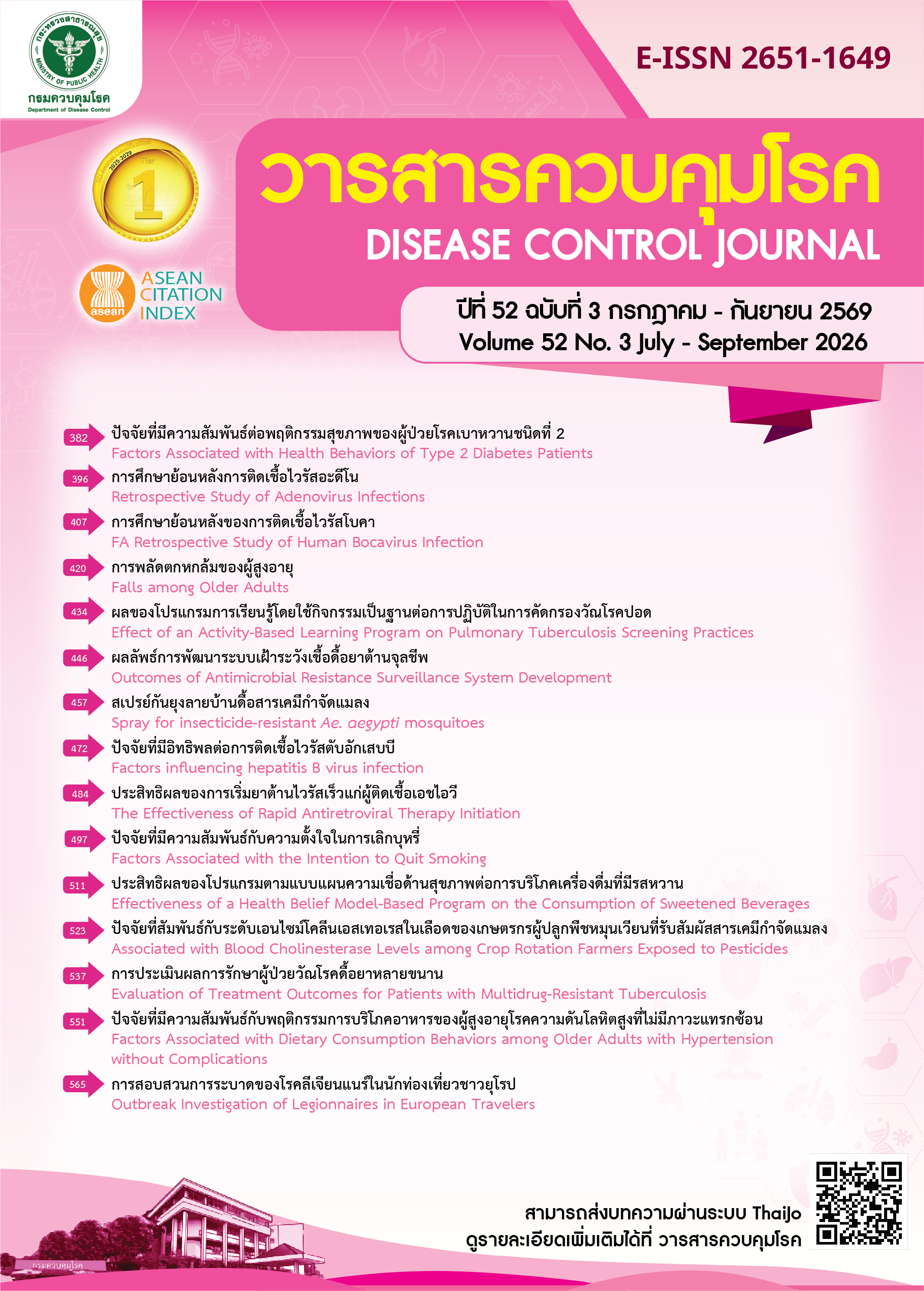
Retrospective Study of Adenovirus Infections at Ramathibodi Hospital (2012-2022): Investigating Risk Factors through Nucleic Acid Amplification Testing (NAAT) in Virology Laboratory Diagnostics
DOI:
https://doi.org/10.14456/dcj.2026.32Keywords:
adenovirus, retrospective study, Ramathibodi hospitalAbstract
Human adenovirus (HAdV) has been identified as a significant causative agent of infection, affecting patients of all age demographics. The present retrospective study was conducted with the objective of investigating the association of risk factors with adenovirus infection. An analysis was conducted on data from the Virology Laboratory, Department of Pathology, Faculty of Medicine, Ramathibodi Hospital, from 2012 to 2022. The study included a total of 46,128 individuals. The study identified 2,348 infections (5.09%), with the highest number of infections (436, 9.86%) recorded in 2013. In particular, the infection rate was found to be higher in children under 12 years. The former group included toddlers (8.46%), preschoolers (9.17%), and school-aged children (6.11%), with the infection rate greather than for the newborn and infant being 3.92%. Correlation analysis was performed Multivariable logistic regression analysis revealed that toddlers (Adjusted OR=2.12, 95% CI=1.74-2.57), preschoolers (Adjusted OR=2.41, 95% CI=1.95-2.97), and school-aged children (Adjusted OR=1.63, 95% CI=1.26-2.12) had a significantly higher risk of adenovirus infection than newborns and young children, respectively. There was no significant difference in infection risk between males and females. The sample with the highest incidence of adenovirus infection was nasal rinse fluid (Adjusted OR=1.82, 95% CI=1.28-2.59), followed by throat swabs (Adjusted OR=1.70, 95% CI=1.25-2.32). The findings reported herein pertain to adenovirus infection in the period preceding the advent of the pandemic caused by the severe acute respiratory syndrome (SARS)-coronavirus (CoV-2). The levels were found to be significantly higher than during the post-pandemic period, with an observed increase of 1.93 times (Adjusted OR=1.93, 95% CI=1.52-2.44). These findings have the potential to inform the enhancement of medical and public health preparedness in anticipation of future adenovirus outbreaks, thereby facilitating more effective responses.
Downloads
References
Usman N, Suarez M. Adenoviruses. StatPearls. Treasure Island (FL): StatPearls Publishing 2024.
Shieh WJ. Human adenovirus infections in pediatric population - An update on clinico -pathologic correlation. Biomed J. 2022;45(1):38-49. doi: 10.1016/j.bj.2021.08.009.
Xu D, Chen L, Wu X, Ji L. Molecular typing and epidemiology profiles of human adenovirus infection among hospitalized patients with severe acute respiratory infection in Huzhou, China. PLoS One. 2022;17(4):e0265987. doi: 10.1371/journal.pone.0265987.
Wu Z, Zhang R, Liu D, Liu X, Zhang J, Zhang Z, et al. Acute Respiratory Distress Syndrome Caused by Human Adenovirus in Adults: A Prospective Observational Study in Guangdong, China. Front Med (Lausanne). 2021;8:791163. doi: 10.3389/fmed.2021.791163.
Kajon AE, Ison MG. Severe Infections with Human Adenovirus 7d in 2 Adults in Family, Illinois, USA, 2014. Emerg Infect Dis. 2016;22(4):730-3. doi: 10.3201/eid2204.151403
Dotan M, Zion E, Bilavsky E, Nahum E, Ben-Zvi H, Zalcman J, et al. Adenovirus can be a serious, life-threatening disease, even in previously healthy children. Acta Paediatr. 2022;111(3):614-9. doi: org/10.1111/apa.16207.
Wang H, Pan T, Li X, Zhu X. Fatal adenovirus pneumonia in a 15-day-old infant despite extracorporeal life support treatment: A case report. Med Int (Lond). 2022;2(3):15. doi: 10.3892/mi.2022.40.
Wang YF, Shen FC, Wang SL, Kuo PH, Tsai HP, Liu CC, et al. Molecular Epidemiology and Clinical Manifestations of Adenovirus Respiratory Infections in Taiwanese Children. Medicine (Baltimore). 2016;95(18):e3577. doi: 10.1097/MD.0000000000003577.
Fratty IS, Reznik-Balter S, Nemet I, Atari N, Kliker L, Sherbany H, et al. Outbreak of Influenza and Other Respiratory Viruses in Hospitalized Patients Alongside the SARS-CoV-2 Pandemic. Front Microbiol. 2022;13:902476. doi: 10.3389/fmicb.2022.902476.
Motta JC, Gómez CC. Adenovirus and novel coronavirus (SARS-Cov2) coinfection: A case report. IDCases. 2020;22:e00936. doi: 10.1016 /j.idcr.2020.e00936.
Mao NY, Zhu Z, Zhang Y, Xu WB. Current status of human adenovirus infection in China. World J Pediatr. 2022;18(8):533-7. doi: 10.1007/s12519-022-00568-8.
Altoum R, Bdour S, Ayyash H. Adenovirus Infections in Jordanian Hospitalized Pediatric Patients: Prevalence and Clinical Features. Jordan Medical Journal [Internet]. 2009; [cited 2026 Apr 29]. Available from URL: https://www.researchgate.net/publication/272174621_Adenovirus_Infections_in_Jordanian_Hospitalized_Pediatric_Patients_Prevalence_and_Clinical_Features
Xu XH, Fan HF, Shi TT, Yang DY, Huang L, Zhang DW, Lu G. Analysis of mortality risk factors in children with severe adenovirus pneumonia: A single-center retrospective study. Pediatr Neonatol. 2023;64(3):280-7. doi: 10.1016/j.pedneo.2022.06.016.
Yu J, Xie Z, Zhang T, Lu Y, Fan H, Yang D, et al. Comparison of the prevalence of respiratory viruses in patients with acute respiratory infections at different hospital settings in North China, 2012-2015. BMC Infect Dis. 2018;18(1):72. doi: 10.1186/s12879-018-2982-3.
Hou N, Wang K, Zhang H, Bai M, Chen H, Song W, et al. Comparison of detection rate of 16 sampling methods for respiratory viruses: a Bayesian network meta-analysis of clinical data and systematic review. BMJ Glob Health. 2020;5(11):e003053. doi: 10.1136/bmjgh-2020-003053.
Xie L, Zhang B, Xiao N, Zhang F, Zhao X, Liu Q, et al. Epidemiology of human adenovirus infection in children hospitalized with lower respiratory tract infections in Hunan, China. J Med Virol. 2019;91(3):392-400. doi: 10.1002/jmv.25333.
Ukuli QA, Erima B, Mubiru A, Atim G, Tugume T, Kibuuka H, et al. Molecular characterisation of human adenoviruses associated with respiratory infections in Uganda. BMC Infect Dis. 2023;23(1):435. doi: 10.1186/s12879-023-08403-9.
Downloads
Published
How to Cite
Issue
Section
License
Copyright (c) 2026 Disease Control Journal

This work is licensed under a Creative Commons Attribution-NonCommercial-NoDerivatives 4.0 International License.
Articles published in the Disease Control Journal are considered as academic work, research or analysis of the personal opinion of the authors, not the opinion of the Thailand Department of Disease Control or editorial team. The authors must be responsible for their articles.